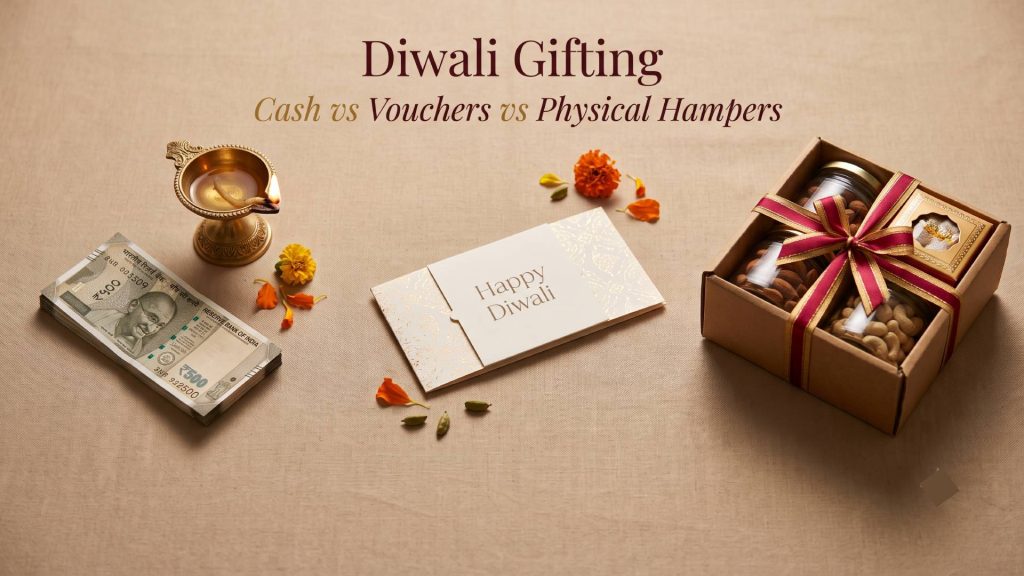
Diwali Gifting: Cash vs Vouchers vs Physical Hampers
Key Takeaways
- Cash is the most flexible, but it is taxed as salary, has low emotional impact and is inappropriate for clients and vendors.
- Gift vouchers offer choice and are easy to send to remote teams. Together with other employer gifts, they are generally tax-free for employees up to Rs. 15,000 a year from tax year 2026-27.
- Physical hampers deliver the strongest festive experience and brand visibility, and are the safest choice for clients and vendors.
- A Rs. 3,000 cash gift can leave an employee in the 30 percent tax slab with about Rs. 2,064, while a Rs. 3,000 voucher or hamper is received at full value.
- A hybrid approach, such as a hamper plus a voucher, often gives the best balance of choice and memorability.
- A statutory bonus, where applicable, is a legal obligation and is separate from your Diwali gift.
First, Separate the Diwali Bonus From the Diwali Gift
Many companies mix these up, which leads to confused decisions.- Statutory bonus: For eligible employees, a bonus may be a legal obligation, not a gift. It is now governed by the Code on Wages, 2019, which replaced the Payment of Bonus Act, 1965, and generally ranges from 8.33 percent to 20 percent of eligible wages. Many companies pay it around Diwali, but it is part of compensation. Check eligibility with your payroll or legal team.
- Discretionary Diwali bonus: An extra cash payment you choose to make. It is taxed as salary.
- Diwali gift: A hamper, voucher or product given to celebrate the festival and say thank you.
Option 1: Cash Gifts on Diwali
Cash includes a bank transfer, a “Diwali gift” line in payroll, or an envelope of currency notes.Pros of cash
- Maximum flexibility. Employees can use it for festival shopping, EMIs, travel home or savings.
- Zero logistics. No packaging, couriers or address collection.
- Highly valued by frontline, factory and lower-income employees, for whom the festive season brings real expenses.
- Fast. It can be processed in the next payroll run.
Cons of cash
- Taxed as salary. Cash does not qualify for the gift exemption. An employee in the 30 percent slab loses close to a third of it to tax.
- Low recall. Cash merges with salary and is often forgotten within weeks.
- No brand or festive feel. There is nothing to unbox, share or display at home.
- Can feel transactional, especially for small amounts like Rs. 1,000 to Rs. 2,000.
- Not appropriate for clients or vendors. Cash to an external party can breach anti-bribery laws and client gift policies, and creates audit risk.
When cash makes sense
- Frontline, factory, warehouse, delivery and support teams where immediate financial value matters most.
- As a separate bonus alongside a smaller physical gift.
- When the amount is large enough to feel meaningful.
Option 2: Gift Vouchers and Gift Cards
These include e-gift cards from Amazon, Flipkart, Myntra, Tanishq and Croma, multi-brand vouchers, and “pick your gift” catalogue platforms.Pros of gift vouchers
- Choice. Employees pick what they actually want, which suits diverse and multi-generational teams.
- Tax efficient. From tax year 2026-27, gifts, vouchers and tokens given by an employer are generally tax-free for the employee if the annual total does not exceed Rs. 15,000. The earlier limit was Rs. 5,000.
- Easy for remote and distributed teams. Delivered by email or SMS to employees anywhere in India.
- Fast to deploy. Even a last-minute order can be sent within a day or two.
- Easy to tier. Different values for different groups can be sent without anyone seeing a visible difference.
Cons of gift vouchers
- Low emotional impact. A code in an inbox rarely feels like a festive celebration.
- No brand visibility. Nothing carries your logo into the employee’s home.
- Expiry and unused balances. Some vouchers expire within 6 to 12 months, and a share always goes unredeemed. Ask your provider about validity and redemption rates.
- Single-brand vouchers can disappoint. A fashion voucher means little to someone who wants electronics.
- Often not suitable for clients. Many corporate and MNC gift policies treat vouchers as cash equivalents and do not allow employees to accept them.
- The Rs. 15,000 limit is annual and acts as a cliff. If the total value of employer gifts in the year crosses Rs. 15,000, the full value can become taxable, not just the excess. Track birthday, anniversary and festival gifts together.
When vouchers make sense
- Large, distributed or fully remote workforces.
- Teams with very diverse preferences.
- Late decisions where there is no time for physical gifts.
- As an add-on to a smaller hamper. See our guide to corporate Diwali gift card ideas.
Option 3: Physical Diwali Hampers
These include curated boxes of dry fruits, mithai, diyas, candles, gourmet treats, festive decor, and branded keepsakes such as bottles, mugs or brass items.Pros of hampers
- Strongest festive feel. Unboxing a beautiful hamper at home, with family, is what Diwali gifting is about.
- High recall and brand visibility. A branded bottle, diary or brass diya stays in the home for months or years.
- Shareable. Hampers are often opened with family, which extends the goodwill beyond the employee.
- Tax efficient for employees. Hampers count towards the same annual Rs. 15,000 gift limit as vouchers.
- Best for clients and vendors. A tasteful hamper is the accepted business gift for Diwali in India, and perishables like sweets and dry fruits often fit even strict gift policies.
- Fully customisable with your logo, colours and a personal message.
Cons of hampers
- Logistics. Address collection, packing, courier and delivery tracking take planning, especially across many cities.
- Lead time. Customised hampers need 1 to 4 weeks, depending on branding. Read our guide on the branded corporate gift set for Diwali for ideas.
- Less personal choice. A hamper may include items some recipients do not use. Good curation and dietary options reduce this.
- Delivery costs of roughly Rs. 100 to Rs. 300 per box for doorstep delivery across India.
When hampers make sense
- Clients, channel partners and vendors (almost always).
- Office-based or hybrid teams where gifts can be handed out together.
- Companies that want brand visibility and a shared festive moment.
Cash vs Gift Vouchers vs Hampers: Side-by-Side Comparison
| Factor | Cash | Gift Vouchers | Physical Hampers |
| Flexibility for recipient | Highest | High | Medium |
| Emotional and festive impact | Low | Low to medium | High |
| Brand visibility | None | None | High |
| Tax for employees (2026-27) | Taxed as salary | Generally tax-free up to Rs. 15,000 a year in total | Generally tax-free up to Rs. 15,000 a year in total |
| Suitable for clients | No | Often restricted | Yes |
| Suitable for vendors | No | Sometimes | Yes |
| Logistics effort | None | Low | Medium to high |
| Lead time | 1 to 3 days | 1 to 3 days | 1 to 4 weeks |
| Works for remote teams | Yes | Yes | Yes, with doorstep delivery |
| Recall after 3 months | Low | Low | High |
The Real Value per Rupee: A Tax Comparison
Here is what an employee in the 30 percent tax slab actually receives from a Rs. 3,000 Diwali gift, assuming their total employer gifts for the year stay within Rs. 15,000:| Format | Company Spend | Tax for Employee | Value Received |
| Cash | Rs. 3,000 | About Rs. 936 (30% plus 4% cess) | About Rs. 2,064 |
| Gift voucher | Rs. 3,000 | Nil | Rs. 3,000 |
| Physical hamper | Rs. 3,000 | Nil | Rs. 3,000 worth of products, plus the festive experience |
What Should You Give Each Audience?
Employees
There is no single right answer. Choose by workforce type:| Workforce Type | Best Format | Why |
| Office-based or hybrid teams in metros | Branded hamper, or hamper plus voucher | Shared festive moment, brand recall |
| Fully remote or spread across many cities | Gift voucher, or hamper with doorstep delivery | Easy delivery, choice |
| Frontline, factory, warehouse and field staff | Cash bonus plus a sweet or dry fruit box | Financial value matters, gift adds festive feel |
| Leadership and senior managers | Premium hamper or curated luxury gift | Personal, high-quality, memorable |
| Interns, contract and support staff | Sweet box or small hamper | Inclusive and appreciated |
Clients
- Give a physical hamper. It is the accepted standard for Diwali business gifting in India.
- Avoid cash completely. It can be treated as a bribe and may breach the Prevention of Corruption Act and client codes of conduct.
- Be careful with vouchers. Many MNCs, banks and PSUs ban employees from accepting vouchers or anything cash-like.
- Prefer perishables for strict policies. Sweets, dry fruits and gourmet items are acceptable to most clients.
- Tier your clients. Key accounts deserve a premium, personalised hamper. Explore our Luxury and CXO gifting range.
Vendors and partners
- Give a hamper or a large sweet and dry fruit box for the team. Typical spend is Rs. 750 to Rs. 3,000.
- Never give cash. It raises questions about procurement fairness.
- Treat dealers and distributors like clients. Premium hampers work well and strengthen festive-season sales.
The Hybrid Approach: Why Many Companies Now Combine Formats
More Indian companies are combining formats instead of choosing one:- Hamper plus voucher: A Rs. 1,500 branded hamper for the festive moment, plus a Rs. 1,500 voucher for choice.
- Cash bonus plus sweet box: Popular in manufacturing and frontline businesses. The bonus gives financial value and the box gives the festive touch.
- Pick-your-hamper catalogue: Employees choose from three or four curated hampers within the same budget. This gives choice and keeps the physical, branded experience.
- Hamper for office teams, voucher for remote teams: Same rupee value, delivered in the format that fits each group.
Hidden Costs and Risks of Each Option
| Option | Hidden Costs or Risks |
| Cash | Employee tax deduction, payroll processing, low perceived value, compliance risk if given to outsiders |
| Gift vouchers | Expiry, unused balances, platform or service fees, limited brand choice, client policy restrictions |
| Physical hampers | Packaging and branding costs, delivery charges, address collection, damage in transit, lead time |
A Simple Decision Framework
Ask these five questions:- Who is the recipient? Clients and vendors: hamper. Employees: go to question 2.
- Where do they work? Mostly office or hybrid: hamper. Highly distributed: voucher or doorstep hamper.
- What matters most to them? Financial need: cash bonus plus small gift. Recognition and festive feel: hamper. Choice: voucher or catalogue.
- How much time do you have? Under one week: voucher or ready hamper. Three weeks or more: customised branded hamper.
- Do you want brand recall? Yes: branded hamper. No: voucher or cash.
Timeline for Diwali 2026
With Diwali on 8 November 2026:- Customised branded hampers: Approve designs by mid to late October.
- Ready-made hampers with branded cards: Order by the last week of October.
- Doorstep delivery across cities: Dispatch by 1 November. See our guide to multi-location corporate gifts.
- Vouchers: Can be sent up to a day or two before Diwali, though earlier is better.
- Cash: Plan for the October or early November payroll run.
How RidgeGap Can Help
RidgeGap Solutions is a Bengaluru-based corporate gifting company with 10 years of experience, 300+ corporate clients and 20,000+ packages delivered across India. Whether you choose hampers or a hybrid model, we handle the full process:- Curated Corporate Diwali Gifts in price bands from Rs. 500 to Rs. 7,000.
- Curated gift boxes with your logo, custom sleeves and personalised notes.
- Sustainable and eco-friendly gifting options.
- Separate tiers for employees, clients and vendors from a single order.
- Samples before bulk orders, pan-India doorstep delivery and tracking.
- One GST invoice and a clear cost breakdown for finance.
Frequently Asked Questions (FAQs)
1. Is it better to give cash or a gift to employees on Diwali?
It depends on your workforce. Cash is valued for financial flexibility, especially by frontline and lower-income employees, but it is taxed as salary and quickly forgotten. Hampers and vouchers are generally tax-free up to Rs. 15,000 a year in total and feel more like a gift. Many companies give a cash bonus plus a small hamper.2. Are Diwali gift vouchers taxable for employees in 2026?
From tax year 2026-27, gifts, vouchers and tokens from an employer are generally tax-free for the employee if the total value in the tax year does not exceed Rs. 15,000. If the total crosses this limit, the full amount may become taxable. Cash is always taxed as salary. Confirm with your CA.3. Is a Diwali hamper taxable for employees?
A hamper is treated like other employer gifts. It is generally tax-free if the total value of all gifts and vouchers from the employer in the tax year stays within Rs. 15,000.4. Can we give cash or gift vouchers to clients on Diwali?
Cash should never be given to clients, as it can be treated as a bribe and breach anti-corruption laws and client policies. Many companies also do not allow their employees to accept vouchers. A physical hamper, especially with sweets or dry fruits, is the safest and most accepted option.5. Is the Diwali bonus mandatory in India?
A statutory bonus may be mandatory for eligible employees, generally between 8.33 percent and 20 percent of eligible wages, under the Code on Wages, 2019. A discretionary Diwali bonus or gift is not mandatory. Check eligibility with your payroll or legal advisor.6. What is the right value for a Diwali gift voucher for employees?
Most Indian companies give vouchers between Rs. 1,000 and Rs. 3,000 per employee, with higher values for leadership. Keep the annual total of all employer gifts within Rs. 15,000 to retain the tax benefit.7. What do employees prefer: gift vouchers or hampers?
Preferences vary. Employees who value choice tend to prefer vouchers, while those who value the festive experience and family sharing prefer hampers. A pick-your-hamper catalogue or a hamper plus voucher combination satisfies both groups.8. What are the disadvantages of gift vouchers?
Vouchers can expire, may go unused, carry no brand visibility and often feel impersonal. Single-brand vouchers may not suit everyone. Choose multi-brand vouchers with long validity.9. How early should we order Diwali hampers for 2026?
For customised branded hampers, order 3 to 4 weeks before Diwali on 8 November 2026. Ready-made hampers with a branded card can be arranged within about a week, subject to stock.Final Word
There is no single winner between cash, gift vouchers and physical hampers. Cash is flexible but taxed and forgettable. Vouchers offer choice and tax efficiency but little festive feel. Hampers create the strongest connection and brand recall, and remain the right choice for clients and vendors. For most Indian companies, the best answer for Diwali 2026 is a thoughtfully curated hamper, combined with a voucher or bonus where your team needs flexibility. Talk to the RidgeGap team for a free quote and Diwali hamper options matched to your budget and timeline. Contact RidgeGap: Call (+91) 82968 13621 or (+91) 97391 40044, or visit ridgegap.com/contact-usResources and Further Reading
- Corporate Diwali Gifts by RidgeGap
- Curated Gift Boxes
- Luxury and CXO Gifting
- Sustainable and Eco-Friendly Gifting
- Corporate Diwali Gift Card Ideas: Employee Gift Guide 2026
- Branded Corporate Gift Set for Diwali: Best 2026 Ideas
- Diwali Gifting Etiquette for MNCs Operating in India
- Diwali Gifts for Startups: Best Ideas for 20-50 Employees
- Multi-Location Corporate Gifts: The Complete Indian Guide
- What Happens When Diwali Gifting Goes Wrong

Pingback:Employee Annual Day Awards: 30+ Categories & Trophy Ideas