Diwali Gifting Etiquette for MNCs Operating in India: 2026 Guide
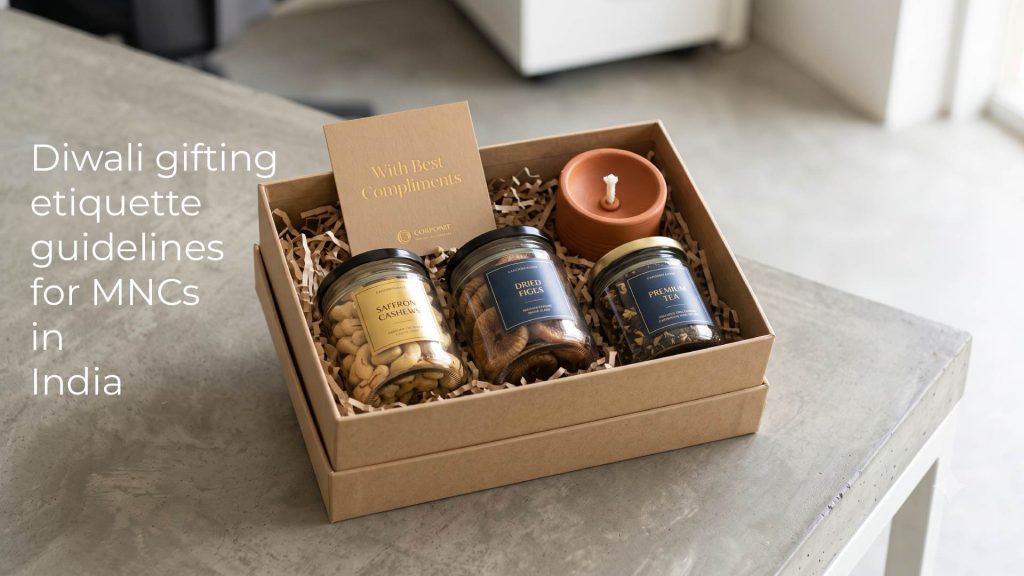
Why Diwali Gifting Is Different for MNCs in India
Local Indian businesses gift on instinct. MNCs cannot. A global company carries obligations that a homegrown firm often does not, and those obligations collide with festive expectations every October and November. The tension usually comes from three places:- Global policy vs. local expectation. Your global HQ may cap gift values or discourage gifting entirely, while your Indian teams and clients genuinely expect a Diwali gesture. Silence can read as coldness.
- Compliance exposure. MNCs listed in the US, UK, or EU are bound by anti-bribery laws that follow the company wherever it operates, including India.
- Scale and distribution. A single Diwali campaign for an MNC may mean shipping thousands of gifts to hybrid employees across dozens of cities, plus curated boxes for high-value clients, all before the festival date.
The Dos: Diwali Gifting Etiquette for MNCs
These are the practices that make your gifting feel warm, professional, and appropriate for a global brand in India.- Do plan 6 to 8 weeks ahead. Customisation, sourcing, branding, and pan-India delivery all take time. Most reputable gifting partners recommend locking your order at least 30 to 45 days before Diwali to avoid last-minute stockouts and courier delays.
- Do keep branding subtle. A discreet logo on the packaging or a printed festive card is fine. A giant company logo stamped across the product itself makes the gift feel like marketing collateral, not a genuine gesture.
- Do personalise where you can. A handwritten note or a short, specific message of appreciation lifts even a modest hamper. In an age of automated emails, a physical note stands out.
- Do choose useful, festive items. Think wellness kits, premium drinkware, desk plants, gourmet curated gift boxes, or quality dry fruits. Utility is what stops a gift from being regifted.
- Do respect dietary and cultural preferences. Offer vegetarian, vegan, and sugar-free options. Many Indian recipients avoid alcohol and non-vegetarian items, especially during Diwali.
- Do set clear budget tiers. Separate what you spend on employees, mid-level associates, and premium clients. One-size-fits-all gifting almost always misfires.
- Do document everything. For an MNC, a clean record of who received what, at what value, and why is not bureaucracy. It is your protection if compliance or tax ever asks.
The Don’ts: What MNCs Should Avoid at Diwali
- Don’t over-brand. As above, self-promotion disguised as a gift is the fastest way to make a recipient feel like a target rather than a valued relationship.
- Don’t gift items considered inauspicious. In Indian tradition, sharp objects (knives, scissors), black-coloured items, empty wallets, clocks, and leather goods can carry negative or inauspicious associations. When in doubt, avoid them.
- Don’t ignore religious diversity. Leather products can offend certain communities, alcohol is unwelcome for many, and non-vegetarian gourmet items exclude a large share of recipients.
- Don’t gift during sensitive windows. Avoid sending gifts to a client in the middle of an active contract negotiation, a live tender or RFP process, or a procurement blackout. Timing can make an innocent gift look like an inducement.
- Don’t gift government officials casually. Gifting public officials is the single highest-risk category for an MNC. Most global codes of conduct restrict or ban it entirely. Treat this as off-limits unless legal has explicitly cleared it.
- Don’t skimp on presentation. A premium product in torn packaging undoes the whole gesture. Festive, clean, and cohesive presentation matters as much as the contents.
- Don’t leave your remote and hybrid staff out. Forgetting your work-from-home employees while gifting only the in-office team creates visible inequity.
Navigating Compliance: Anti-Bribery and Gift Policy for MNCs
This is the section most Diwali gifting articles ignore, and it is exactly where MNCs get exposed. If your parent company is incorporated or listed abroad, these frameworks travel with you into India.- US FCPA (Foreign Corrupt Practices Act). Applies to US-listed and US-connected companies globally. It targets anything of value given to a foreign official to obtain or retain business. Diwali gifts to private-sector clients are generally lower risk; gifts touching government officials or public-sector undertakings are high risk.
- UK Bribery Act 2010. Broader than the FCPA. It covers private-to-private bribery too and has a “failure to prevent bribery” clause, which means the company itself can be liable if it lacks adequate procedures.
- India’s Prevention of Corruption Act, 1988 (amended 2018). Criminalises giving undue advantage to public servants. The 2018 amendment made the bribe-giver explicitly liable, not just the receiver.
- Set a per-recipient value cap and stick to it. Many MNC codes of conduct use a modest threshold above which pre-approval is required.
- Keep gifts modest, festive, and non-cash. Cash and cash equivalents (like open gift cards) attract the most scrutiny. Curated hampers, sweets, and lifestyle items are far safer.
- Route client gifting through a register. Log recipient, value, and business justification.
- Get legal or compliance sign-off for anything unusual, high-value, or aimed at a regulated counterparty.
- Apply the newspaper test. If a gift would look questionable on the front page of a business daily, do not send it.
Tax and GST Implications of Corporate Diwali Gifts in India
Another blind spot. Corporate gifting in India has real tax consequences, and finance teams inside MNCs are increasingly expected to get this right. Treat the notes below as a planning starting point and confirm specifics with your tax advisor, since rules and thresholds do change. For gifts to employees- Gifts to employees are broadly exempt from perquisite tax up to a value of Rs. 5,000 per employee in a financial year. Beyond that limit, the excess is generally treated as a taxable perquisite in the employee’s hands under salary provisions.
- Under GST rules, gifts to an employee exceeding Rs. 50,000 in value in a financial year can be treated as a deemed supply and attract GST.
- Input Tax Credit (ITC) is generally blocked on goods bought and given away as gifts, so factor that cost in.
- Section 194R of the Income Tax Act requires the giver to deduct TDS at 10% on the value of benefits or perquisites provided in the course of business, once the total value to a single recipient crosses Rs. 20,000 in a financial year.
- If the recipient has not furnished a PAN, that TDS rate can rise to 20%.
- This applies to gifts, hampers, sponsored trips, and similar business benefits, so high-value client gifting needs to be tracked carefully.
Gifting a Multicultural and Distributed Workforce
An MNC workforce in India is rarely homogeneous. In a single Bengaluru or Gurugram office you may have Hindu, Muslim, Christian, Jain, Sikh, and non-religious colleagues, alongside expat staff and international team members. Diwali gifting for such a group works best when it is inclusive rather than narrowly religious.- Frame it as a festive gesture, not a religious obligation. Position the gift around light, gratitude, and new beginnings so everyone feels included.
- Default to neutral, universally welcome items. Gourmet hampers, wellness kits, quality drinkware, and premium chocolates travel across every belief system.
- Respect Jain and vegetarian dietary rules. Avoid onion, garlic, and certain root ingredients in gourmet selections meant for Jain colleagues, and always offer pure-veg options.
- Mind regional nuance. North Indian recipients may lean towards traditional sweets and diyas, while South Indian teams may prefer local sweets and lamps. A flexible hamper covers both.
- Include your remote and hybrid staff. Post-2020, most MNC teams are distributed. Address-level dispatch to home locations keeps gifting fair.
Diwali Gift Budgets and Indian Pricing: What to Actually Spend
Budgeting is where global finance teams often ask for hard numbers. Here is a realistic view of Indian pricing for corporate Diwali gifts in 2026, based on current market ranges. Prices are per hamper or per box and typically exclude GST.- Rs. 500 to Rs. 1,000 per box: Entry-level employee gifting for large teams. Think logo-printed chocolate boxes, snack hampers, or a compact festive combo. Ideal when you need to cover the entire workforce cost-effectively.
- Rs. 1,000 to Rs. 2,000 per box: The most popular mainstream band for employee Diwali hampers. Expect a richer mix of dry fruits, gourmet snacks, a small keepsake, and premium packaging.
- Rs. 2,000 to Rs. 3,000 per box: Senior staff, managers, and mid-level associates. Larger assortments, better presentation, and space for a branded lifestyle item.
- Rs. 2,500 to Rs. 6,000+ per box: Premium clients and key partners, where impression matters most. This is where curated luxury hampers and considered personalisation earn their keep.
- Above Rs. 5,000 per box: Reserved for top-tier CXO and marquee client relationships. Our luxury and CXO gifting range is built for exactly this bracket.
A Practical Diwali Gifting Timeline for MNCs
Use this checklist to run a clean, compliant, on-time campaign.- 8 weeks out: Confirm total budget, headcount split (employees vs. clients), and per-recipient value caps aligned with your gift policy.
- 6 to 7 weeks out: Shortlist your gifting partner, review samples, and finalise customisation and packaging. Ask specifically about pan-India pin-code coverage.
- 5 weeks out: Lock the order. Collect employee delivery addresses via a clean CSV for distributed teams.
- 3 to 4 weeks out: Approve final branding proofs, notes, and any compliance sign-offs for client gifts.
- 1 to 2 weeks out: Dispatch begins with tracking. Confirm delivery windows so gifts arrive before, not after, Diwali.
- Post-Diwali: Reconcile records for tax and audit, and capture feedback to improve next year.
Employees vs. Clients: How the Etiquette Differs
It helps to think of these as two separate campaigns with different rules.- Employees: Practical, inclusive, and equitable. Consistent value across similar levels avoids friction. A festive new joiner kit style of curation, extended to the whole team, works beautifully.
- Clients: Polished, personal, and compliance-aware. Higher value is acceptable, but a per-recipient cap, a business justification, and a handwritten note matter more here than sheer spend.
How RidgeGap Helps MNCs Gift Right at Diwali
For over a decade, RidgeGap has handled festive and corporate gifting for global brands operating out of Bengaluru and across India, including many of the marquee names you would recognise. We help MNC HR, admin, and procurement teams by:- Curating inclusive, tasteful hampers across every budget band, from Rs. 500 employee boxes to premium CXO gifting.
- Managing subtle, tasteful branding that respects both your identity and gifting etiquette.
- Handling address-level, pan-India delivery for distributed and hybrid teams.
- Advising on presentation, sustainability, and customisation that fits a global brand.
Frequently Asked Questions (FAQ)
- What is the ideal budget for corporate Diwali gifts in India?
- Are corporate Diwali gifts taxable in India?
- Can an MNC gift government officials at Diwali?
- How far in advance should MNCs plan Diwali gifting?
- What should MNCs avoid gifting at Diwali?
- How do you gift a multicultural or remote MNC workforce?
- Should employees and clients receive the same Diwali gift?
Further Reading and Resources
- RidgeGap Blog: Corporate Gifting Etiquette Do’s and Don’ts
- RidgeGap: Corporate Diwali Gifts Collection
- RidgeGap: Luxury and CXO Gifting
- RidgeGap: Sustainable and Eco-Friendly Gifting
- RidgeGap: Explore all corporate gifting insights on our Blog

Pingback:Diwali Gifts for Startups: Best Ideas for 20–50 Employees