Monthly Archives: September 2026
Multi-Location Corporate Gifts: The Complete Indian Guide

What Is Multi-Location Corporate Gifting?
Multi-location corporate gifting is the process of sourcing, customising and delivering the same (or an equivalent) corporate gift to recipients spread across more than one city, office, or address, while keeping the branding, quality and delivery timeline consistent everywhere. It covers three common scenarios that Indian companies deal with:- Multi-office gifting – a company with branch offices in cities such as Bengaluru, Mumbai, Delhi NCR, Hyderabad, Chennai or Pune, where each office needs a bulk drop.
- Distributed or remote team gifting – individual employees working from home across tier-1, tier-2 and tier-3 cities, each needing an individual, trackable delivery.
- Multi-city client or channel partner gifting – clients, vendors or channel partners located in different regions who all need to receive gifts around the same occasion, such as Diwali or a financial year-end.
Why Multi-Location Corporate Gifting Is Becoming the Norm in India
A decade ago, most corporate gifting in India meant one warehouse, one HR office and a single delivery address. That has changed fast, and a few shifts explain why:- Hybrid and remote work is now standard. A large share of Indian companies, especially in IT, SaaS, fintech and BPO, run hybrid or fully remote teams, which means employee addresses are spread across dozens of pin codes instead of one campus.
- Companies are expanding beyond metro headquarters. Many organisations now have satellite offices or hiring hubs in tier-2 cities like Coimbatore, Jaipur, Indore, Mysuru and Kochi, in addition to their metro base.
- Client and channel networks are geographically wide. Pharma, BFSI, FMCG and manufacturing companies routinely need to gift doctors, dealers or distributors across an entire state or the whole country.
- Festive gifting volumes have grown. Diwali alone accounts for a large share of annual corporate gifting spend in India, and most of that volume now needs to reach recipients in more than one city at the same time.
Key Challenges Companies Face With Multi-Location Corporate Gifting
Before you plan anything, it helps to know exactly where multi-location programmes tend to break down.1. Collecting and Verifying Delivery Addresses
The single biggest source of failed deliveries is not logistics, it is bad data. Incomplete addresses, outdated pin codes, or employees who have relocated but never updated HR records all cause returned shipments.2. Maintaining Quality and Brand Consistency Across Cities
When gifts are packed or sourced from different regional vendors to save on delivery cost, quality starts to vary. A premium hamper that looks flawless in Bengaluru but arrives with a crushed box in a tier-3 city undermines the whole gesture.3. Pincode and Courier Coverage Gaps
Most courier networks cover metro and tier-1 cities well. Coverage thins out for tier-3 towns and rural pin codes, which means delivery timelines and reliability can differ sharply between a Mumbai office and a smaller branch location.4. Coordinating Timelines Across Regions
If gifts need to land on the same day, for example a festival or an all-hands announcement, dispatch has to be staggered by region based on transit time, not sent out on a single date for the whole country.5. Budget Control and Per-Location Cost Variance
Delivery cost per gift is not flat. Metro-to-metro shipping is cheaper than shipping to remote pin codes, and unplanned budgets often get eaten up by last-mile delivery charges that were not accounted for upfront.6. GST, Invoicing and Tax Compliance
Bulk gifting invoices, input tax credit rules, and employee-level gift taxability are frequently overlooked until finance asks for documentation after the fact. Multi-location orders often need consolidated GST invoicing even when the shipment itself is split.A 7-Step Framework to Plan Multi-Location Corporate Gifting
This is the part most guides skip. Here is a practical, repeatable process you can use for any multi-location gifting programme.- Build one centralised recipient sheet. List every recipient with name, department or office, complete address, pin code and a verified phone number. This single sheet becomes the source of truth for the entire programme.
- Segment recipients by delivery type. Split the list into “bulk to office” (one shipment, one reception point) and “individual home delivery” (each recipient gets their own tracked parcel). The two need different packing and dispatch plans.
- Lock the gift and set a per-person budget. Choose one hero product or a small set of interchangeable options so branding and quality stay identical no matter where the recipient sits.
- Confirm pincode-level courier coverage before finalising the date. Ask your vendor to check delivery timelines for every city and flag remote pin codes early, not after dispatch.
- Stagger dispatch by transit time, not by a single calendar date. Work backward from the delivery date and dispatch tier-2 and tier-3 locations a few days ahead of metro locations.
- Set up tracking and a single point of escalation. Every recipient should get a tracking link, and your team should have one dashboard or report to monitor delivery status across all cities, not city-wise spreadsheets.
- Plan for failed deliveries and replacements. Even with 99%+ delivery reliability, some parcels will bounce back. Keep 5 to 10% buffer stock so replacements do not delay the whole programme.
Multi-Location Corporate Gift Pricing in India (2026)
Pricing for multi-location gifting has two parts: the cost of the gift itself, and the added logistics cost of shipping to multiple addresses instead of one office. Here is a realistic breakdown for the Indian market.| Budget Tier | Price Per Recipient | Best Suited For |
| Economy | Rs 300 – Rs 800 | Large-scale event giveaways, promotional gifting, entry-level festive tokens |
| Mid-range | Rs 800 – Rs 2,500 | Standard employee gifting, client appreciation, festive hampers |
| Premium | Rs 2,500 – Rs 6,000 | Onboarding kits, milestone awards, mid-senior client gifting |
| Luxury / CXO | Rs 6,000 – Rs 20,000+ | Leadership gifting, top-tier client relationships, board-level occasions |
- Individual home delivery: roughly Rs 70 – Rs 150 per parcel depending on weight and pin code, compared to a flat bulk-freight cost when shipping to a single office.
- Custom branding and packaging: typically adds Rs 50 – Rs 250 per unit depending on complexity.
- Buffer stock for failed or returned deliveries: plan for 5 to 10% extra units.
How to Choose a Corporate Gifting Partner for Multi-Location Delivery
Not every vendor that says “PAN India delivery” can actually execute a multi-city programme well. Use this checklist before you sign off on a partner:- Verified pincode coverage, including tier-2 and tier-3 cities, not just the eight or nine metro hubs.
- A single point of contact who owns the entire order across all locations, instead of one contact per region.
- Address-collection and validation support, ideally through a shared sheet or a simple online form rather than email threads.
- Consolidated GST invoicing even when the shipment itself is split across multiple destinations.
- Real-time tracking for every parcel, with a status report you can share internally.
- A buffer and replacement policy for returned or damaged shipments, agreed upfront.
- Proven bulk-order experience, ideally with client references from companies of a similar size and spread.
Best Corporate Gift Categories for Multi-Location Distribution
Some gift categories travel and store better than others, which matters a great deal when the same box has to survive a courier run to both a Bengaluru office and a smaller tier-3 town.- Curated gift boxes – rigid packaging holds up well across long-distance shipping and looks consistent regardless of the delivery city.
- New joiner kits – ideal for distributed hiring, since new hires across cities can receive an identical onboarding experience on day one.
- Swag packs – lightweight, budget-friendly, and easy to ship in bulk to large distributed teams.
- Customised T-shirts and apparel – compact, low shipping cost per unit, and a reliable choice for large-scale team gifting.
- Corporate laptop bags and custom backpacks – practical for hybrid and remote employees who work from more than one location themselves.
- Luxury and CXO gifting – best reserved for a shorter, high-value recipient list such as regional leadership or key clients, where white-glove delivery matters more than shipping cost.
- Sustainable and eco-friendly gifts – a growing preference for companies that want their multi-city footprint to reflect responsible packaging choices too.
Single-Location vs Multi-Location Corporate Gifting: Quick Comparison
| Factor | Single-Location Gifting | Multi-Location Gifting |
| Address management | One reception point | Dozens to hundreds of individual addresses |
| Delivery cost | Flat bulk-freight rate | Variable, per pin code and weight |
| Timeline planning | One dispatch date | Staggered dispatch by region |
| Quality control | Easy to inspect on-site | Needs standardised packing across hubs |
| Vendor coordination | Single contact, single order | Needs a dedicated account manager |
| Tax and invoicing | One GST invoice | Consolidated invoicing across shipments |
| Risk of failed delivery | Low | Higher, needs buffer stock |
Common Mistakes to Avoid in Multi-Location Corporate Gifting
- Finalising the gift before confirming pincode coverage. Choosing a bulky or fragile product without checking delivery feasibility to every city first.
- Using outdated address data. Employee or office addresses that have not been refreshed in months lead to avoidable returns.
- Sending a single dispatch date for the whole country. Ignoring transit-time differences between metro and non-metro locations causes uneven arrival dates.
- No buffer stock. Under-ordering exactly to the headcount, with no cushion for damaged or returned parcels.
- Splitting the order across multiple small vendors. This looks cost-effective on paper but usually creates inconsistent quality and multiple invoices to reconcile.
- Ignoring GST documentation. Treating a multi-city order as informal or undocumented, which creates problems during a tax audit.
Why Companies Choose Ridgegap for Multi-Location Corporate Gifting
Ridgegap has spent 10 years managing corporate gifting for companies across India, with over 20,000 packages delivered and 300+ corporate clients on record. For multi-location programmes specifically, our team handles:- Pan-India delivery, including door delivery to individual employee addresses in tier-1, tier-2 and tier-3 cities
- A single dedicated account manager who owns your order end to end, regardless of how many cities are involved
- In-house customisation and consistent packaging quality across every shipment
- Consolidated GST-compliant invoicing for multi-city orders
- Real-time tracking and delivery reporting
Frequently Asked Questions
- What is multi-location corporate gifting?
- How much does multi-location corporate gifting cost in India?
- Can gifts be delivered directly to employee homes across different cities?
- How far in advance should a multi-location gifting programme be planned?
- Do multi-location corporate gifts attract GST or income tax?
- What happens if a delivery fails in a remote city?
- Is it cheaper to use one vendor for all locations or split the order regionally?
- What is the minimum order size for multi-location corporate gifting?
- Which gift categories work best for distributed teams?
Final Thoughts
Multi-location corporate gifting rewards planning more than it rewards last-minute effort. The companies that get it right start with clean recipient data, lock a consistent gift and budget early, and pick a vendor that can genuinely handle pincode-level delivery rather than just promising it. Get those three things right, and gifting across 5 cities feels no more stressful than gifting from a single office. If you are planning a gifting programme that spans multiple offices or a distributed workforce, talk to the Ridgegap team for a pricing quote based on your actual recipient list and locations. Further reading and sources:- Income Tax Department of India – Perquisites Guidance (Rule 3(7)(iv)) – official reference for gift taxability rules cited in this article.
- Related on the Ridgegap blog: Bulk Corporate Gifting for Employees: Challenges & Solutions
Branded Corporate Gift Set for Diwali: Best 2026 Ideas

What Is a Branded Corporate Gift Set for Diwali?
A branded corporate gift set is a curated combination of two or more products, presented in coordinated packaging, personalised with your company identity. The “branding” can be as loud as a printed logo or as subtle as a colour-matched ribbon and an embossed note card. The best sets share four traits:- Curated, not random. Every item earns its place. No filler.
- Useful. Recipients keep and use it, which extends brand visibility for months.
- Tastefully branded. The brand is present, not shouting.
- Well-packaged. The unboxing moment is where the gift wins or loses.
Why Branded Gift Sets Work Better Than Standalone Gifts
- Higher perceived value. Three coordinated items feel like more than one expensive item at the same total cost.
- Longer brand recall. A set usually contains at least one daily-use item (a bottle, a mug, a diary), keeping your brand in sight all year.
- Stronger relationships. Diwali gifting boosts employee morale, improves client retention, and strengthens partner goodwill.
- Flexible across recipients. The same core set can be scaled up or down for employees, clients, and leadership.
- Brand consistency. Coordinated packaging makes 2,000 gifts look like one deliberate campaign, not a mixed bag.
Branding Methods Explained (And What They Cost)
This is where most guides go quiet. “Customisation” is not one thing. The method you choose changes the look, the cost, and the minimum order quantity. Here is the honest breakdown.- Screen printing: Best for bags, t-shirts, and flat surfaces. Cost-effective at volume. Great for bold, single-colour logos.
- UV printing / digital printing: Sharp, full-colour logos on bottles, diaries, and boxes. Ideal when your logo has gradients or multiple colours.
- Laser engraving: Premium, permanent, and understated. Perfect for metal pens, bottles, and wooden items. Reads as “expensive” without adding much cost.
- Embroidery: The most premium finish for apparel, caps, and bags. Higher cost, but it signals quality instantly.
- Custom sleeves, cards, and packaging: Often the smartest branding choice. Branding the box and the note card, rather than every product, keeps items resale-clean and the gift tasteful.
Branded Corporate Diwali Gift Sets by Budget (With Indian Pricing)
Below are realistic budget bands used by most Indian companies, with what a good set looks like at each level. Prices are per set and vary with quantity, branding method, and packaging.Tier 1: Rs. 200 to Rs. 500 per set (best for large teams)
Ideal when you are gifting 200+ employees and need quality that looks premium without overspending.- Branded metal pen with laser-engraved logo + a soft-touch notebook.
- Custom jute or canvas tote bag + a small box of sweets or chocolates.
- Seed paper greeting card + chocolate box for a sustainable touch.
- A single ceramic mug or diya set in branded packaging.
Tier 2: Rs. 500 to Rs. 1,000 per set (the sweet spot)
The most popular band for employee gifting. Enough room for a proper multi-item set.- Branded steel bottle + diary + metal pen, in a coordinated box.
- Curated snack and dry-fruit hamper with a branded sleeve.
- Scented candle + ceramic mug + gourmet tea sampler.
- Compact utility kit: power bank cable organiser + notebook + pen.
Tier 3: Rs. 1,000 to Rs. 2,000 per set (client and mid-tier)
For clients, partners, and high-performing teams where the gift also represents your brand.- Premium dry-fruit box + brass or terracotta diya set + a card.
- Insulated bottle + travel mug + gourmet chocolate hamper.
- Branded backpack or laptop sleeve + tech accessory.
- Eco-friendly hamper with reusable drinkware and organic goodies.
Tier 4: Rs. 2,000 and above (leadership, CXO, and VIP)
For key accounts and leadership, where the gift must feel distinct from what everyone else received.- Luxury gourmet hamper + engraved metal or wooden keepsake.
- Premium leather diary + branded pen set + artisanal treats.
- Curated wellness or single-malt-adjacent gourmet set (as policy allows).
- Fully bespoke set in a premium wooden crate.
Match the Set to the Recipient
You are rarely gifting just one kind of person. A typical Diwali list has five segments, and a good branded set flexes across all of them.- Employees: Prioritise daily-use, practical items. Drinkware, diaries, tote bags, and snack hampers land well.
- Clients: Go more polished. The gift represents your brand, so lean on premium hampers, elegant lamps, and curated sets.
- Business partners and vendors: Professional but warm. A mid-tier gourmet or utility set works.
- Leadership and VIPs: Make it distinct. Bespoke, higher-value, and personalised.
- Remote employees: The gift must travel well and arrive at a home address. Choose durable, well-packed items and collect addresses early.
Anatomy of a Great Branded Gift Set
A memorable set usually follows a simple formula. Aim for three to five items across these roles:- The hero item: The one standout piece (a premium bottle, a lamp, a leather diary). It sets the tone.
- The daily-use item: Keeps your brand visible long after Diwali (mug, pen, tote).
- The festive or edible item: Ties the gift to Diwali specifically (sweets, dry fruits, a diya, chocolates).
- The personal touch: A handwritten-style note card or a name tag. Cheapest element, biggest emotional payoff.
- The packaging: A branded box, sleeve, or potli that makes the unboxing feel deliberate.
Eco-Friendly and Sustainable Branded Sets
Sustainability is now a decision factor for many Indian companies, especially MNCs with ESG commitments. Green branded sets also tend to photograph better and feel more considered.- Swap plastic packaging for kraft paper, jute, cotton potlis, or reusable boxes.
- Choose reusable drinkware, bamboo products, and organic edibles.
- Include seed paper cards or plantable crackers.
- Ask for recyclable or reusable outer packaging.
Branding Etiquette: Getting It Right for MNCs and Formal Clients
A branded gift set can go wrong if it ignores etiquette. A few guardrails:- Respect gift-value policies. Many MNCs and their clients cap the value of gifts employees may accept. Confirm before selecting a high-value set.
- Keep branding subtle for clients. A discreet logo on packaging beats a large logo on every item.
- Avoid alcohol and sensitive items unless you are certain of the recipient’s and the company’s policy.
- Be inclusive. Choose items that suit all recipients regardless of dietary or cultural preference.
Minimum Order Quantity, Customisation, and Delivery
Practical logistics decide whether your branded set arrives as planned.- MOQ: Minimum order quantity depends on the product and branding method. Simple printing has low MOQs; embroidery and bespoke packaging usually need higher volumes. Confirm before finalising.
- Samples: Ask for a sample or a mock-up of the branded set before committing to a full run. Sample and branding charges may apply.
- Branding options: Laser engraving, UV printing, screen printing, embroidery, custom sleeves, cards, and packaging can all be combined within one set.
- Pan-India delivery: A capable partner ships to both office addresses and the home addresses of remote employees across cities like Bengaluru, Mumbai, Delhi NCR, Pune, Hyderabad, and Chennai.
Diwali 2026 Gifting Timeline
With Diwali on 8 November 2026, work backwards:- 4 to 5 weeks before (early October): Finalise budget, recipient list, and set composition. Request samples.
- 3 weeks before: Approve mock-ups and place the bulk order. Branding and quality checks begin.
- 2 weeks before: Production and packing. Collect home addresses for remote staff.
- 1 week before: Dispatch, with buffer for outstation and pan-India delivery.
Common Mistakes to Avoid
- Ordering too late, which forces rush fees and leftover stock.
- Over-branding, which cheapens the set.
- Generic filler items nobody keeps.
- Ignoring remote employees or collecting addresses too late.
- Skipping the sample, then discovering print or quality issues at scale.
- One-size-fits-all across employees, clients, and leadership.
Frequently Asked Questions (FAQ)
Q1. What is a branded corporate gift set for Diwali? It is a curated set of two or more products, presented in coordinated packaging and personalised with your company identity through logo printing, engraving, embroidery, or branded packaging and cards. It is designed to feel premium and thoughtful, not like generic promotional merchandise. Q2. How much does a branded corporate Diwali gift set cost in India? Most sets fall between Rs. 200 and Rs. 2,000 per set. Large-team employee sets sit around Rs. 200 to Rs. 500, the popular sweet spot is Rs. 500 to Rs. 1,000, client sets run Rs. 1,000 to Rs. 2,000, and leadership or CXO sets start at Rs. 2,000 and go up. Final price depends on quantity, branding method, and packaging. Q3. Can gift sets be customised with our company logo? Yes. Branding options include laser engraving, UV or digital printing, screen printing, embroidery, and custom sleeves, cards, and packaging. The best-looking sets often brand the packaging and card rather than every product. Q4. Is there a minimum order quantity for branded Diwali gift sets? Yes, and it varies by product and branding method. Simple printing usually has low MOQs, while embroidery and fully bespoke packaging need higher volumes. Always confirm the MOQ before finalising your set. Q5. How early should we place a bulk Diwali order? Ideally 3 to 4 weeks before Diwali, and earlier for large or highly customised orders. Branding, quality checks, and pan-India delivery all take time, and the window tightens quickly as the festival nears. Q6. Can you deliver to employees working from home across different cities? Yes. A capable gifting partner ships to both office and home addresses pan-India. Collect remote employees’ addresses early so nothing is delayed at dispatch. Q7. What are the best branded Diwali gifts for employees in 2026? Practical, daily-use items win: branded drinkware, diaries, metal pens, tote bags, snack and dry-fruit hampers, and eco-friendly sets. Pair a useful item with a festive or edible one and clean branded packaging. Q8. Can we request a sample before placing a bulk order? Yes. Requesting a sample or a mock-up of the branded set is strongly recommended so you can check quality, print, and packaging before committing. Sample, branding, and shipping charges may apply. Q9. What is the ideal number of items in a Diwali gift set? Three to five items usually works best: a hero item, a daily-use item, a festive or edible item, a personal note card, and coordinated packaging. More items do not always mean a better set.Final Thoughts
A branded corporate gift set for Diwali is one of the highest-return gestures a company can make each year. Done well, it lifts employee morale, strengthens client and partner relationships, and keeps your brand in sight long after the diyas are packed away. The formula is simple: curate a few useful items, brand the packaging tastefully rather than everything, match the set to each recipient tier, respect gifting etiquette, and start early enough to get the details right. Get those basics right and your Diwali gift will be remembered for the thought behind it, not just the logo on it.Helpful Resources from RidgeGap
- Corporate Diwali Gifts collection
- Curated Gift Boxes
- Swag Packs
- Customised T-Shirts and Branding
- Luxury and CXO Gifting
- Sustainable and Eco-Friendly Gifting
- Diwali Gift Ideas Under Rs. 500 to Rs. 2000
- Diwali Gifting Etiquette for MNCs
- Diwali Gifting Timeline and Planning Guide
- What Happens When Diwali Gifting Goes Wrong
- Talk to the RidgeGap team for a custom quote
Diwali Gift Ideas Handmade and DIY: 2026 Guide India
Why Handmade and DIY Diwali Gifts Win in 2026
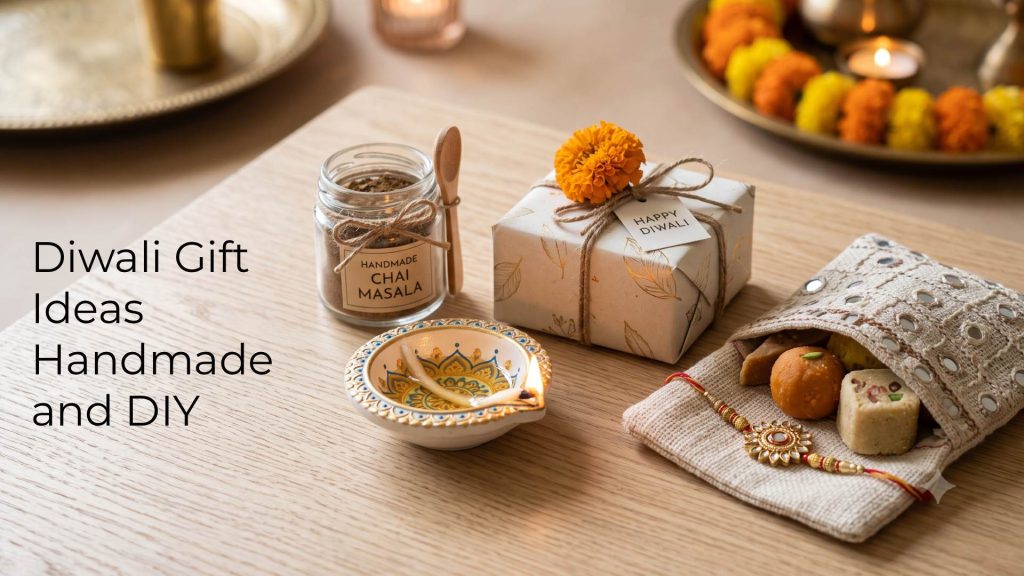
Before the ideas, here is why “homemade Diwali gift ideas” keep trending on every search bar each October:- They feel personal. A handcrafted diya set or a hand-poured candle signals effort. That is the whole point of Diwali gifting.
- They are budget-friendly. Most DIY Diwali gifts cost between Rs. 80 and Rs. 400 per unit in materials, a fraction of a store-bought hamper.
- They are eco-friendly. Reusable jars, seed paper, cotton potlis, and terracotta cut down on the plastic and thermocol that pile up after every festive season.
- They are flexible. You can personalise every single one, which is impossible with a bulk-bought gift.
- They support local artisans. Buying handmade (when you cannot make it yourself) puts money directly into the hands of Indian craftspeople.
12 Easy Handmade and DIY Diwali Gift Ideas (With Indian Pricing)
Here are the most giftable, most doable DIY Diwali gift ideas for 2026, sorted roughly from easiest to most involved. Each includes an approximate material cost per piece so you can plan your budget.1. Hand-Painted Terracotta Diyas
The classic. Buy plain clay diyas in bulk and paint them with acrylics, add mirror work, or wrap them in gota patti.- What you need: Plain diyas, acrylic paints, brushes, glitter or kundan stones.
- Cost per set of 6: Rs. 90 to Rs. 150.
- Time: 30 to 40 minutes per set.
- Best for: Neighbours, colleagues, return gifts.
2. Hand-Poured Soy Wax Candles
Scented candles are one of the most searched handmade Diwali gifts, and they are surprisingly easy.- What you need: Soy wax, cotton wicks, fragrance oil, glass jars or small terracotta pots.
- Cost per candle: Rs. 120 to Rs. 250.
- Time: 20 minutes plus setting time.
- Best for: Friends, family, premium-feel gifts on a small budget.
3. DIY Diwali Gift Hamper in a Potli or Basket
Instead of making one item, curate a small hamper. This is the highest-impact idea on the list.- What to include: Homemade laddoos or dry fruits, a diya, a mini candle, a handwritten card, seed paper crackers.
- Cost per hamper: Rs. 250 to Rs. 600 depending on contents.
- Best for: Close family, seniors, and anyone you want to impress.
4. Homemade Sweets and Snacks (Edible Gifts)
Nothing beats besan laddoo, kaju katli, or chakli in a reusable jar.- What you need: Ingredients plus airtight glass jars and ribbon.
- Cost per jar: Rs. 150 to Rs. 350.
- Best for: Everyone. Edible homemade Diwali gifts are universally loved.
5. Decorated Sweet or Cookie Jars
If baking is not your thing, buy good-quality sweets and elevate the presentation with a hand-decorated jar and a custom label.- Cost per jar: Rs. 200 to Rs. 400.
- Best for: Last-minute gifts that still look handmade.
6. DIY Rangoli Stencil and Colour Kit
A thoughtful gift that keeps on giving every festive season.- What to include: Reusable rangoli stencils, small packets of rangoli powder, a diya.
- Cost per kit: Rs. 120 to Rs. 250.
- Best for: Newlyweds, new homeowners, families.
7. Handmade Paper Lanterns and Torans
Paper craft is beginner-friendly and photographs beautifully.- What you need: Coloured chart paper, glue, thread, beads.
- Cost per piece: Rs. 60 to Rs. 150.
- Best for: Kids to make, and to gift to schools, societies, and offices.
8. Upcycled Home Decor
Turn old glass bottles into painted vases, or repurpose jars into tealight holders. Zero-cost creativity.- Cost per piece: Rs. 40 to Rs. 120 (mostly paint).
- Best for: The eco-conscious friend who values sustainability.
9. DIY Bath and Wellness Kit
Homemade soaps, bath salts, or a natural ubtan packed in a small box.- What you need: Melt-and-pour soap base, essential oils, moulds, small containers.
- Cost per kit: Rs. 180 to Rs. 400.
- Best for: Self-care lovers and women colleagues.
10. Personalised Photo Frames or Fridge Magnets
Polymer clay magnets shaped like diyas or mandalas, or a decorated photo frame.- Cost per piece: Rs. 80 to Rs. 200.
- Best for: Long-distance family and sentimental gifts.
11. Plantable Seed Paper Cards and Crackers
The most sustainable idea on this list. Seed paper grows into herbs or flowers after use.- Cost per piece: Rs. 50 to Rs. 150.
- Best for: Corporate gifting, schools, and green Diwali celebrations.
12. DIY Chocolate Hampers
Melt, mould, and wrap chocolates at home, then box them with a ribbon.- Cost per box: Rs. 200 to Rs. 500.
- Best for: Kids, teens, and anyone with a sweet tooth.
Handmade Diwali Gifts by Recipient
Not sure which idea fits whom? Use this quick match:- For parents and grandparents: Homemade sweets jar, hand-painted diyas, a wellness kit.
- For friends: Soy candles, chocolate hampers, upcycled decor.
- For kids: Chocolate boxes, DIY craft kits they can decorate themselves.
- For colleagues and bosses: Curated potli hamper, seed paper stationery, a tea or coffee sampler.
- For clients and partners: A premium semi-handmade hamper with branded packaging (more on this below).
DIY vs Buying Handmade vs Bulk Gifting: How to Decide
This is the part most guides skip. Making everything by hand is lovely for 5 to 10 gifts. It falls apart at scale. Here is a simple framework. Choose full DIY when:- You are gifting fewer than 15 to 20 people.
- You have time in hand (start at least 2 weeks before Diwali).
- The personal, handmade touch matters more than perfect uniformity.
- You want the handmade look without the effort.
- You are gifting 20 to 50 people.
- You value supporting Indian craftspeople but cannot make items at volume.
- You are an office, HR team, or business gifting 50, 500, or 5,000+ units.
- You need consistent quality, branding, and on-time pan-India delivery.
- You still want that artisanal, thoughtful feel, just produced reliably at scale.
Handmade Diwali Gifting at Scale: For Offices, HR, and Businesses
If you are reading this from a procurement or HR desk in Bengaluru, Mumbai, Delhi NCR, Pune, or Hyderabad, a fully DIY plan for 800 employees is not realistic. But you do not have to settle for a soulless box either. Here is how to get the handmade feel at corporate volume:- Lead with artisan-made components. Hand-poured candles, hand-painted diyas, terracotta drinkware, hand-rolled incense, and hand-packed gourmet sweets all read as “handmade” even in a curated box.
- Personalise the packaging. A branded potli, a wooden crate, or eco-friendly kraft packaging with a handwritten-style note card lifts the entire gift.
- Go eco-friendly. Seed paper, jute, cotton, and terracotta signal a thoughtful, sustainable brand. Explore RidgeGap’s sustainable and eco-friendly gifting range.
- Match the budget band. Handmade-feel corporate hampers typically land at:
- Rs. 300 to Rs. 800 for employee gifting at volume.
- Rs. 800 to Rs. 2,000 for mid-tier client gifting.
- Rs. 2,000 and above for luxury and CXO gifting.
- Plan the timeline. Custom and handmade orders need lead time. Start early using RidgeGap’s Diwali gifting timeline and planning guide.
Presentation Tips That Make Any Handmade Gift Look Premium
The gift matters, but the wrap seals the impression. A few low-cost upgrades:- Swap plastic for a cotton potli or jute pouch. Instantly more festive and reusable.
- Add a handwritten note or a custom tag. The single cheapest way to add sentiment.
- Stick to a festive palette. Red, gold, orange, and maroon photograph well and feel traditional.
- Include one “hero” item. A standout piece (a candle or a decor object) anchors the hamper.
- Use natural fillers. Dried flowers or shredded kraft paper instead of plastic crinkle.
A Simple Handmade Diwali Gifting Timeline for 2026
With Diwali on 8 November 2026, here is a stress-free plan:- 3 to 4 weeks before (mid-October): Finalise the list, decide DIY vs curated, and buy or order materials.
- 2 weeks before: Start making or place your bulk order. Custom branding needs this window.
- 1 week before: Assemble, pack, and label. Do a quality check.
- 3 to 4 days before: Dispatch and deliver, especially for outstation and pan-India gifts.
Frequently Asked Questions (FAQ)
Q1. What are the best handmade Diwali gift ideas on a low budget? Hand-painted terracotta diyas (Rs. 90 to Rs. 150 a set), paper lanterns (Rs. 60 to Rs. 150), homemade sweets in a reusable jar (Rs. 150 to Rs. 350), and soy wax candles (Rs. 120 to Rs. 250) are the most budget-friendly. All look premium for what they cost. Q2. What are some easy DIY Diwali gifts to make at home? The easiest are decorated diyas, paper torans and lanterns, upcycled bottle vases, and sweet or cookie jars with custom labels. Most take under 40 minutes and need only basic craft supplies. Q3. How much does a DIY Diwali gift hamper cost in India? A well-put-together DIY hamper in a potli or basket usually costs Rs. 250 to Rs. 600 per hamper, depending on whether you include homemade sweets, a candle, a diya, and a card. Q4. Are handmade Diwali gifts good for corporate gifting? Yes, when done at the right scale. Full DIY is impractical beyond 15 to 20 units, but a semi-handmade model, artisan-made components curated into a branded, personalised hamper, delivers the handmade feel with reliable quality and delivery. This is ideal for employee and client gifting. Q5. What are the most eco-friendly handmade Diwali gift ideas? Seed paper cards and crackers, terracotta diyas and drinkware, cotton potlis, hand-rolled natural incense, and upcycled decor. These avoid plastic and thermocol and reflect a sustainable, thoughtful choice. Q6. When should I start preparing handmade Diwali gifts for 2026? With Diwali on 8 November 2026, begin 3 to 4 weeks ahead for DIY, and at least 2 weeks ahead for any bulk or custom-branded order that needs personalisation and pan-India delivery. Q7. Where can I get handmade Diwali gifts in bulk for my office? For volume orders that still feel handmade, a corporate gifting partner like RidgeGap curates artisan-led hampers with custom branding and pan-India delivery. You can request a quote here. Q8. What should I include in a handmade Diwali gift for colleagues? A safe, well-received mix is a curated potli with a candle or diya, a small box of good sweets or dry fruits, a tea or coffee sampler, and a handwritten note. Keep it useful and universally acceptable.Final Thoughts
Handmade and DIY Diwali gifts are not just a budget hack, they are the most genuine way to say “I thought about you” during the festival of lights. For a handful of people, roll up your sleeves and make something. For a whole office or client list, keep the handmade soul and let a gifting partner handle the scale. Whichever route you take, start early, personalise generously, and let every gift carry a little of that Diwali warmth.Helpful Resources from RidgeGap
- Corporate Diwali Gifts collection
- Curated Gift Boxes
- Sustainable and Eco-Friendly Gifting
- Luxury and CXO Gifting
- Diwali Gift Ideas Under Rs. 500 to Rs. 2000
- Diwali Return Gifts Ideas
- Diwali Gift Hampers and Baskets in Bangalore
- Diwali Gifting Timeline and Planning Guide
- Talk to the RidgeGap team for a custom quote
Diwali Gifting RFQ Template: Corporate Buying Guide 2026
- Forces every vendor to quote on the same specification, so you compare like with like
- Splits pricing into per-piece + branding + packaging + freight + GST instead of one opaque number
- Pegs delivery to the actual Diwali date, not a vague “ASAP”
- Builds in compliance asks (GSTIN, DPDP data handling, itemised invoice) that Indian finance and legal teams need
- Creates a paper trail your audit and finance teams will thank you for
When to use an RFQ vs an RFP for Diwali gifting
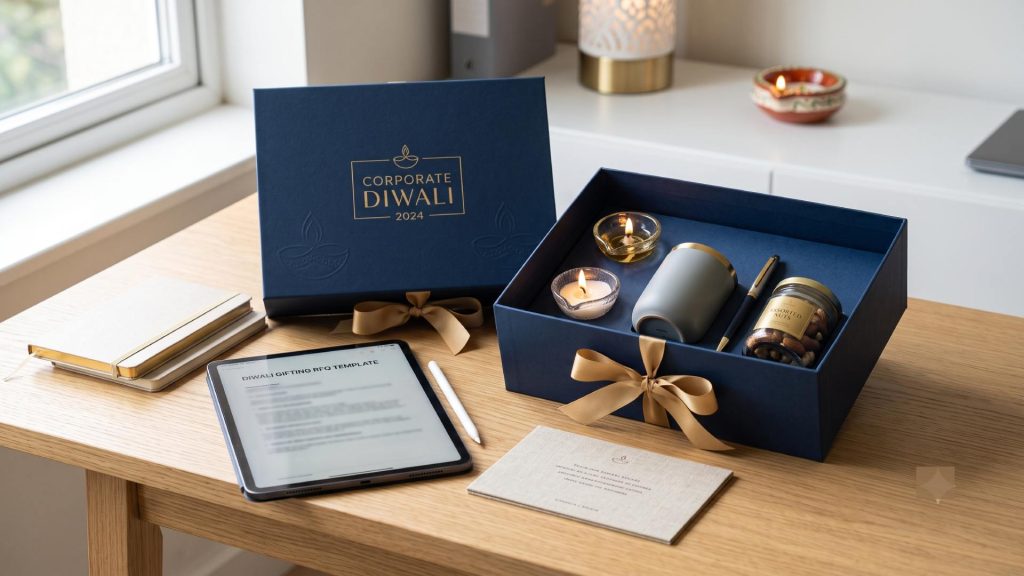
These two get confused constantly, so here is the clean distinction for a gifting context:- Use an RFQ when you already know what you want — e.g. “500 branded gift boxes, each with a stainless-steel bottle, a diya set, dry fruits, and a personalised card, budget ₹1,200 per box.” You just need competing prices. This is the most common Diwali scenario.
- Use an RFP (Request for Proposal) when you want the vendor to design the solution — e.g. “We have ₹6 lakh and 400 recipients across three tiers; propose a creative concept.” Here you are buying ideas plus pricing.
The 8 building blocks of a strong Diwali gifting RFQ
Here is what every festive RFQ should contain, section by section. Copy the full template further down — this explains why each block earns its place.1. Buyer and issue details
Your company name, GSTIN, billing and delivery states, a single point of contact (name, email, mobile), the RFQ reference number, and the issue date. A named contact and reference number signal that you are a serious, organised buyer — and vendors quote their best price to serious buyers.2. Recipient tiers and quantities
Segment your list before you ask for a price. Most Indian companies split into:- All employees / staff (the largest, most price-sensitive tier)
- Team leads and managers (a mid tier)
- Key clients and VIP accounts (premium)
- CXO / VP / board and marquee clients (luxury)
- Vendors, channel partners, and dealers (often a separate practical tier)
3. Per-tier budget slabs (in INR)
Give a target per-piece budget for each tier. This is not “showing your hand” — it lets vendors curate to your number instead of over- or under-quoting. Common 2026 slabs seen across the Indian market:- ₹500-₹800: mass employee gifting for teams of 100+; a compact hamper (one branded item + one edible + a festive card)
- ₹800-₹1,500: the sweet spot for mid-size teams — premium without triggering audit questions or department-to-department disparity
- ₹1,500-₹2,500: senior staff, managers, and mid-tier clients; think smart bottles, quality drinkware sets, gourmet hampers
- ₹2,500-₹5,000+: CXO tier and marquee clients — presentation boxes, premium nuts, personalised note from leadership
4. Product and customisation specification
Be specific. For each tier, list the contents, the branding you want, and where the logo goes:- Contents: exact items in the box or hamper
- Branding method: screen print, UV print, laser engraving, embroidery, foiling, embossing — and on which item
- Personalisation: name on each item, individual recipient message, or a common festive card
- Packaging: rigid box vs kraft carton, ribbon, tissue, recipient-name tag, eco / plastic-free fillers
- Sample requirement: state clearly that a physical sample is required before bulk production
5. Itemised pricing table
This is the heart of the RFQ. Insist that every vendor fills a table with these columns, per tier:- SKU / item description
- Per-piece base price (before tax)
- Branding / customisation charge per piece
- Packaging per kit
- Freight per recipient or per consignment
- HSN code
- GST rate (%)
- All-in landed cost per piece (incl. GST)
6. Delivery timeline pegged to Diwali
Never write “ASAP.” Write the actual dates:- Sample approval deadline
- Bulk production window
- Dispatch date
- Required in-hand date (a safe 2-4 days before Diwali)
7. Compliance and documentation asks
For Indian procurement, this block is non-negotiable:- Active GSTIN (verifiable on the GST portal, not provisional)
- Itemised, HSN-coded, GST-split sample invoice
- DPDP Act 2023 data-handling note — where your recipient list is stored, who can access it, retention period (12 months post-delivery max), and destruction protocol. The vendor becomes a data processor the moment you share names and addresses
- Willingness to sign a mutual NDA covering recipient lists and artwork
- Replacement-at-vendor-cost clause for goods that fail QC against the approved sample
8. Submission deadline and quote validity
State the date and time by which quotes must arrive, the preferred format (a shared sheet is easiest), and a required quote validity (e.g. “valid for 30 days”). This prevents a vendor from re-pricing after you’ve made your decision.A worked example: filled RFQ pricing (so you know what “good” looks like)
Say you have 320 employees, 40 managers, and 25 key clients. A well-completed vendor response for the employee tier might read:- Item: branded gift box (steel bottle + diya set + 200g dry fruits + festive card)
- Per-piece base: ₹690 · Branding: ₹45 · Packaging: ₹60 · Freight: ₹35 · HSN: 2106 · GST: 18% · Landed ≈ ₹979 per box
- Item: rigid presentation box (premium nuts assortment + gourmet chocolate + leather-tag notebook + CEO note)
- Per-piece base: ₹2,850 · Branding: ₹120 · Packaging: ₹280 · Freight: ₹80 · HSN: 2106 · GST: 18% · Landed ≈ ₹3,930 per box
Common mistakes that sink a Diwali RFQ
- Sending it too late. After mid-September, customisation slots vanish and you get standard SKUs. Send the RFQ 6-8 weeks out.
- Accepting lump-sum quotes. “₹X per kit, all-inclusive” hides freight, branding, and GST. Reject it.
- Not asking for a sample. Digital mockups are not proof. Insist on a physical sample before bulk.
- Skipping HSN and GST split. This is where invoice pain and ITC (input tax credit) trouble start.
- Ignoring DPDP. Sharing 500 employees’ names and addresses with no data-handling agreement is a real compliance exposure.
- Inviting only one vendor. With no competing quote, you have no price band and no leverage. Invite at least three.
- Vague delivery date. “Before Diwali” is not a date. Write the in-hand date into the RFQ.
How RidgeGap responds to a Diwali gifting RFQ
At RidgeGap, we are built to answer exactly this kind of structured brief. With 10 years in corporate gifting, 300+ brands to choose from, and pan-India door delivery, we return itemised quotes by default — per-piece, branding, packaging, freight, HSN and GST split out — so your finance team never has to chase a hidden line. If you are shaping your festive brief, these RidgeGap resources map directly to the RFQ blocks above:- Curated Gift Boxes — the workhorse format for tiered Diwali hampers
- Luxury & CXO Gifting — presentation boxes for your ₹2,500+ tier
- Sustainable & Eco-Friendly Gifting — plastic-free packaging and recycled-content options
- Swag Packs and Customised T-Shirts — practical branded add-ons for the mass tier
- Corporate Diwali Gifts — our full festive range
- Contact Us — send us your filled RFQ and we will return a mapped, itemised quote
Frequently Asked Questions
What is a Diwali gifting RFQ template?
It is a standardised one-page document you send to gifting vendors to request comparable, line-item pricing for a bulk festive order. It captures buyer details, recipient tiers and quantities, per-tier budget slabs in INR, product and customisation specs, an itemised pricing table (with HSN and GST), a Diwali-pegged delivery timeline, compliance asks, and a submission deadline. It replaces a scattered WhatsApp price hunt with a clean, apples-to-apples comparison.When should I send a Diwali RFQ to vendors?
Send it 6-8 weeks before Diwali — practically, by mid-September. Most large custom orders in India close around then, and branded or personalised packaging needs an extra two weeks. Orders placed in the final week before the festival usually ship as standard SKUs with no customisation.How much do companies spend per employee on Diwali gifts in India?
Budgets typically range from ₹500 to ₹15,000+ per employee. The mass-employee sweet spot in 2026 sits around ₹800-₹1,500 per gift box; ₹500-₹800 works well for very large teams; managers and mid-tier clients land at ₹1,500-₹2,500; and CXO/VIP hampers run ₹2,500-₹5,000+. Actual spend depends on team size, customisation, and packaging.Is there a tax angle I should build into the budget?
Yes. Under current income-tax rules, non-cash gifts up to ₹5,000 per employee per financial year are generally exempt as a perquisite; the excess above ₹5,000 is taxable in the employee’s hands. Keeping mass employee gifts within roughly ₹500-₹2,500 keeps things clean. Always confirm the exact treatment with your finance team before large orders.What HSN code and GST rate apply to Diwali gift hampers?
There is no single “gift” HSN code — the rate follows the item. Mixed hampers are commonly classified under HSN 2106, chocolates under 1806, and dry fruits/nuts under 0802. A mixed hamper billed as one composite product often attracts 18% GST depending on the principal item. Ask the vendor to state and justify the HSN on the quote, and verify it yourself.RFQ or RFP — which should I use for corporate Diwali gifting?
Use an RFQ when you already know exactly what you want and just need competing prices — the most common festive scenario. Use an RFP when you want vendors to design the concept for a given budget and audience. Many teams run an RFP to shortlist, then send a tight RFQ to the final three vendors for pricing.How many vendors should I send the RFQ to?
At least three. One quote gives you no price band and no leverage. Three gives you a genuine market range and lets you disqualify outliers — the vendor who won’t itemise, won’t sample, or won’t sign a data-handling clause.What documents should I ask a Diwali gifting vendor for?
An active, portal-verifiable GSTIN; a sample HSN-coded, GST-split invoice; a DPDP Act 2023 data-handling note; willingness to sign a mutual NDA; and a replacement-at-vendor-cost clause for goods that fail QC against the approved sample.Resource: Download and adapt
Copy the template block above into Word, Excel, or Google Sheets and adapt the brackets to your order. For a ready itemised quote mapped to each RFQ block, share your filled template with the RidgeGap team at ridgegap.com/contact-us.Sources and references
- Income-tax perquisite treatment of employee gifts (₹5,000 exemption) — general guidance; confirm with your finance team
- GST/HSN classification for hampers, chocolates, and dry fruits — CBIC HSN directory and GST advisories
- DPDP Act 2023 — MeitY, for recipient-data handling
- Indian corporate Diwali budget benchmarks (2026) — market surveys from gifting suppliers
Corporate Diwali Gift Card Ideas: Employee Gift Guide 2026
Why Gift Cards Are Trending for Corporate Diwali Gifting in India
- Zero size or fit issues. Unlike apparel or gadgets, a gift card cannot be the wrong size, colour or model.
- Faster turnaround. Digital gift vouchers can be issued and delivered in days, useful when Diwali approval sign-offs slip into late October.
- Easier for large, distributed teams. Companies with employees across multiple cities, factories or work-from-home setups avoid the courier and address-collection headache entirely.
- Budget precision. Finance teams can allocate an exact amount per employee, per client tier or per department without hidden shipping or packaging cost variance.
- Choice-driven satisfaction. Recipients report higher satisfaction with vouchers because they select something relevant to them, rather than receiving a one-size-fits-all hamper.
Types of Corporate Diwali Gift Card Ideas to Consider
Not all gift cards suit every recipient. Here are the categories that consistently work well for Indian corporate Diwali gifting:- E-commerce gift cards – Amazon Pay, Flipkart and Myntra cards work for almost any employee segment and are the easiest to issue in bulk.
- Multi-brand gift vouchers – Platforms like Woohoo and GyFTR let recipients redeem across 300 plus brands spanning fashion, electronics, wellness and dining, which removes the guesswork for HR teams gifting a large, diverse workforce.
- Dining and food delivery cards – Swiggy, Zomato or restaurant-chain vouchers are popular with younger employees and urban client contacts.
- Travel gift cards – MakeMyTrip and similar travel vouchers work well for senior employees, CXOs and long-tenured clients who appreciate an experience-led gift over a product.
- Fuel and mobility cards – Practical for field staff, sales teams and factory or plant employees who commute daily.
- Wellness and grooming cards – Spa, salon and fitness app vouchers suit gifting where employee wellbeing is a stated company priority.
- Entertainment and OTT vouchers – Movie ticket or streaming subscription cards are budget-friendly and popular for junior staff and bulk client gifting.
- Meal and rewards cards (Pluxee, formerly Sodexo) – Reloadable cards accepted at a wide retail and dining network, useful where a company wants a recurring or year-round benefit rather than a one-time Diwali gift.
Corporate Diwali Gift Card Ideas by Budget (Indian Pricing)
Indian companies typically plan Diwali gifting in clear budget tiers. Here is how gift card value maps to realistic corporate spending this season. Under ₹500 per person (large workforce, bulk staff gifting)- Small-denomination food delivery or entertainment vouchers
- Combine with a low-cost festive card or diya to avoid a bare-voucher feel
- Best suited for interns, contract staff and large blue-collar teams
- Multi-brand vouchers (Woohoo, GyFTR) giving recipients a genuine choice
- Single-brand e-commerce cards for straightforward, no-fuss distribution
- Pairs well with a small branded desk item; see Diwali gift ideas under ₹500 to ₹2,000 for combination ideas at this exact budget band
- Dining or travel-linked vouchers
- Wellness or grooming cards for a more personal, less transactional feel
- Reloadable rewards cards for teams the company wants to recognise beyond a single occasion
- Premium multi-brand vouchers redeemable at fashion, jewellery or lifestyle brands
- Travel gift cards for an experience-led gesture
- Consider combining the card with a smaller curated gift box so the client receives something tangible to unwrap, not just a code
- High-value travel or lifestyle gift cards
- Best paired with a premium hamper rather than sent standalone; our luxury and CXO gifting range is built specifically for this recipient tier
Corporate Diwali Gift Card Ideas by Recipient
- Employees (pan-India, mixed seniority): multi-brand vouchers work best since teams span different cities, tastes and price sensitivities.
- Women employees: wellness, grooming and lifestyle-brand cards tend to perform well; for a wider, more considered list beyond gift cards alone, see our guide to Diwali gift ideas for female employees.
- Remote and work-from-home staff: food delivery, e-commerce and grocery vouchers solve the delivery-address problem entirely.
- Factory, plant and field staff: fuel cards, grocery vouchers and mobile recharge cards are more practically useful than lifestyle vouchers for this segment.
- Clients and channel partners: travel, dining or premium lifestyle vouchers signal a higher-value relationship and work better combined with a branded note or small hamper.
- New joiners: a modest gift card alongside their onboarding kit reinforces a positive first festive season with the company.
- CXOs and leadership contacts: high-denomination travel or luxury-brand cards, ideally hand-delivered with a premium hamper rather than emailed as a plain link.
Gift Cards vs Physical Diwali Gifts vs Hybrid Hampers
| Factor | Gift Cards | Physical Gifts/Hampers | Hybrid (Card + Hamper) |
| Personalisation feel | Low unless customised | High | High |
| Logistics effort | Very low | Higher (packaging, courier, addresses) | Moderate |
| Recipient choice | Highest | Lowest | Balanced |
| Brand visibility | Low | High (branded packaging, products) | High |
| Best for | Large, distributed teams | Clients, senior staff, culturally significant gifting | Most corporate Diwali programmes |
| Typical Indian budget fit | ₹300 to ₹10,000+ | ₹500 to ₹7,000+ | ₹1,000 to ₹10,000+ |
Are Corporate Diwali Gift Cards Taxable in India? 2026 Rules
This is one of the most searched questions around Diwali gift cards, and the rules changed recently, so many older articles online are now out of date.- Under the Income Tax Rules notified with effect from April 1, 2026, the annual tax exemption limit on gifts and festival vouchers given by an employer to an employee has been raised from ₹5,000 to ₹15,000 per financial year, applicable under both the old and new tax regimes.
- Gift cards, digital vouchers and multi-brand cards all qualify under this non-cash gift exemption; cash bonuses do not qualify under any circumstance, regardless of how they are labelled.
- If the aggregate value of gift cards and other non-cash gifts given to an employee in a financial year stays within ₹15,000, the entire benefit is treated as nil perquisite value and is fully tax-free.
- If the total exceeds ₹15,000 in the year, only the excess amount is added to the employee’s taxable salary as a perquisite; the first ₹15,000 remains exempt.
- Vouchers given to clients or business associates (not employees) are usually treated as business promotion expenses rather than perquisites, and should be documented for GST and audit purposes.
- GST input tax credit on gift vouchers is a nuanced area since ITC is generally restricted for goods and services used for personal consumption; companies should confirm treatment with their tax advisor based on how the vouchers are procured.
How to Choose the Right Partner for Bulk Diwali Gift Cards
- Check bulk denomination flexibility. Confirm the platform supports custom values (not just fixed slabs) so budgets across employee tiers can be set precisely.
- Ask about co-branding. Some platforms allow a company logo, custom landing page or personalised message alongside the card, which meaningfully improves how the gift is received.
- Confirm delivery speed and format. Digital delivery via email, SMS or WhatsApp is fastest; physical card options need longer lead time.
- Get GST-compliant invoicing. Ensure the vendor issues proper tax invoices for accounting and audit purposes.
- Plan the timeline early. Vendors get overbooked in the two to three weeks before Diwali; our Diwali gifting timeline and planning guide outlines exactly when to start finalising budgets, vendors and dispatch to avoid last-minute rush pricing.
- Consider a combined gifting partner. If you want gift cards alongside a branded hamper, apparel or eco-friendly product line rather than managing two separate vendors, it is worth consolidating with one corporate gifting partner who can execute both under a single order and delivery timeline.
Tips to Make Diwali Gift Cards Feel More Personal
- Add a handwritten or personalised note. Even a short, warm message with the recipient’s name changes how a digital gift is perceived.
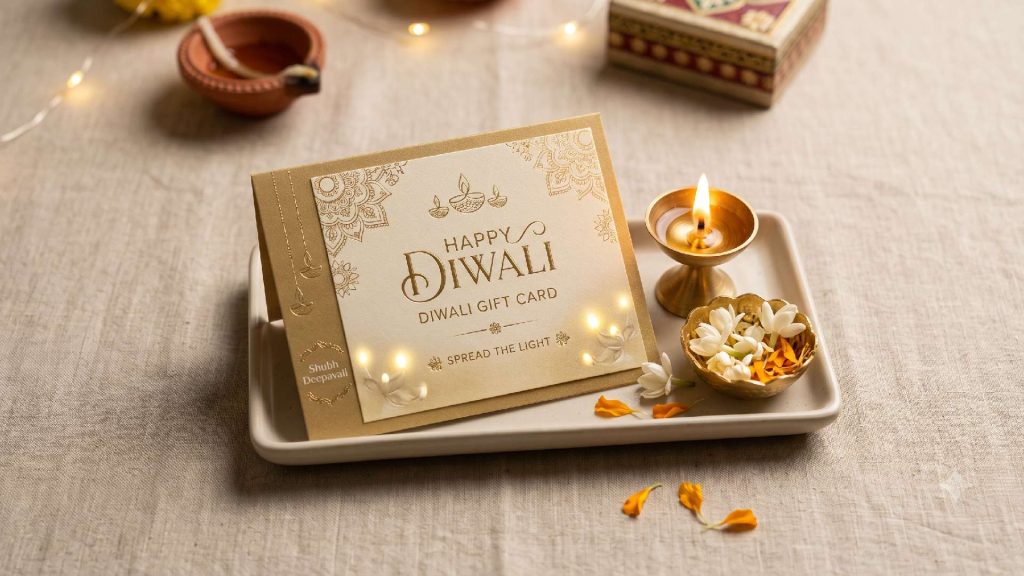
- Send it inside a small branded sleeve or festive card, not a bare email link.
- Pair with a token physical item, such as a diya, a small mithai box or a branded desk accessory, so the gift is not entirely digital.
- Time the delivery well. Sending gift cards a few days before Diwali, rather than on the day itself, allows recipients to actually plan and use them during the festive shopping window.
- Segment by relationship, not just budget. A client of five years and a client of five months should not automatically receive the identical voucher; tailor the platform or value slightly by relationship depth.
- Go eco-conscious where it fits your brand. Digital gift cards are inherently low-waste; pairing them with a sustainable physical element (recycled packaging, plantable seed cards) works well for companies that want their eco-friendly gifting values reflected at Diwali too.
Common Mistakes to Avoid
- Sending a single-brand card to a diverse workforce. Not every employee shops on the same platform; multi-brand vouchers avoid this mismatch entirely.
- Ignoring the tax threshold. Crossing the ₹15,000 exemption limit without informing employees can create payroll and TDS confusion later; flag it proactively in the gifting communication.
- Waiting too long to order. Bulk gift card platforms and hamper vendors both see order backlogs in the final two weeks before Diwali.
- No personalisation at all. A plain, unbranded voucher email risks feeling like an afterthought rather than genuine appreciation.
- Forgetting client-side documentation. Vouchers given to external clients need to be recorded correctly as business promotion expenses, not personal gifts, for audit clarity.