Author Archives: ridgegap_user
Are Diwali Gifts to Clients Tax Deductible in India? (2026 Guide)

Quick Answer
Yes, in most cases. Diwali gifts to clients are allowed as a business expense in India when they are incurred wholly and exclusively for business, are reasonable in value, and are backed by proper invoices. There is no fixed rupee cap on the deduction. Three rules decide whether your claim survives scrutiny:- Business purpose: The gift must build or protect client relationships, not serve a personal or family purpose.
- TDS compliance: If you give one client benefits worth more than Rs. 20,000 in a financial year (excluding GST), you generally have to deduct 10% TDS. Missing this can put the deduction at risk.
- GST credit: You cannot claim GST input tax credit (ITC) on gifts. That GST becomes part of your cost.
In This Guide
- Is a client Diwali gift really a deductible expense?
- What changed in 2026: the new Income-tax Act
- The 6 conditions for claiming the deduction
- TDS on client gifts above Rs. 20,000 (with an example)
- GST and input tax credit on Diwali gifts
- Tax treatment by gift type, with Indian price bands
- Documents to keep
- Mistakes that trigger tax notices
- Client gifts vs employee gifts
- A 7-step plan before Diwali
- FAQs and resources
Is a Client Diwali Gift Really a Deductible Expense?
Indian tax law lets you deduct business costs from your profits. The general rule says an expense is allowed if it is laid out wholly and exclusively for business or profession, and if it is not capital in nature or a personal expense of the owner. Client gifting fits comfortably inside that rule. In India, sending sweets, hampers or branded gifts at Diwali is a long-standing business custom. It supports client retention, referrals and goodwill. A tax officer is therefore unlikely to question the principle of gifting, but will question the proof, the value and the compliance. Think of the deduction as conditional rather than automatic. The gift is accepted as business promotion. Your records and TDS filings must then prove it.What Changed in 2026: The New Income-tax Act
Most articles on this topic still quote the Income-tax Act, 1961. That is outdated for this Diwali. The Income-tax Act, 2025 came into force on 1 April 2026. Gifts you give in October and November 2026 fall in financial year 2026-27, which is now called “tax year 2026-27”. Section numbers have been renumbered:| Topic | Old Act (1961) | New Act (2025) |
| General business expenditure (wholly and exclusively) | Section 37(1) | Section 34 |
| TDS on benefit or perquisite from business | Section 194R | Section 393(1), Table Sl. No. 8(iv) |
| Perquisite value of employee gifts | Section 17(2) with Rule 3 | Corresponding provisions of the 2025 Act and new rules |
The 6 Conditions for Claiming the Deduction
1. The gift must have a business purpose
Gifts to genuine clients, customers, dealers, vendors and referral partners qualify. Gifts to your own family, friends or relatives do not, even if they happen to be clients’ relatives. A gold coin for your cousin is a personal expense, however it is booked.2. The value must be reasonable
India has no statutory cap on client gift value. However, officers compare gift cost against your turnover, your industry norms and the client’s size. A Rs. 1,500 hamper for 200 clients looks natural. A Rs. 60,000 gadget for a single small vendor invites questions.3. It must be supported by a proper invoice
Buy from a registered supplier and keep a GST invoice in your business name with GSTIN. Handwritten slips and informal cash purchases are the weakest evidence.4. It must not be paid in cash
The Delhi bench of the Income Tax Appellate Tribunal has upheld a disallowance where Diwali gifts were distributed in cash, in a case linked to the cash-payment restriction in Section 40A(3). Pay suppliers by bank transfer, UPI or cheque, and prefer in-kind gifts.5. It must be lawful
An expense that is an offence or prohibited by law is never deductible. This matters for two groups:- Government officials: Gifts that look like inducements can breach the Prevention of Corruption Act, 1988.
- Doctors and healthcare professionals: The CBDT has treated freebies given to doctors in violation of medical council rules as inadmissible. Pharma companies must follow the marketing code strictly.
6. TDS must be handled where applicable
If Section 194R (now Section 393(1)) applies and you do not deduct tax, a part of the expense can be disallowed. The next section explains when it applies.TDS on Client Gifts Above Rs. 20,000: The Rule Most Businesses Miss
Section 194R was introduced to tax business benefits that were earlier slipping through. It covers any benefit or perquisite, whether in cash or in kind, that a resident receives from a business or profession. The key points, based on the Income Tax Department’s guidelines:- Rate: 10% of the value of the benefit.
- Threshold: Rs. 20,000 per recipient in a financial year. Once the total crosses this limit, TDS applies to the full amount, not only the excess.
- GST excluded: The value for this purpose is measured without GST.
- Benefits in kind: If you give a hamper, laptop bag or gadget, you must ensure tax is paid before releasing it.
- Not for employees: Employee gifts follow the salary and perquisite route instead.
- Small-business relief: An individual or HUF giver whose business turnover did not exceed Rs. 1 crore (or professional receipts Rs. 50 lakh) in the previous year is generally outside this requirement. Verify this with your CA for your situation.
Worked example
A Bengaluru IT services firm sends a client a Rs. 12,000 Diwali hamper in November. In March, it sends a Rs. 9,000 branded gift for the client’s project completion.- Total benefits in the year: Rs. 21,000 (excluding GST)
- This is above Rs. 20,000, so TDS at 10% applies on the full Rs. 21,000
- TDS: Rs. 2,100
- The firm must pay this in advance, since both benefits were in kind
What happens if you skip it?
The giver can face interest and penalties for short deduction, and a percentage of the gift expense can be disallowed in computing taxable profit. In a bulk Diwali programme, even a small gap repeated across 300 clients becomes a large exposure.GST and Input Tax Credit on Diwali Gifts
GST on gifts is where most businesses lose money without noticing.- No ITC on gifts: Section 17(5)(h) of the CGST Act blocks input tax credit on goods disposed of by way of gift or free samples. The GST you pay on a hamper therefore cannot be set off against your output GST.
- It is still part of your cost: Since the credit is blocked, the GST you paid generally forms part of the total expense you claim for income tax, subject to your CA’s view.
- Contractual rewards are different: Items given under a contractual scheme, such as a published sales target incentive, may be treated differently from voluntary gifts. Treat this as an area for professional advice.
Tax Treatment by Gift Type, With Indian Price Bands
| Gift type | Typical price per client (Rs.) | Deductible? | Key watch-out |
| Branded merchandise (bottles, notebooks, desk items) | 500 to 1,500 | Yes | Keep the invoice and a client list |
| Sweets and dry fruit boxes | 800 to 2,500 | Yes | Reasonable value, perishable, keep delivery proof |
| Curated Diwali hampers | 1,500 to 3,500 | Yes | Track annual total per client |
| Premium hampers and tech gadgets | 3,500 to 10,000 | Yes, if reasonable | Check Rs. 20,000 annual TDS limit |
| CXO and luxury gifts | 10,000 and above | Yes, with strong justification | Likely to cross the TDS threshold |
| Gift cards and vouchers | 1,000 to 5,000 | Usually yes | Treat like a benefit; record client-wise |
| Cash or cash envelopes | Any | High risk | Disallowance risk; avoid |
| Gold or silver coins | 2,000 to 15,000 | Case by case | Looks personal; document the purpose |
| Gifts to government officials | Nominal only | Risky | Anti-corruption law applies |
| Gifts to doctors (pharma) | Restricted | Often not allowed | Marketing code and CBDT position |
Documents to Keep for Every Diwali Gift Claim
Auditors and assessing officers rely on paper. Keep this file ready for at least the period prescribed for assessments and audits:- GST tax invoice from the vendor, in your company name and GSTIN
- Purchase order and approval email or note from the competent authority
- Client-wise gift register showing name, company, PAN or GSTIN, item, value and date
- Proof of delivery, such as courier tracking or signed acknowledgement
- Bank or UPI payment proof, never cash
- Gifting policy approved by management, stating budget slabs by client tier
- TDS computation, challan and return reference, wherever Section 194R or 393(1) applied
- A short note on the business purpose, such as “annual client appreciation, top 100 accounts”
Mistakes That Trigger Tax Notices
- Booking personal gifts as client gifts: Family gold coins or personal shopping booked under “Diwali expenses” is the most common red flag.
- Ignoring the annual total: Diwali, New Year and project-completion gifts add up for the same client.
- Paying cash for hampers: This invites disallowance under cash-payment rules.
- Claiming GST credit: ITC on gifts is blocked and is often reversed with interest.
- Vague descriptions: Entries like “Diwali expenses – misc” with no vendor, client list or invoice are easy to disallow.
- Mixing employee and client gifts: The tax rules differ, so book them under separate heads.
- Festival or puja spending treated as client gifting: Tribunals have disallowed pooja and festival expenses where no business link was proven.
- Overspending on one party: An unusually high gift to one vendor or client needs a clear commercial reason.
Client Gifts vs Employee Gifts: A Quick Comparison
Many finance teams run one Diwali budget for both groups, but the tax rules are different.| Point | Clients and business associates | Employees |
| Deduction for giver | Business expenditure rule (old Section 37(1), now Section 34) | Business expenditure, subject to perquisite rules |
| Tax-free limit | No fixed limit, but TDS above Rs. 20,000 a year | Gifts up to Rs. 5,000 a year are generally tax-free for the employee |
| TDS | Section 194R, now 393(1), at 10% | Through salary TDS if taxable |
| GST ITC | Blocked | Blocked on gifts |
| Cash | Avoid | Taxable as salary |
A 7-Step Plan Before Diwali (8 November 2026)
- Segment your clients: Split them into key accounts, regular clients and prospects.
- Set budget slabs: For example Rs. 1,000 for regular, Rs. 3,000 for key accounts, Rs. 8,000 for top accounts.
- Check last 12 months of benefits: Add earlier gifts, events and incentives given to each client.
- Run the Rs. 20,000 test: Flag clients likely to cross the threshold and decide whether to cap or to deduct TDS.
- Choose vendors who issue proper GST invoices: Ask for GSTIN, HSN codes and delivery proof.
- Pay by bank or UPI: Avoid cash and personal cards.
- Maintain the register: Update it as gifts are dispatched, not months later.
How Ridgegap Can Help You Gift Compliantly
Ridgegap is a Bengaluru-based corporate gifting company serving companies across India. The team supports bulk Diwali programmes with:- GST-compliant invoicing and client-wise dispatch reports
- Curated gift boxes at budget slabs from Rs. 800 upwards
- Corporate Diwali gifts with logo branding and festive packaging
- Sustainable and eco-friendly gifting for ESG-conscious clients
- Swag packs and branded merchandise for partners and channel teams
- Pan-India delivery with tracking, so your proof of delivery is ready
Frequently Asked Questions
Are Diwali gifts to clients tax deductible in India?
Generally yes. They are allowed as business expenditure if incurred wholly and exclusively for business and supported by invoices. Personal gifts, cash gifts and illegal payments are not.Is there a limit on how much I can spend on client Diwali gifts?
There is no fixed statutory cap. The expense must be reasonable relative to your business. However, once benefits to one client exceed Rs. 20,000 in a year, TDS at 10% generally applies.What is Section 194R and does it apply to Diwali hampers?
Section 194R required TDS at 10% on business benefits and perquisites given to residents. Under the Income-tax Act, 2025 this sits in Section 393(1). It can apply to hampers, gadgets or vouchers once the annual value per client crosses Rs. 20,000, excluding GST.Can I claim GST input tax credit on Diwali gifts?
No. Section 17(5)(h) of the CGST Act blocks ITC on goods given away as gifts. Treat the GST as a cost.Are gift cards and vouchers for clients deductible?
Usually yes if the business purpose is clear and documented. They are treated as a benefit, so include them in the client’s annual total for the TDS check.Are cash gifts to clients allowed as an expense?
They are high risk. Tribunal rulings have upheld disallowance for Diwali gifts given in cash, and cash payments above prescribed limits are restricted. Use in-kind gifts paid by bank transfer.Do small businesses and freelancers also get the deduction?
Yes. Self-employed professionals and small businesses can claim reasonable client gifts if they keep invoices. Individuals and HUFs below the turnover limits are generally outside TDS under this rule, but should confirm with their CA.Is a Diwali gift taxable for the client who receives it?
It can be treated as business income of the recipient, depending on facts. Gifts received by an individual from a business may also be assessed as a business benefit. Recipients should consult their own tax advisor.Which section applies to Diwali gifts in FY 2026-27?
Because the Income-tax Act, 2025 applies from 1 April 2026, the business expense rule is now Section 34 (earlier Section 37(1)), and the TDS rule is Section 393(1) (earlier Section 194R).Can I give Diwali gifts to government officials or doctors?
Be extremely careful. Gifts to public servants can violate anti-corruption law, and freebies to doctors in breach of medical marketing rules are not deductible. Keep to nominal, policy-compliant items or avoid gifting altogether.Resources and References
- Income Tax Department, Section 37 of the Income-tax Act, 1961: https://incometaxindia.gov.in/w/section-37-64
- Income Tax Department, Section 194R and guidelines: https://www.incometaxindia.gov.in/w/tds-on-benefit-or-perquisite-arising-from-business-or-profession
- Income Tax Department, Section 194R text: https://www.incometaxindia.gov.in/w/section-194r-4
- Business Standard, Diwali gifts and shopping: what you can claim and what is taxable: https://www.business-standard.com/finance/personal-finance/diwali-gifts-and-shopping-what-you-can-claim-and-what-is-taxable-125101300741_1.html
- Taxscan, ITAT on Diwali gifts given in cash: https://www.taxscan.in/?p=35605
- TaxHeal, GST ITC on gifts and Diwali expenses: https://www.taxheal.com/gst-itc-gifts-diwali-expenses.html
- TaxGuru, Income-tax Act 2025 section mapping: https://taxguru.in/?p=1027834
- TDSMAN, TDS on benefit or perquisite under Section 393(1): https://blog.tdsman.com/2026/05/tds-on-benefit-or-perquisite-section-3931-194r/
Diwali Gifting Budget: Employees, Clients and Vendors
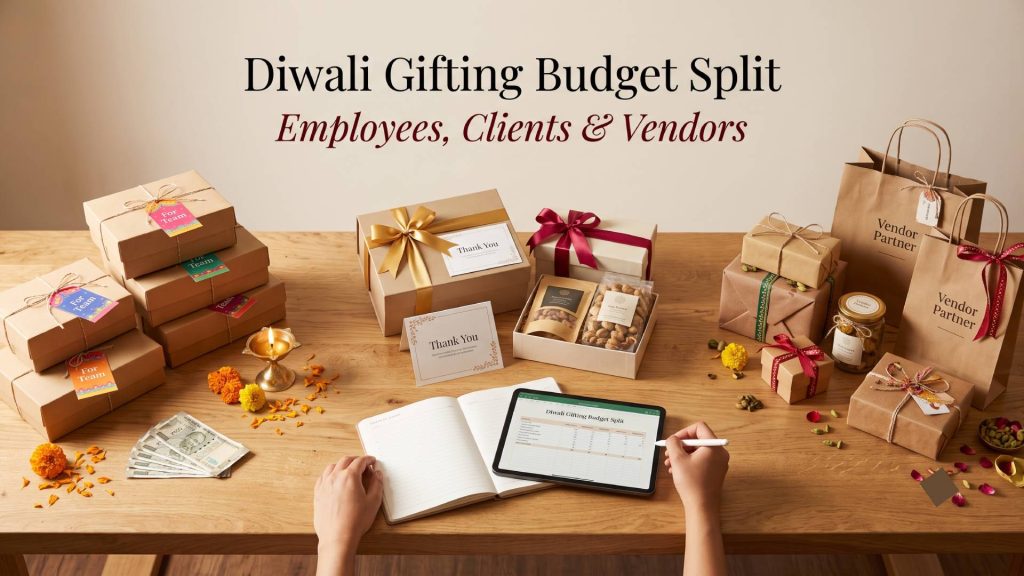
Key Takeaways
- Start with recipient counts and tiers, not a lump sum. Budget per head x number of people is more accurate than a top-down percentage.
- A typical split is 50 to 60 percent employees, 20 to 35 percent clients, 5 to 10 percent vendors, and 8 to 12 percent for operations and contingency.
- Tier your clients (A, B, C) and spend most on the top 20 percent of accounts that drive most of your revenue.
- Employees should get one consistent, fair gift value. Avoid visible differences between teams.
- From tax year 2026-27, gifts and vouchers to an employee up to Rs. 15,000 in a year are generally tax-free for the employee. Cash is not.
- Always reserve 5 to 10 percent for late joiners, new clients, damaged deliveries and price changes.
Why a Budget Split Matters More Than the Gift Itself
Most Diwali gifting problems are budget problems in disguise. When there is no clear split:- The employee gift gets cut at the last minute because client gifting ran over.
- Key clients receive the same box as a one-time vendor, which sends the wrong signal.
- Delivery, GST and branding costs are forgotten, and the “Rs. 1,500 hamper” actually costs Rs. 1,900 landed.
- New joiners in November are left out because every box was already allocated.
Step 1: List Every Recipient Group and Count Them
Before you talk about percentages, build a simple recipient list. In most Indian companies, it looks like this: Employees- Full-time employees across all offices
- Remote and hybrid employees (doorstep delivery needed)
- Contract staff, interns and support staff (security, housekeeping, drivers)
- Leadership team (optional separate tier)
- Key accounts (Tier A): top clients by revenue or strategic value
- Regular clients (Tier B): active accounts with steady business
- Small or occasional clients (Tier C)
- Prospects in late-stage deals (check your gifting policy first)
- Strategic suppliers and long-term vendors
- Channel partners, dealers and distributors
- Service providers: logistics partners, agencies, consultants, landlords and facility teams
Step 2: Choose a Budget Split Based on Your Business Type
There is no single correct split. The table below shows typical allocation ranges for Indian companies by business model.| Business Type | Employees | Clients | Vendors and Partners | Operations and Contingency |
| Startups, IT and tech services (employee-heavy) | 55 to 65% | 20 to 30% | 5 to 10% | 8 to 12% |
| Agencies, consulting and professional services (client-led) | 40 to 50% | 35 to 45% | 5% | 8 to 10% |
| B2B manufacturing, FMCG and distribution (channel-led) | 25 to 35% | 40 to 50% (incl. dealers) | 5 to 10% | 10 to 15% |
| Retail, hospitality and frontline businesses | 60 to 70% | 10 to 20% | 5 to 10% | 8 to 10% |
- Employee-heavy businesses (most Bengaluru and Pune tech companies) spend most of the budget on people, because headcount is large and client lists are short.
- Client-led businesses (agencies, law firms, consulting) earn revenue from a small number of relationships, so client gifting gets a bigger share.
- Channel-led businesses (FMCG, pharma, building materials, auto components) depend on dealers and distributors, especially in Tier 2 and Tier 3 cities, so partner gifting becomes a core sales investment.
- Operations and contingency covers packaging, branding, greeting cards, delivery, GST impact and a buffer. It is higher for businesses shipping to many cities.
Step 3: Set Per-Head Budget Bands in Rupees
Percentages tell you the shape. Per-head bands tell you what each person actually receives. These are typical Diwali 2026 ranges across Indian companies (excluding GST and delivery):| Recipient Group | Typical Budget per Head | What It Usually Buys |
| Support staff and contract teams | Rs. 500 to Rs. 1,000 | Dry fruits, mithai, diyas, a small useful item |
| Employees (standard) | Rs. 1,000 to Rs. 2,500 | Curated hamper, branded bottle or mug, festive decor |
| Leadership and senior managers | Rs. 3,000 to Rs. 7,000 | Premium hamper, tech accessory, brass or silver-plated decor |
| Tier C clients | Rs. 1,000 to Rs. 2,000 | Gourmet box with branded card |
| Tier B clients | Rs. 2,000 to Rs. 5,000 | Premium hamper with keepsake |
| Tier A key accounts and CXOs | Rs. 5,000 to Rs. 15,000+ | Luxury gift set, personalised keepsake |
| Vendors and service providers | Rs. 750 to Rs. 2,000 | Sweets, dry fruits, festive hamper |
| Strategic partners, dealers, distributors | Rs. 2,000 to Rs. 10,000 | Premium hamper, home and living gift, tech gift |
Step 4: Use the Bottom-Up Formula
The most reliable way to build your budget is bottom-up: Total budget = (Recipients in each tier x Budget per head) + Packaging and branding + Delivery + GST impact + Contingency (5 to 10%) Then compare the result with the number finance has approved. If it is higher, adjust in this order:- Reduce the number of client tiers (merge Tier B and C).
- Trim vendor gifting to strategic vendors only.
- Reduce leadership gift value before touching the standard employee gift.
- Switch from individual doorstep delivery to office drops where possible.
- Only then reduce the standard employee gift value.
Worked Example 1: Mid-Size IT Company in Bengaluru (Rs. 10 lakh budget)
Recipients: 200 employees, 10 key clients, 30 regular clients, 30 vendors.| Budget Line | Calculation | Amount | Share |
| Employees | 200 x Rs. 3,000 | Rs. 6,00,000 | 60% |
| Tier A clients | 10 x Rs. 10,000 | Rs. 1,00,000 | 10% |
| Tier B clients | 30 x Rs. 4,000 | Rs. 1,20,000 | 12% |
| Vendors | 30 x Rs. 2,000 | Rs. 60,000 | 6% |
| Packaging, branding and delivery | Lump sum | Rs. 80,000 | 8% |
| Contingency | Buffer | Rs. 40,000 | 4% |
| Total | Rs. 10,00,000 | 100% |
Worked Example 2: Startup With 40 Employees (Rs. 1.5 lakh budget)
Recipients: 40 employees, 8 clients, 5 vendors.| Budget Line | Calculation | Amount | Share |
| Employees | 40 x Rs. 2,000 | Rs. 80,000 | 53% |
| Clients | 8 x Rs. 5,000 | Rs. 40,000 | 27% |
| Vendors | 5 x Rs. 1,500 | Rs. 7,500 | 5% |
| Packaging, branding and delivery | Lump sum | Rs. 12,500 | 8% |
| Contingency | Buffer | Rs. 10,000 | 7% |
| Total | Rs. 1,50,000 | 100% |
Worked Example 3: FMCG Distributor With a Dealer Network (Rs. 25 lakh budget)
Recipients: 300 employees, 150 dealers and key clients, 60 vendors, spread across Karnataka, Tamil Nadu, Telangana and Maharashtra.| Budget Line | Calculation | Amount | Share |
| Employees | 300 x Rs. 2,000 | Rs. 6,00,000 | 24% |
| Dealers and key clients | 150 x Rs. 8,000 | Rs. 12,00,000 | 48% |
| Vendors | 60 x Rs. 2,500 | Rs. 1,50,000 | 6% |
| Packaging, branding and multi-city delivery | Lump sum | Rs. 3,00,000 | 12% |
| Contingency | Buffer | Rs. 2,50,000 | 10% |
| Total | Rs. 25,00,000 | 100% |
How to Split the Employee Budget Fairly
Employees are usually the largest share, and also the most sensitive. Keep these principles in mind:- One standard gift for everyone. Differences between departments or locations create resentment quickly.
- Include everyone who works for you. Contract staff, interns and support teams should get a gift, even if it is a smaller value.
- Leadership gifts can be separate, but discreet. Deliver them separately rather than side by side with team gifts.
- Remote employees need doorstep delivery. Budget Rs. 100 to Rs. 300 per box for courier delivery within India, depending on box size and location.
- Choice-based gifting works well for diverse teams. Gift cards or a pick-your-gift catalogue respect different preferences. See our corporate Diwali gift card ideas.
- Plan for new joiners. Keep 5 percent extra boxes for people joining before Diwali.
The 2026 tax rule that affects your employee budget
From tax year 2026-27, under the new Income-tax Rules, 2026, gifts, vouchers and tokens given by an employer are generally treated as tax-free for the employee if their total value in the tax year does not exceed Rs. 15,000. The earlier limit was Rs. 5,000. A few points to note:- Cash does not qualify. Cash or a “gift allowance” paid through salary is taxed as salary.
- The limit is annual. Diwali, New Year, birthday and work-anniversary gifts all count towards the same April to March total.
- Crossing the limit can make the full value taxable, not just the excess.
How to Split the Client Budget
Client gifting is where most budgets are wasted, because every client gets the same box. A tiered approach works better.Tier your clients using the 80/20 rule
In most B2B businesses, roughly 20 percent of clients bring in most of the revenue. Spend accordingly:- Tier A (top 10 to 20 percent of clients): about 50 to 60 percent of the client budget. Personalised, premium gifts, ideally delivered by the account manager. Explore Luxury and CXO gifting for this tier.
- Tier B (next 30 percent): about 30 percent of the client budget. Premium curated hampers with your branding.
- Tier C (the rest): about 10 to 20 percent of the client budget. A smaller, elegant gourmet box with a personal card.
Check client gifting policies before you spend
Many large companies, MNCs, banks and PSUs have strict limits on gifts their employees can accept. Some cap gift value, some allow only perishable items like sweets, and government bodies may not accept gifts at all.- Ask your account managers to check each Tier A client’s gift policy.
- For clients with low limits, choose sweets, dry fruits or a charity donation made in their name.
- Never send gifts to prospects in an active tender or RFP process.
How to Split the Vendor and Partner Budget
Vendors are often forgotten, yet a modest Diwali gift strengthens supply reliability, especially during the busy festive season.- Strategic vendors (critical suppliers, logistics partners, long-term agencies): Rs. 1,500 to Rs. 3,000 per box.
- Regular service providers (facility management, landlord, smaller suppliers): Rs. 750 to Rs. 1,500 per box.
- Channel partners, dealers and distributors: treat these as clients, not vendors. They often deserve Tier A or Tier B budgets.
- Shared gifts for vendor teams: a large sweet or dry fruit box for a vendor’s whole team is often better value than individual gifts.
Hidden Costs That Eat Into Your Diwali Gifting Budget
A common reason budgets run over is that only the gift price was counted. Include these lines:| Hidden Cost | Typical Range | How to Control It |
| Custom packaging and branding | Rs. 50 to Rs. 400 per box | Use a branded sleeve instead of a fully custom box |
| Greeting cards and personal notes | Rs. 20 to Rs. 100 per card | Print one design for all tiers |
| Delivery within a city | Rs. 50 to Rs. 150 per box | Bulk office drops |
| Pan-India doorstep courier | Rs. 100 to Rs. 300+ per box | Collect accurate addresses early |
| GST (no input credit on gifts) | 5 to 18% depending on items | Budget all prices inclusive of GST |
| Replacements and damages | 2 to 3% of boxes | Order a small buffer |
| Rush charges in Diwali week | 10 to 25% extra | Order 3 to 4 weeks ahead |
When Should You Finalise the Budget Split for Diwali 2026?
With Diwali on 8 November 2026, here is a practical timeline:- By early October: Finance approval of the total budget and the split.
- By mid-October: Recipient list, tiers and per-head bands finalised. Vendor quotes collected.
- By 20 to 25 October: Gifts and branding approved, orders placed.
- By 1 November: Dispatch for multi-city and doorstep delivery.
Common Budget-Split Mistakes to Avoid
- Giving every client the same gift. It under-rewards key accounts and overspends on small ones.
- Cutting the employee gift to fund client gifts. Internal goodwill is harder to rebuild than external.
- Forgetting support staff and contract workers.
- Ignoring client gift policies, which can lead to gifts being returned or causing compliance issues.
- Not tracking delivery, so you never know which boxes actually arrived.
- No contingency, leaving nothing for new joiners or new clients in November.
How RidgeGap Helps You Plan and Execute Your Diwali Budget
RidgeGap Solutions is a Bengaluru-based corporate gifting company with 10 years of experience, 300+ corporate clients and 20,000+ packages delivered across India. We help HR, admin and procurement teams turn one budget into the right gift for every recipient group:- Curated Corporate Diwali Gifts catalogues in clear price bands from Rs. 500 to Rs. 7,000.
- Tiered gifting for employees, clients and vendors from a single order.
- Curated gift boxes with logo branding, custom sleeves and personalised notes.
- Sustainable and eco-friendly gifting options for ESG-focused companies.
- Samples before bulk orders, pan-India doorstep delivery and multi-office dispatch with tracking.
- One GST invoice and a clear cost breakdown for your finance team.
Frequently Asked Questions (FAQs)
1. What percentage of the Diwali gifting budget should go to employees?
Most Indian companies allocate 50 to 60 percent of their Diwali gifting budget to employees. Employee-heavy businesses such as IT and tech startups may go up to 65 percent, while sales-led B2B businesses with large dealer networks often allocate 25 to 35 percent.2. How much should a company spend per employee on Diwali gifts in India?
A typical Diwali gift per employee in India costs Rs. 1,000 to Rs. 2,500. Support staff often receive Rs. 500 to Rs. 1,000, and leadership gifts range from Rs. 3,000 to Rs. 7,000.3. How much should I spend on Diwali gifts for clients?
Spend according to client value. Key accounts typically receive Rs. 5,000 to Rs. 15,000 or more, regular clients Rs. 2,000 to Rs. 5,000, and smaller clients Rs. 1,000 to Rs. 2,000. Always check the client’s gift acceptance policy first.4. Should vendors receive Diwali gifts?
Yes, a modest Diwali gift for strategic vendors and service providers builds goodwill and reliability. Most companies spend Rs. 750 to Rs. 3,000 per vendor and keep values consistent to avoid concerns about procurement fairness.5. Are Diwali gifts to employees taxable in India in 2026?
From tax year 2026-27, gifts and vouchers from an employer are generally tax-free for the employee if the total value in the tax year does not exceed Rs. 15,000. Cash gifts are taxed as salary. Check with your CA for your specific case.6. Is GST applicable on corporate Diwali gifts?
Yes. GST applies to the purchase of gift items, and input tax credit on goods given away as gifts is generally restricted. Gifts to an employee worth up to Rs. 50,000 in a year are generally not treated as a taxable supply. Budget all gift costs inclusive of GST.7. How much contingency should I keep in my Diwali gifting budget?
Keep 5 to 10 percent of the total budget as contingency. It covers new joiners, new clients, damaged deliveries, replacements and price changes close to Diwali.8. Should all employees get the same Diwali gift?
Yes, ideally all regular employees receive the same gift or the same value. Leadership gifts can be higher but should be delivered separately and discreetly.9. What is a good total Diwali gifting budget for a small company?
A small company with 20 to 50 employees and a handful of clients typically spends Rs. 75,000 to Rs. 2,50,000 in total, depending on per-head values. Build it bottom-up from recipient counts rather than picking a lump sum.Final Word
Splitting a Diwali gifting budget well comes down to three things: count every recipient, tier them by relationship value, and protect the employee gift. A typical split of 50 to 60 percent for employees, 20 to 35 percent for clients, 5 to 10 percent for vendors and 8 to 12 percent for operations works for most Indian companies. Adjust it to how your business actually earns revenue. With Diwali 2026 less than four weeks away, now is the time to lock your numbers. Talk to the RidgeGap team for a free quote and a tiered gifting plan built around your budget. Contact RidgeGap: Call (+91) 82968 13621 or (+91) 97391 40044, or visit ridgegap.com/contact-usResources and Further Reading
- Corporate Diwali Gifts by RidgeGap
- Curated Gift Boxes
- Luxury and CXO Gifting
- Sustainable and Eco-Friendly Gifting
- Diwali Gifts for Startups: Best Ideas for 20-50 Employees
- Multi-Location Corporate Gifts: The Complete Indian Guide
- Diwali Gifting RFQ Template: Corporate Buying Guide 2026
- Corporate Diwali Gift Card Ideas: Employee Gift Guide 2026
- Diwali Gifting Etiquette for MNCs Operating in India
- Branded Corporate Gift Set for Diwali: Best 2026 Ideas
- What Happens When Diwali Gifting Goes Wrong
Gifting into Employee Engagement Programs in India
Key Takeaways
- Gifting works best for engagement when it is tied to a moment, a message and a company value, not just an occasion on the calendar.
- Map gifts to the employee lifecycle: onboarding, birthdays, work anniversaries, milestones, festivals, recognition and wellness.
- A typical structured program costs Rs. 5,000 to Rs. 10,000 per employee per year in India.
- From tax year 2026-27, employer gifts and vouchers are generally tax-free for employees up to Rs. 15,000 a year in total. Cash is not.
- Fairness matters. Use clear eligibility rules, so the same moment gets the same gift for everyone.
- Measure impact with pulse surveys, eNPS, participation rates and early attrition, not just “did the gift arrive?”
Why Gifting Belongs Inside Your Engagement Program
Engagement programs often struggle because they are invisible. A policy update or an HR email rarely stays with anyone. A well-timed, thoughtful gift does three things that most engagement activities cannot:- It makes recognition tangible. A “great job” message is forgotten. An engraved bottle or a curated box on the desk is a daily reminder.
- It reaches the family. In India especially, a festive hamper or welcome kit opened at home extends goodwill to the people who matter most to the employee.
- It reinforces culture. Sustainable gifts signal ESG commitment, local artisan products signal community, and branded merchandise builds team pride.
Step 1: Define What Your Gifting Program Should Achieve
Start with the engagement goal, not the product. Common goals for Indian companies include:- Reducing early attrition: make the first 90 days feel welcoming.
- Improving retention of experienced staff: recognise tenure and milestones.
- Building culture in hybrid teams: create shared moments for people who rarely meet.
- Strengthening recognition: reward wins, behaviour and values, not only targets.
- Improving wellbeing: show care beyond work.
- Building employer brand: give people something they are proud to show off.
Step 2: Map Gifts to the Employee Lifecycle
This is the core of an integrated program. Below is a lifecycle map with typical Indian per-head budgets.| Lifecycle Moment | Engagement Goal | Gift Ideas | Typical Budget per Head |
| Offer acceptance and pre-joining | Reduce offer drop-outs | Welcome note, branded tee, small hamper | Rs. 500 to Rs. 1,500 |
| Day one onboarding | First impression, belonging | New joiner kit: backpack, bottle, diary, tech accessory | Rs. 1,500 to Rs. 4,000 |
| Birthdays | Personal care | Cake voucher, gourmet box, personalised mug | Rs. 500 to Rs. 1,000 |
| Work anniversaries (yearly) | Retention, recognition | Curated box, engraved item | Rs. 1,000 to Rs. 2,000 |
| Milestones (3, 5, 10 years) | Long-term loyalty | Premium gift, travel accessory, luxury item | Rs. 3,000 to Rs. 15,000 |
| Diwali and major festivals | Shared celebration | Festive hamper, decor, dry fruits | Rs. 1,000 to Rs. 3,000 |
| Rewards and recognition | Reinforce performance and values | Spot award gift, trophy plus hamper | Rs. 1,000 to Rs. 5,000 |
| Wellness campaigns | Wellbeing | Fitness kit, healthy snack box, plant | Rs. 500 to Rs. 1,500 |
| Team events and offsites | Team bonding | Swag packs, branded apparel | Rs. 500 to Rs. 2,000 |
| Life events (wedding, new baby) | Personal care | Personalised gift box | Rs. 1,500 to Rs. 3,000 |
| Exit and alumni | Positive farewell, referrals | Farewell gift, alumni swag | Rs. 500 to Rs. 2,000 |
Onboarding: the highest-return gifting moment
The first week shapes how a new joiner feels about your company. A thoughtful kit waiting at their desk, or delivered home for remote hires, creates an immediate sense of belonging. Explore RidgeGap’s new joiner kits, or read our comparison of welcome kits vs gift hampers for employees.Work anniversaries and milestones
Annual anniversaries deserve a consistent, modest gift. Milestone years (3, 5 and 10) deserve something memorable and personalised, ideally presented by a leader in front of the team. For senior milestones, consider options from our Luxury and CXO gifting range.Festivals: go beyond Diwali
India’s workforce is diverse. A program that only recognises Diwali can feel exclusive. Consider:- Pongal and Makar Sankranti in January, especially for Chennai and Tamil Nadu teams
- Onam in August or September for Kerala teams
- Durga Puja in October for Kolkata and eastern teams
- Eid, Christmas, Ugadi, Gudi Padwa and Baisakhi, depending on your workforce
Recognition and R&R
Gifts linked to recognition carry the most meaning when they are:- Timely: given soon after the achievement, not months later
- Specific: accompanied by a note explaining exactly what was recognised
- Public, where appropriate: presented in a team meeting or town hall
- Values-linked: tied to the behaviours your company wants more of
Step 3: Build a Year-Round Gifting Calendar
Spreading gifts across the year keeps engagement steady and avoids the Diwali-only spike. A sample calendar for an Indian company:| Month | Company-Wide Moments | Ongoing Moments |
| January | New Year, Pongal or Sankranti (regional) | Birthdays, anniversaries, new joiners |
| March | Women’s Day, year-end appreciation, Holi | Q4 recognition awards |
| April to May | New financial year kickoff, appraisal cycle | Promotion gifts |
| June | Wellness month, Yoga Day kits | Birthdays, anniversaries |
| August | Independence Day, company foundation day | Onam (regional) |
| October to November | Diwali hampers | Festive recognition, Durga Puja (regional) |
| December | Christmas, year-end party swag | Annual awards, long service awards |
Step 4: Set a Budget per Employee per Year
Instead of budgeting gift by gift, budget per employee per year. Typical Indian ranges:| Program Level | Annual Gifting Budget per Employee | What It Covers |
| Basic | Rs. 3,000 to Rs. 5,000 | Diwali, birthday, onboarding kit for new joiners |
| Standard | Rs. 5,000 to Rs. 10,000 | Basic plus anniversaries, recognition gifts, one wellness campaign |
| Premium | Rs. 10,000 to Rs. 15,000 | Standard plus milestone gifts, regional festivals, event swag |
Sample annual plan: 200-employee tech company in Bengaluru
| Program Element | Calculation | Annual Cost |
| Diwali hampers | 200 x Rs. 2,500 | Rs. 5,00,000 |
| Birthday gifts | 200 x Rs. 750 | Rs. 1,50,000 |
| Work anniversary gifts | 160 eligible x Rs. 1,500 | Rs. 2,40,000 |
| New joiner kits | 40 hires x Rs. 2,500 | Rs. 1,00,000 |
| Wellness and Women’s Day campaigns | 200 x Rs. 750 | Rs. 1,50,000 |
| Quarterly R&R awards | 48 awards x Rs. 2,000 | Rs. 96,000 |
| 5-year milestone gifts | 10 x Rs. 5,000 | Rs. 50,000 |
| Packaging, delivery and contingency (10%) | Rs. 1,28,600 | |
| Total | Rs. 14,14,600 |
Step 5: Choose the Right Gift Format for Each Moment
Different moments need different formats.- Physical gifts and hampers: best for onboarding, festivals, milestones and recognition, where the unboxing moment and brand visibility matter. See our curated gift boxes.
- Branded merchandise: best for team identity, events and offsites. Explore our swag packs and customised t-shirts.
- Vouchers and gift cards: best for birthdays, spot awards and remote teams, where speed and choice matter.
- Experiences: best for top performers and milestones, such as a weekend stay, a spa day or a workshop.
- Sustainable gifts: best for companies with ESG goals. Browse our sustainable and eco-friendly gifting range.
Step 6: Personalise Without Losing Scale
Personalisation is what turns a gift into recognition. It does not need to be expensive.- Add the employee’s name on the box, card or an engraved item.
- Include a handwritten or personalised note from their manager.
- Reference a specific achievement in recognition gifts.
- Offer dietary options (Jain, vegan, sugar-free) in food hampers.
- Let employees choose from two or three options for bigger moments.
Step 7: Make It Fair and Inclusive
Nothing damages engagement faster than a gift program that feels unfair. Build these rules into your policy:- Same moment, same gift. Every employee completing one year gets the same anniversary gift, regardless of team or location.
- Include everyone who works for you. Contract staff, interns, support staff, frontline and factory workers should be part of the program, even at a different value. See our guide to Diwali gifts for manufacturing and factory workers.
- Equal experience for remote employees. Doorstep delivery for remote and hybrid staff, so they receive gifts at the same time as office teams.
- Clear criteria for recognition gifts. Written criteria and a review panel reduce perceived favouritism.
- Respect cultural and religious diversity in festival choices and gift contents.
Step 8: Handle Tax and Compliance Properly
Gifting programs in India need basic compliance in place:- Income tax for employees: From tax year 2026-27, under the Income-tax Rules, 2026, gifts, vouchers and tokens from an employer are generally tax-free for the employee if the total value in the tax year does not exceed Rs. 15,000. The earlier limit was Rs. 5,000.
- Track the annual total per employee. Birthday, anniversary, festival and recognition gifts all count towards the same April to March total. If the total crosses Rs. 15,000, the full value can become taxable, not just the excess.
- Cash is taxed as salary. Cash awards do not get the gift exemption.
- GST: Gifts to an employee worth up to Rs. 50,000 in a year are generally not treated as a taxable supply. Input tax credit on goods given away as gifts is generally restricted, so budget costs inclusive of GST.
- Documentation: Keep a written gifting policy, purchase invoices and a per-employee gift register for audits.
Step 9: Measure the Impact of Gifting on Engagement
Most companies measure delivery, not impact. Track these instead:| Metric | How to Measure | What Good Looks Like |
| Gift satisfaction | Two-question pulse survey after each major gifting moment | Rising scores year on year |
| eNPS | Quarterly or half-yearly survey | Improvement after program launch |
| Early attrition | Exits within the first 90 to 180 days | Lower after improved onboarding gifts |
| Recognition participation | Share of managers nominating for R&R | Broad participation across teams |
| Social sharing | Employee posts on LinkedIn or Instagram featuring gifts | Organic employer brand visibility |
| Voucher redemption | Platform reports | High redemption, low expiry |
| Delivery success | On-time, undamaged delivery rate | Close to 100 percent |
Step 10: Decide Between In-House and Outsourced Execution
A year-round program creates a lot of operational work: sourcing, branding, packing, storage, address management and delivery across cities. Most Indian companies with more than 50 employees find it easier to work with a gifting partner who can:- Keep a curated catalogue for each lifecycle moment
- Store branded kits and dispatch them on demand, for example for new joiners
- Deliver to offices and homes across India with tracking
- Provide one GST invoice and clear reporting
Common Mistakes to Avoid
- Gifting only at Diwali and calling it an engagement program.
- Generic gifts with no message, which feel like procurement rather than recognition.
- Inconsistent gifts across teams or locations.
- Forgetting remote, contract and frontline employees.
- No tracking of the annual gift value per employee, which creates tax surprises.
- No feedback loop, so the same unpopular gifts repeat every year.
- Low-quality branded items that end up unused and damage brand perception.
How RidgeGap Helps Build Year-Round Gifting Programs
RidgeGap Solutions is a Bengaluru-based corporate gifting company with 10 years of experience, 300+ corporate clients and 20,000+ packages delivered across India. We help HR and people teams run gifting as a planned program, not a series of last-minute orders:- New joiner kits and onboarding packs, ready for on-demand dispatch
- Curated gift boxes for birthdays, anniversaries and recognition
- Corporate Diwali gifts and regional festival hampers
- Swag packs and event and conference gifts for team events and offsites
- Luxury and CXO gifts for milestones and leadership recognition
- 5,000+ products across 20+ categories, logo branding and personalisation
- Pan-India doorstep delivery, tracking and one GST invoice
Frequently Asked Questions (FAQs)
1. How does gifting improve employee engagement?
Gifting makes recognition tangible and personal. When gifts are linked to specific moments, such as joining, milestones and achievements, and accompanied by a meaningful message, they help employees feel valued, strengthen their connection to the company and support retention.2. How much should Indian companies spend on employee gifts per year?
Most Indian companies spend Rs. 3,000 to Rs. 5,000 per employee per year for a basic program, Rs. 5,000 to Rs. 10,000 for a standard program, and Rs. 10,000 to Rs. 15,000 for a premium program.3. What are the best occasions for employee gifts in India?
The most effective occasions are onboarding, birthdays, work anniversaries, milestone years, Diwali and other major festivals, rewards and recognition events, wellness campaigns and team offsites.4. Are employee gifts taxable in India?
From tax year 2026-27, gifts, vouchers and tokens from an employer are generally tax-free for the employee if the total value in the tax year does not exceed Rs. 15,000. Cash gifts are taxed as salary. Confirm with your CA.5. Should employee gifts be the same for everyone?
For the same moment, yes. Every employee completing a work anniversary or receiving a Diwali gift should get the same gift or value. Recognition and milestone gifts can differ, but should follow clear, written criteria.6. How do you include remote employees in a gifting program?
Collect home addresses securely, use doorstep delivery across India, and time dispatch so remote employees receive gifts on the same day as office teams. Vouchers work well for quick, location-independent moments like birthdays.7. How do you measure the ROI of employee gifting?
Track gift satisfaction through short pulse surveys, eNPS, early attrition, recognition participation, social sharing and voucher redemption. Compare engagement survey results before and after launching the program.8. What is the difference between employee rewards and employee gifts?
Rewards are earned for performance or behaviour, such as spot awards and annual awards. Gifts are given to everyone for a shared moment, such as Diwali or a birthday. A strong engagement program uses both.9. Should we outsource our employee gifting program?
Companies with more than 50 employees, multiple offices or frequent hiring usually benefit from a gifting partner who handles sourcing, branding, storage and pan-India delivery. Smaller teams can manage simple programs in-house.Final Word
Integrating gifting into your employee engagement program means moving from “what should we buy for Diwali?” to “how do we make people feel valued throughout the year?” Map gifts to the employee lifecycle, set a clear per-head budget, keep it fair and inclusive, stay within the tax rules and measure what changes. A structured program at around Rs. 5,000 to Rs. 10,000 per employee per year can do more for engagement than a much larger one-time spend. Talk to the RidgeGap team for a free consultation and a year-round gifting calendar built around your people and your budget. Contact RidgeGap: Call (+91) 82968 13621 or (+91) 97391 40044, or visit ridgegap.com/contact-usResources and Further Reading
- New Joiner Kits
- Curated Gift Boxes
- Swag Packs
- Luxury and CXO Gifting
- Sustainable and Eco-Friendly Gifting
- Welcome Kits vs Gift Hampers for Employees
- Off-Cycle Corporate Gifting: Better ROI Guide India
- Personalization vs Standard Gifts: Corporate Guide India
- Corporate Gifts for Cultural Diversity: Indian Guide 2026
- In-House vs Outsourced Gifting: Corporate Guide 2026
- Bulk Corporate Gifting for Employees: Challenges and Solutions
Diwali Gifting: Cash vs Vouchers vs Physical Hampers
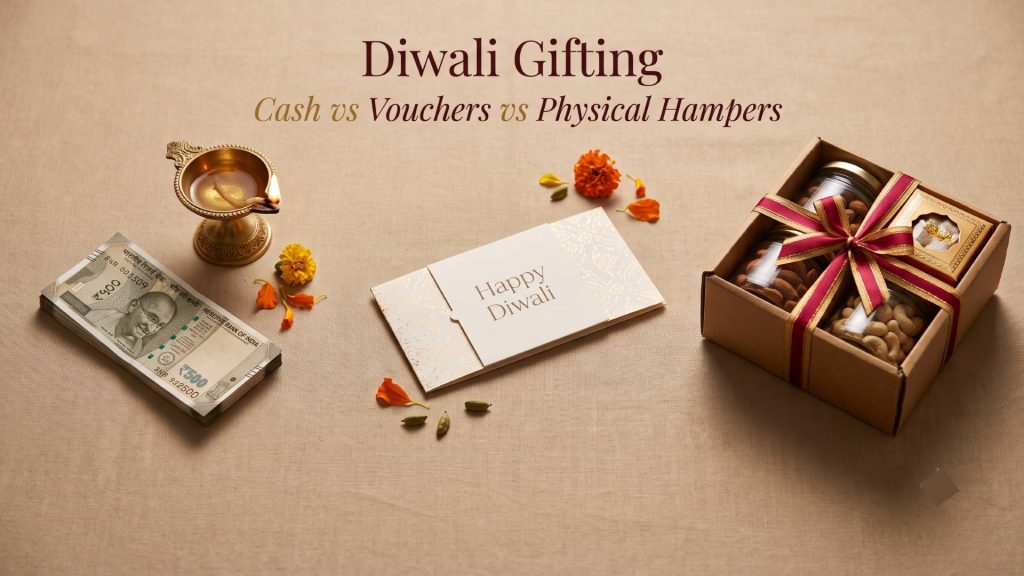
Key Takeaways
- Cash is the most flexible, but it is taxed as salary, has low emotional impact and is inappropriate for clients and vendors.
- Gift vouchers offer choice and are easy to send to remote teams. Together with other employer gifts, they are generally tax-free for employees up to Rs. 15,000 a year from tax year 2026-27.
- Physical hampers deliver the strongest festive experience and brand visibility, and are the safest choice for clients and vendors.
- A Rs. 3,000 cash gift can leave an employee in the 30 percent tax slab with about Rs. 2,064, while a Rs. 3,000 voucher or hamper is received at full value.
- A hybrid approach, such as a hamper plus a voucher, often gives the best balance of choice and memorability.
- A statutory bonus, where applicable, is a legal obligation and is separate from your Diwali gift.
First, Separate the Diwali Bonus From the Diwali Gift
Many companies mix these up, which leads to confused decisions.- Statutory bonus: For eligible employees, a bonus may be a legal obligation, not a gift. It is now governed by the Code on Wages, 2019, which replaced the Payment of Bonus Act, 1965, and generally ranges from 8.33 percent to 20 percent of eligible wages. Many companies pay it around Diwali, but it is part of compensation. Check eligibility with your payroll or legal team.
- Discretionary Diwali bonus: An extra cash payment you choose to make. It is taxed as salary.
- Diwali gift: A hamper, voucher or product given to celebrate the festival and say thank you.
Option 1: Cash Gifts on Diwali
Cash includes a bank transfer, a “Diwali gift” line in payroll, or an envelope of currency notes.Pros of cash
- Maximum flexibility. Employees can use it for festival shopping, EMIs, travel home or savings.
- Zero logistics. No packaging, couriers or address collection.
- Highly valued by frontline, factory and lower-income employees, for whom the festive season brings real expenses.
- Fast. It can be processed in the next payroll run.
Cons of cash
- Taxed as salary. Cash does not qualify for the gift exemption. An employee in the 30 percent slab loses close to a third of it to tax.
- Low recall. Cash merges with salary and is often forgotten within weeks.
- No brand or festive feel. There is nothing to unbox, share or display at home.
- Can feel transactional, especially for small amounts like Rs. 1,000 to Rs. 2,000.
- Not appropriate for clients or vendors. Cash to an external party can breach anti-bribery laws and client gift policies, and creates audit risk.
When cash makes sense
- Frontline, factory, warehouse, delivery and support teams where immediate financial value matters most.
- As a separate bonus alongside a smaller physical gift.
- When the amount is large enough to feel meaningful.
Option 2: Gift Vouchers and Gift Cards
These include e-gift cards from Amazon, Flipkart, Myntra, Tanishq and Croma, multi-brand vouchers, and “pick your gift” catalogue platforms.Pros of gift vouchers
- Choice. Employees pick what they actually want, which suits diverse and multi-generational teams.
- Tax efficient. From tax year 2026-27, gifts, vouchers and tokens given by an employer are generally tax-free for the employee if the annual total does not exceed Rs. 15,000. The earlier limit was Rs. 5,000.
- Easy for remote and distributed teams. Delivered by email or SMS to employees anywhere in India.
- Fast to deploy. Even a last-minute order can be sent within a day or two.
- Easy to tier. Different values for different groups can be sent without anyone seeing a visible difference.
Cons of gift vouchers
- Low emotional impact. A code in an inbox rarely feels like a festive celebration.
- No brand visibility. Nothing carries your logo into the employee’s home.
- Expiry and unused balances. Some vouchers expire within 6 to 12 months, and a share always goes unredeemed. Ask your provider about validity and redemption rates.
- Single-brand vouchers can disappoint. A fashion voucher means little to someone who wants electronics.
- Often not suitable for clients. Many corporate and MNC gift policies treat vouchers as cash equivalents and do not allow employees to accept them.
- The Rs. 15,000 limit is annual and acts as a cliff. If the total value of employer gifts in the year crosses Rs. 15,000, the full value can become taxable, not just the excess. Track birthday, anniversary and festival gifts together.
When vouchers make sense
- Large, distributed or fully remote workforces.
- Teams with very diverse preferences.
- Late decisions where there is no time for physical gifts.
- As an add-on to a smaller hamper. See our guide to corporate Diwali gift card ideas.
Option 3: Physical Diwali Hampers
These include curated boxes of dry fruits, mithai, diyas, candles, gourmet treats, festive decor, and branded keepsakes such as bottles, mugs or brass items.Pros of hampers
- Strongest festive feel. Unboxing a beautiful hamper at home, with family, is what Diwali gifting is about.
- High recall and brand visibility. A branded bottle, diary or brass diya stays in the home for months or years.
- Shareable. Hampers are often opened with family, which extends the goodwill beyond the employee.
- Tax efficient for employees. Hampers count towards the same annual Rs. 15,000 gift limit as vouchers.
- Best for clients and vendors. A tasteful hamper is the accepted business gift for Diwali in India, and perishables like sweets and dry fruits often fit even strict gift policies.
- Fully customisable with your logo, colours and a personal message.
Cons of hampers
- Logistics. Address collection, packing, courier and delivery tracking take planning, especially across many cities.
- Lead time. Customised hampers need 1 to 4 weeks, depending on branding. Read our guide on the branded corporate gift set for Diwali for ideas.
- Less personal choice. A hamper may include items some recipients do not use. Good curation and dietary options reduce this.
- Delivery costs of roughly Rs. 100 to Rs. 300 per box for doorstep delivery across India.
When hampers make sense
- Clients, channel partners and vendors (almost always).
- Office-based or hybrid teams where gifts can be handed out together.
- Companies that want brand visibility and a shared festive moment.
Cash vs Gift Vouchers vs Hampers: Side-by-Side Comparison
| Factor | Cash | Gift Vouchers | Physical Hampers |
| Flexibility for recipient | Highest | High | Medium |
| Emotional and festive impact | Low | Low to medium | High |
| Brand visibility | None | None | High |
| Tax for employees (2026-27) | Taxed as salary | Generally tax-free up to Rs. 15,000 a year in total | Generally tax-free up to Rs. 15,000 a year in total |
| Suitable for clients | No | Often restricted | Yes |
| Suitable for vendors | No | Sometimes | Yes |
| Logistics effort | None | Low | Medium to high |
| Lead time | 1 to 3 days | 1 to 3 days | 1 to 4 weeks |
| Works for remote teams | Yes | Yes | Yes, with doorstep delivery |
| Recall after 3 months | Low | Low | High |
The Real Value per Rupee: A Tax Comparison
Here is what an employee in the 30 percent tax slab actually receives from a Rs. 3,000 Diwali gift, assuming their total employer gifts for the year stay within Rs. 15,000:| Format | Company Spend | Tax for Employee | Value Received |
| Cash | Rs. 3,000 | About Rs. 936 (30% plus 4% cess) | About Rs. 2,064 |
| Gift voucher | Rs. 3,000 | Nil | Rs. 3,000 |
| Physical hamper | Rs. 3,000 | Nil | Rs. 3,000 worth of products, plus the festive experience |
What Should You Give Each Audience?
Employees
There is no single right answer. Choose by workforce type:| Workforce Type | Best Format | Why |
| Office-based or hybrid teams in metros | Branded hamper, or hamper plus voucher | Shared festive moment, brand recall |
| Fully remote or spread across many cities | Gift voucher, or hamper with doorstep delivery | Easy delivery, choice |
| Frontline, factory, warehouse and field staff | Cash bonus plus a sweet or dry fruit box | Financial value matters, gift adds festive feel |
| Leadership and senior managers | Premium hamper or curated luxury gift | Personal, high-quality, memorable |
| Interns, contract and support staff | Sweet box or small hamper | Inclusive and appreciated |
Clients
- Give a physical hamper. It is the accepted standard for Diwali business gifting in India.
- Avoid cash completely. It can be treated as a bribe and may breach the Prevention of Corruption Act and client codes of conduct.
- Be careful with vouchers. Many MNCs, banks and PSUs ban employees from accepting vouchers or anything cash-like.
- Prefer perishables for strict policies. Sweets, dry fruits and gourmet items are acceptable to most clients.
- Tier your clients. Key accounts deserve a premium, personalised hamper. Explore our Luxury and CXO gifting range.
Vendors and partners
- Give a hamper or a large sweet and dry fruit box for the team. Typical spend is Rs. 750 to Rs. 3,000.
- Never give cash. It raises questions about procurement fairness.
- Treat dealers and distributors like clients. Premium hampers work well and strengthen festive-season sales.
The Hybrid Approach: Why Many Companies Now Combine Formats
More Indian companies are combining formats instead of choosing one:- Hamper plus voucher: A Rs. 1,500 branded hamper for the festive moment, plus a Rs. 1,500 voucher for choice.
- Cash bonus plus sweet box: Popular in manufacturing and frontline businesses. The bonus gives financial value and the box gives the festive touch.
- Pick-your-hamper catalogue: Employees choose from three or four curated hampers within the same budget. This gives choice and keeps the physical, branded experience.
- Hamper for office teams, voucher for remote teams: Same rupee value, delivered in the format that fits each group.
Hidden Costs and Risks of Each Option
| Option | Hidden Costs or Risks |
| Cash | Employee tax deduction, payroll processing, low perceived value, compliance risk if given to outsiders |
| Gift vouchers | Expiry, unused balances, platform or service fees, limited brand choice, client policy restrictions |
| Physical hampers | Packaging and branding costs, delivery charges, address collection, damage in transit, lead time |
A Simple Decision Framework
Ask these five questions:- Who is the recipient? Clients and vendors: hamper. Employees: go to question 2.
- Where do they work? Mostly office or hybrid: hamper. Highly distributed: voucher or doorstep hamper.
- What matters most to them? Financial need: cash bonus plus small gift. Recognition and festive feel: hamper. Choice: voucher or catalogue.
- How much time do you have? Under one week: voucher or ready hamper. Three weeks or more: customised branded hamper.
- Do you want brand recall? Yes: branded hamper. No: voucher or cash.
Timeline for Diwali 2026
With Diwali on 8 November 2026:- Customised branded hampers: Approve designs by mid to late October.
- Ready-made hampers with branded cards: Order by the last week of October.
- Doorstep delivery across cities: Dispatch by 1 November. See our guide to multi-location corporate gifts.
- Vouchers: Can be sent up to a day or two before Diwali, though earlier is better.
- Cash: Plan for the October or early November payroll run.
How RidgeGap Can Help
RidgeGap Solutions is a Bengaluru-based corporate gifting company with 10 years of experience, 300+ corporate clients and 20,000+ packages delivered across India. Whether you choose hampers or a hybrid model, we handle the full process:- Curated Corporate Diwali Gifts in price bands from Rs. 500 to Rs. 7,000.
- Curated gift boxes with your logo, custom sleeves and personalised notes.
- Sustainable and eco-friendly gifting options.
- Separate tiers for employees, clients and vendors from a single order.
- Samples before bulk orders, pan-India doorstep delivery and tracking.
- One GST invoice and a clear cost breakdown for finance.
Frequently Asked Questions (FAQs)
1. Is it better to give cash or a gift to employees on Diwali?
It depends on your workforce. Cash is valued for financial flexibility, especially by frontline and lower-income employees, but it is taxed as salary and quickly forgotten. Hampers and vouchers are generally tax-free up to Rs. 15,000 a year in total and feel more like a gift. Many companies give a cash bonus plus a small hamper.2. Are Diwali gift vouchers taxable for employees in 2026?
From tax year 2026-27, gifts, vouchers and tokens from an employer are generally tax-free for the employee if the total value in the tax year does not exceed Rs. 15,000. If the total crosses this limit, the full amount may become taxable. Cash is always taxed as salary. Confirm with your CA.3. Is a Diwali hamper taxable for employees?
A hamper is treated like other employer gifts. It is generally tax-free if the total value of all gifts and vouchers from the employer in the tax year stays within Rs. 15,000.4. Can we give cash or gift vouchers to clients on Diwali?
Cash should never be given to clients, as it can be treated as a bribe and breach anti-corruption laws and client policies. Many companies also do not allow their employees to accept vouchers. A physical hamper, especially with sweets or dry fruits, is the safest and most accepted option.5. Is the Diwali bonus mandatory in India?
A statutory bonus may be mandatory for eligible employees, generally between 8.33 percent and 20 percent of eligible wages, under the Code on Wages, 2019. A discretionary Diwali bonus or gift is not mandatory. Check eligibility with your payroll or legal advisor.6. What is the right value for a Diwali gift voucher for employees?
Most Indian companies give vouchers between Rs. 1,000 and Rs. 3,000 per employee, with higher values for leadership. Keep the annual total of all employer gifts within Rs. 15,000 to retain the tax benefit.7. What do employees prefer: gift vouchers or hampers?
Preferences vary. Employees who value choice tend to prefer vouchers, while those who value the festive experience and family sharing prefer hampers. A pick-your-hamper catalogue or a hamper plus voucher combination satisfies both groups.8. What are the disadvantages of gift vouchers?
Vouchers can expire, may go unused, carry no brand visibility and often feel impersonal. Single-brand vouchers may not suit everyone. Choose multi-brand vouchers with long validity.9. How early should we order Diwali hampers for 2026?
For customised branded hampers, order 3 to 4 weeks before Diwali on 8 November 2026. Ready-made hampers with a branded card can be arranged within about a week, subject to stock.Final Word
There is no single winner between cash, gift vouchers and physical hampers. Cash is flexible but taxed and forgettable. Vouchers offer choice and tax efficiency but little festive feel. Hampers create the strongest connection and brand recall, and remain the right choice for clients and vendors. For most Indian companies, the best answer for Diwali 2026 is a thoughtfully curated hamper, combined with a voucher or bonus where your team needs flexibility. Talk to the RidgeGap team for a free quote and Diwali hamper options matched to your budget and timeline. Contact RidgeGap: Call (+91) 82968 13621 or (+91) 97391 40044, or visit ridgegap.com/contact-usResources and Further Reading
- Corporate Diwali Gifts by RidgeGap
- Curated Gift Boxes
- Luxury and CXO Gifting
- Sustainable and Eco-Friendly Gifting
- Corporate Diwali Gift Card Ideas: Employee Gift Guide 2026
- Branded Corporate Gift Set for Diwali: Best 2026 Ideas
- Diwali Gifting Etiquette for MNCs Operating in India
- Diwali Gifts for Startups: Best Ideas for 20-50 Employees
- Multi-Location Corporate Gifts: The Complete Indian Guide
- What Happens When Diwali Gifting Goes Wrong
MOQ for Customised Diwali Gift Boxes: Bulk Order Guide
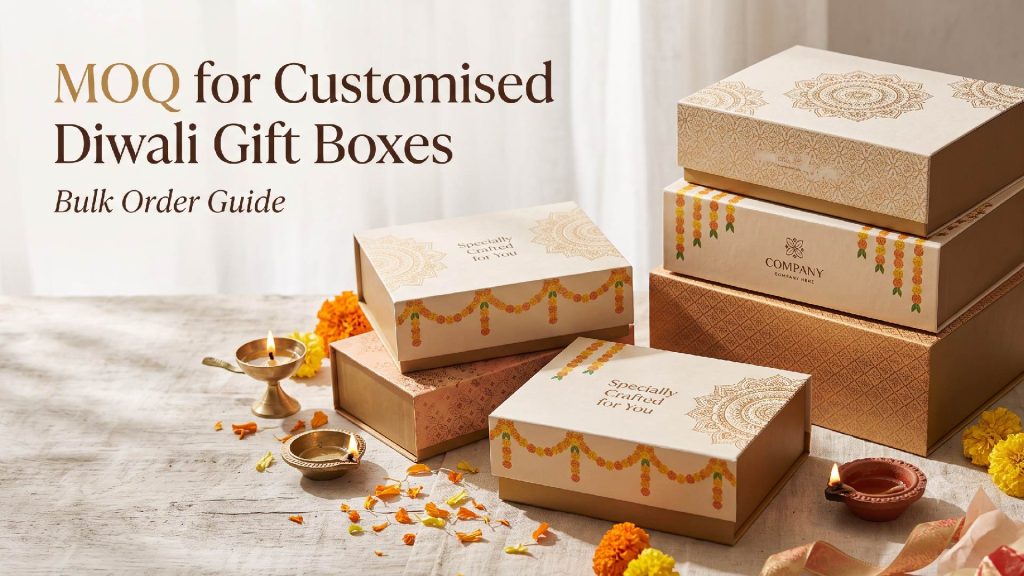
Key Takeaways
- MOQ depends on how much you customise, not just on the gift box itself.
- Logo stickers, sleeves and printed greeting cards: MOQ of roughly 10 to 50 boxes.
- Branded products inside the box (printing, engraving): MOQ of roughly 25 to 100 units per item.
- Fully custom-printed rigid boxes (your size, foil, embossing): MOQ of roughly 300 to 1,000 pieces.
- Per-box price drops as quantity rises because fixed setup costs (plates, dies, screens, sampling) are spread across more boxes.
- For Diwali 2026, finalise designs at least 3 to 4 weeks before 8 November for anything beyond basic branding.
What Does MOQ Mean in Diwali Corporate Gifting?
Minimum order quantity (MOQ) is the smallest number of units a gifting partner or manufacturer will produce for a customised order. In Diwali gifting, MOQ can apply at three different levels:- The hamper level: how many complete gift boxes you must order.
- The product level: how many units of a branded item (mug, bottle, diary, t-shirt) must be printed.
- The packaging level: how many custom boxes, sleeves or bags must be manufactured.
Why Do Suppliers Set an MOQ for Customised Gift Boxes?
MOQ is not a sales trick. It exists because customisation has fixed costs that do not change whether you order 20 boxes or 2,000.- Setup costs: printing plates, screen-printing screens, cutting dies for custom box shapes, foil blocks and laser engraving files are made once per design.
- Sampling and approvals: every custom job needs a digital mock-up and often a physical sample before bulk production.
- Machine changeover: offset printers and box-making machines must be stopped, cleaned and reset for every new job.
- Raw material lots: paper board, rigid box greyboard, fabrics and ribbons are bought in fixed lot sizes.
- Festive capacity: during Diwali, printing units in India run at full capacity, so small jobs are often deprioritised or priced higher.
How setup cost affects your per-box price (illustrative example)
Assume a one-time setup cost of Rs. 6,000 for a custom logo sleeve (design, plate and cutting):| Order Quantity | Setup Cost Added per Box |
| 25 boxes | Rs. 240 per box |
| 50 boxes | Rs. 120 per box |
| 100 boxes | Rs. 60 per box |
| 250 boxes | Rs. 24 per box |
| 500 boxes | Rs. 12 per box |
MOQ for Customised Diwali Gift Boxes by Customisation Level
This is the section most buyers need. These ranges reflect typical practice across Indian corporate gifting partners, print platforms and packaging manufacturers. Exact numbers vary by vendor, product and season.| Customisation Level | What You Get | Typical MOQ | Price per Box (excl. GST) | Lead Time |
| Level 1: Ready hamper + branded card | Pre-curated hamper, your logo on a greeting card or tag | 10 to 25 boxes | Rs. 500 to Rs. 2,000 | 3 to 5 working days |
| Level 2: Logo sleeve, sticker or belly band | Standard box with your brand colours and logo outside | 25 to 50 boxes | Rs. 750 to Rs. 2,500 | 5 to 7 working days |
| Level 3: Branded products inside | Printed mugs, engraved bottles, logo diaries, branded apparel | 25 to 100 units per item | Rs. 1,000 to Rs. 4,000 | 7 to 12 working days |
| Level 4: Custom-printed rigid box | Your size, full print, foil, emboss, magnetic closure | 300 to 1,000 boxes | Rs. 2,000 to Rs. 7,000+ | 15 to 25 working days |
| Level 5: Fully bespoke kit | Custom-made products plus custom packaging and inserts | 250 to 1,000+ kits | Rs. 3,000 to Rs. 15,000+ | 4 to 6 weeks |
Level 1: Ready-made hampers with a branded card (lowest MOQ)
Best for startups, small teams and last-minute orders. You choose from pre-curated Diwali hampers (dry fruits, mithai, diyas, candles, chocolates) and add a printed greeting card with your logo and message.- MOQ: often as low as 10 boxes with online print platforms; 20 to 25 boxes with most corporate gifting partners.
- Best for: teams of 10 to 50, client thank-you boxes, branch-level gifting.
Level 2: Logo sleeves, stickers and belly bands
This is the sweet spot for most Indian companies. The box itself is standard, but a printed sleeve, sticker seal or ribbon tag in your brand colours makes it look fully branded.- MOQ: usually around 50 boxes. Several well-known mithai and gourmet brands use 50 hampers as their cut-off for custom sleeves and stickers.
- Best for: employee Diwali gifting for 50 to 300 people.
Level 3: Branded products inside the box
Here the branding sits on products people keep, such as insulated bottles, coffee mugs, notebooks, desk organisers, tote bags or t-shirts.- Laser engraving (steel bottles, pens, wooden items): MOQ can be as low as 25 units because there is almost no setup.
- Screen printing and pad printing (mugs, bags, apparel): MOQ is usually 50 to 100 units per design.
- Sublimation and UV printing: MOQ of 25 to 50 units for most items.
- Best for: brands that want visibility long after the sweets are finished.
Level 4: Custom-printed rigid gift boxes
If you want a box made to your exact size, with full-colour printing, gold foil, embossing and a magnetic flap, you are ordering from a packaging manufacturer. Listings from Indian packaging makers commonly show MOQs between 500 and 1,000 pieces for printed rigid and duplex gift boxes, with some going down to 300.- Best for: large enterprises, CXO and client gifting programmes, and brands with 500+ recipients.
- Watch out for: lead times. Rigid boxes need board cutting, wrapping, printing and drying. Start at least 4 weeks before Diwali.
Level 5: Fully bespoke, made-from-scratch kits
Think custom-made brass diyas with your logo, co-branded artisan products, or a bespoke wooden box with a custom insert. These are special and custom-made projects with the highest MOQs and longest timelines, but also the most memorable results.Diwali Gift Box Price Guide in India (2026)
Here is what companies across Bengaluru, Mumbai, Delhi NCR, Hyderabad, Pune and Chennai typically spend per box this Diwali season:| Budget Tier | Price per Box | Typical Contents | Ideal For |
| Budget | Rs. 500 to Rs. 1,000 | Dry fruits, diyas, mithai, branded card | Large employee teams, interns, vendors |
| Mid-range | Rs. 1,000 to Rs. 2,000 | Gourmet treats, branded bottle or mug, candle set | Most employee gifting programmes |
| Premium | Rs. 2,000 to Rs. 4,000 | Premium dry fruits, brass or silver-plated decor, tech accessory | Managers, key accounts, channel partners |
| Luxury / CXO | Rs. 4,000 to Rs. 7,000+ | Luxury brand items, premium packaging, curated keepsakes | CXOs, top clients, board members |
What drives the final price of a customised Diwali box?
- Box type: a mono-carton is far cheaper than a rigid magnetic box.
- Printing method: foil and embossing cost more than a simple digital print.
- Contents: branded products, premium dry fruits and brass decor add more than mithai alone.
- Quantity: crossing the next MOQ slab often reduces per-unit cost by 10 to 25 percent.
- Delivery: one office drop is cheaper than individual doorstep delivery to remote employees.
- Taxes: most B2B quotes are exclusive of GST. Ask for a GST invoice. Note that input tax credit on goods given as free gifts is generally restricted, so check the treatment with your CA before budgeting.
Low MOQ vs High MOQ: Which One Is Right for You?
| Factor | Low MOQ (10 to 50 boxes) | High MOQ (300+ boxes) |
| Per-box cost | Higher | Lower |
| Branding depth | Card, sticker, sleeve | Fully custom box and products |
| Lead time | 3 to 7 days | 2 to 6 weeks |
| Design flexibility | Limited | Complete |
| Best for | Startups, SMEs, branches | Large enterprises, MNCs |
Smart Ways to Get Premium Branding With a Small Order
If your team is below the MOQ for a fully custom box, these approaches work well:- Use a standard premium box plus a custom sleeve. You get about 80 percent of the visual impact at a fraction of the MOQ.
- Brand one hero product, not everything. A laser-engraved steel bottle or brass diya carries your logo for years.
- Combine employee and client orders. Ordering 40 employee boxes and 20 client boxes in the same design can push you over a 50-box MOQ.
- Pool orders across offices. If you have teams in Bengaluru and Pune, one consolidated order unlocks better MOQs and pricing. Our guide to multi-location corporate gifts explains how this works.
- Keep the same box design, vary the contents. Use one branded box for everyone and change the inside by tier (employee, manager, client).
- Order a few extras. Add 5 to 10 percent buffer for late joiners, damaged deliveries and last-minute client additions. Re-ordering a small custom batch in Diwali week is costly and slow.
Diwali 2026 Ordering Timeline: When Should You Place Your Order?
Diwali falls on 8 November 2026, with Dhanteras two days earlier. Here is a practical countdown for customised orders:- 5 to 6 weeks before (late September to early October): Finalise budget, headcount and recipient list. Shortlist hampers.
- 4 weeks before (around 10 October): Approve designs for custom-printed boxes and branded products. This is the last safe window for Level 4 and Level 5 customisation.
- 3 weeks before (around 17 October): Approve samples and confirm final quantities. Freeze addresses for doorstep delivery.
- 2 weeks before (around 24 October): Production and packing for Level 2 and Level 3 orders.
- 7 to 10 days before (by 1 November): Dispatch for pan-India and multi-city delivery.
- Diwali week: Only ready-made hampers with minimal branding are realistic.
Questions to Ask Your Gifting Partner About MOQ
Before you sign off a quote, ask these:- Is the MOQ per hamper, per product or per design?
- Can I split the MOQ across two or three hamper variants?
- What is the price at the next quantity slab?
- Is setup or design cost included in the per-box price?
- Can I see a physical sample before bulk production?
- Are prices inclusive or exclusive of GST and delivery?
- Do you deliver to individual employee addresses and multiple cities?
- What happens if a box is damaged or a delivery fails?
Customised Diwali Gift Boxes for Different Audiences
For employees
Practical, festive and inclusive. Think dry fruits, diyas, a branded insulated bottle and a personal note from leadership. Budget: Rs. 750 to Rs. 2,000 per box. Startups with 20 to 50 people can see our Diwali gifts for startups guide for ideas sized to small teams.For clients and channel partners
Elegant packaging matters more here. A rigid box with foil branding, premium dry fruits and a keepsake (brass urli, silver-plated diya, artisanal candle) works well. Budget: Rs. 2,000 to Rs. 5,000. For more ideas, see our branded corporate gift set for Diwali guide.For CXOs and top accounts
Limited quantities, maximum personalisation. Name engraving, luxury brand products and handwritten notes. Explore our Luxury and CXO gifting solutions.For sustainability-focused companies
Jute or cotton bags, seed-paper cards, plantable diyas, organic treats and plastic-free packaging. See our sustainable and eco-friendly gifting range, or explore Diwali custom gifting bags as a reusable alternative to boxes.How RidgeGap Handles MOQ for Diwali Gift Boxes
RidgeGap Solutions is a Bengaluru-based corporate gifting company with 10 years of experience, 300+ corporate clients and 20,000+ packages delivered across India. For Diwali, we work with companies of every size, from 20-person startups to large enterprises, and structure MOQs around what you actually need:- Flexible MOQs based on customisation level, not a one-size-fits-all number.
- Curated Diwali catalogues in clear price bands: Rs. 500 to 1,000, Rs. 1,000 to 2,000, Rs. 2,000 to 4,000 and Rs. 4,000 to 7,000.
- Logo branding, custom sleeves, personalised notes and branded packaging.
- Samples before bulk orders, so you can check quality first.
- Pan-India doorstep delivery and multi-office dispatch with tracking.
- An in-house team for sourcing, customisation, packing and shipping.
Frequently Asked Questions (FAQs)
1. What is the minimum order quantity for customised Diwali gift boxes in India?
Most Indian gifting partners accept 10 to 50 boxes for hampers branded with a card, sticker or sleeve. Branded products inside the box usually need 25 to 100 units per item. Fully custom-printed rigid boxes typically need 300 to 1,000 pieces.2. Can I order customised Diwali gift boxes in small quantities, like 10 or 20?
Yes. At small quantities, customisation is usually limited to a branded greeting card, logo sticker or name tag on a ready-made hamper. Laser engraving on bottles or pens is also possible at low quantities because setup cost is minimal.3. What is the price of a customised Diwali gift box per piece?
Customised Diwali gift boxes in India typically cost Rs. 500 to Rs. 1,000 for budget hampers, Rs. 1,000 to Rs. 2,000 for mid-range, Rs. 2,000 to Rs. 4,000 for premium and Rs. 4,000 to Rs. 7,000+ for luxury or CXO gifting. Prices are usually exclusive of GST and delivery.4. Does ordering more boxes reduce the price per box?
Yes. Setup costs such as printing plates, dies and design work are fixed, so they are spread across more boxes in larger orders. Moving up to the next quantity slab often reduces per-box cost by 10 to 25 percent.5. How early should I order customised Diwali gift boxes for Diwali 2026?
For fully custom-printed boxes, approve designs by early October. For logo sleeves and branded products, order at least 2 to 3 weeks before 8 November 2026. Ready-made hampers with branded cards can be arranged within 3 to 5 working days, subject to stock.6. Can I split the MOQ across different hamper types?
Many gifting partners allow this, especially when the outer box or sleeve design stays the same. For example, 60 employee boxes and 20 client boxes in one branded design can be treated as a single 80-box order. Always confirm with your vendor.7. Can customised Diwali gift boxes be delivered to multiple cities?
Yes. Corporate gifting partners like RidgeGap offer pan-India delivery to offices and individual employee homes across cities such as Bengaluru, Mumbai, Delhi NCR, Hyderabad, Pune and Chennai, with tracking for each shipment.8. Is GST charged on corporate Diwali gift boxes?
Yes. GST applies to gift boxes and their contents at rates that depend on the items inside. Ask your vendor for a proper GST invoice. Input tax credit on goods given away as gifts is generally restricted, so confirm the treatment with your chartered accountant.9. Can I get a sample before placing a bulk Diwali order?
Most reputable gifting partners provide a sample or a sampler box before bulk production. RidgeGap offers samples so you can check quality, branding and packaging before confirming.Final Word
The MOQ for customised Diwali gift boxes depends on how much you customise. A few logo sleeves on curated hampers can start from small quantities. A fully bespoke printed rigid box needs hundreds of pieces and several weeks. Decide your branding level first, then match it to the right MOQ, budget and timeline. With Diwali 2026 just weeks away, the best time to lock your order is now. Talk to the RidgeGap team for a free quote, a curated catalogue in your budget, and a delivery plan that gets every box to your people before the lamps are lit. Contact RidgeGap: Call (+91) 82968 13621 or (+91) 97391 40044, or visit ridgegap.com/contact-usResources and Further Reading
- Corporate Diwali Gifts by RidgeGap
- Curated Gift Boxes
- Luxury and CXO Gifting
- Sustainable and Eco-Friendly Gifting
- Special and Custom-Made Projects
- Branded Corporate Gift Set for Diwali: Best 2026 Ideas
- Diwali Gifting RFQ Template: Corporate Buying Guide 2026
- Multi-Location Corporate Gifts: The Complete Indian Guide
- Diwali Gifts for Startups: Best Ideas for 20-50 Employees
- Diwali Custom Gifting Bags Ideas: Corporates Guide with Pricing
- What Happens When Diwali Gifting Goes Wrong
Diwali Gifts for Startups: Best Ideas for 20–50 Employees
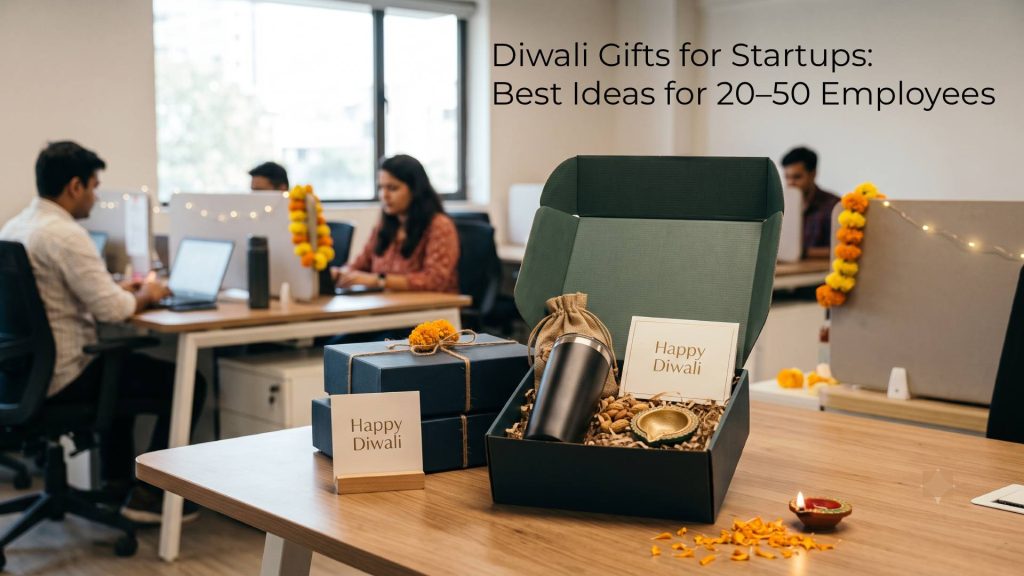
Table of Contents
- Why Diwali gifting matters more for startups
- How much should a startup spend per employee?
- Total budget math for 20, 30 and 50 employees
- Best Diwali gifts for startups by budget
- Gifts for founders, interns and leadership
- Gifts for remote and multi-city teams
- Inclusive gifting for diverse teams
- What to avoid
- Tax and GST basics for Diwali gifts
- Order timeline for Diwali 2026
- How to choose a corporate gifting vendor
- Quick picks
- FAQs
- Resources
Why Diwali Gifting Matters More for Startups
Diwali is the biggest gifting season in India. For a startup, it is also a cheap and powerful retention tool.- Small teams feel gifts personally. In a 30-person company, the founder is often known to everyone. A thoughtful gift reflects directly on you.
- It signals stability. Even a modest hamper tells employees the company is doing well enough to say thank you.
- It supports hiring and retention. Employees compare how startups treat people. A well-presented gift gets shared on LinkedIn and Instagram, which also helps your employer brand.
- It costs far less than attrition. Replacing one employee often costs several months of salary. A Rs. 1,500 gift is a small price for goodwill.
- It builds culture early. Rituals formed at 30 employees tend to last at 300.
How Much Should a Startup Spend per Employee?
There is no fixed rule, but these ranges are common in India for small and growing teams:- Rs. 500 to Rs. 800: Bootstrapped or very early-stage teams. A small sweets box with a diya set or a branded notebook.
- Rs. 800 to Rs. 1,500: The most common range. A curated hamper with dry fruits, sweets and one keepsake.
- Rs. 1,500 to Rs. 3,000: Funded startups and high-retention teams. Premium hampers or a useful gadget with gourmet items.
- Rs. 3,000 to Rs. 5,000+: Founders’ circle, senior leaders, or top performers.
Total Budget Math for 20, 30 and 50 Employees
Most articles quote only per-head prices. Founders need the total number. Here is an indicative breakdown using a Rs. 1,200 base gift:- Product cost per hamper: Rs. 1,200
- Branding (logo print, custom card, ribbon): about Rs. 100 to Rs. 200
- Premium packaging: about Rs. 80 to Rs. 150
- Delivery within one city: about Rs. 60 to Rs. 150 per parcel
- GST: commonly 5% to 18% depending on the items in the hamper
- 20 employees: about Rs. 30,000 to Rs. 38,000
- 30 employees: about Rs. 45,000 to Rs. 56,000
- 50 employees: about Rs. 75,000 to Rs. 95,000
Best Diwali Gifts for Startups by Budget
Diwali Gifts Under Rs. 1,000
Ideal for early-stage teams that want to look thoughtful without stretching cash.- Dry fruit and sweet box (Rs. 500 to Rs. 900): A classic that nearly everyone accepts. Choose sealed, branded packaging for a premium look.
- Branded diya and candle set (Rs. 400 to Rs. 800): Festive, light and easy to ship.
- Plantable or potted desk plants (Rs. 300 to Rs. 700): Low-cost, eco-friendly and long-lasting. A good fit for design-led and sustainability-focused startups.
- Custom notebook and pen combo (Rs. 350 to Rs. 800): Useful for office and WFH desks, with logo and a handwritten-style message.
- Festive snack hamper (Rs. 600 to Rs. 900): Good for younger teams who prefer savoury and modern snacks.
Diwali Gifts from Rs. 1,000 to Rs. 2,000
The sweet spot for most startups with 20 to 50 employees.- Curated Diwali hamper (Rs. 1,000 to Rs. 2,000): Dry fruits, chocolates, a diya set and a keepsake in a reusable box. Explore our curated gift boxes for ready-to-brand options.
- Insulated steel bottle or flask with logo (Rs. 800 to Rs. 1,500): Used daily, so your brand stays visible.
- Ceramic or copper drinkware set (Rs. 1,000 to Rs. 1,800): Feels premium and fits festive hosting.
- Desk organiser and wellness kit (Rs. 1,200 to Rs. 2,000): Practical for hybrid teams. Our swag packs bundle several useful items in one branded kit.
- Eco-friendly gift box (Rs. 1,000 to Rs. 1,800): Jute, bamboo, recycled paper and seed cards. See our sustainable and eco-friendly gifting range.
Diwali Gifts from Rs. 2,000 to Rs. 3,500
Best for funded startups or when rewarding a strong year.- Gourmet hamper with premium dry fruits (Rs. 2,000 to Rs. 3,500)
- Wireless earbuds, power bank or charger combos (Rs. 1,800 to Rs. 3,500): Popular with tech teams. Choose reputable brands and check warranty terms.
- Backpack or laptop sleeve (Rs. 1,800 to Rs. 3,000): Useful for commuters and often kept for years. Browse corporate laptop bags and custom backpacks and read our guide to Diwali custom gifting bags with pricing.
- Premium home decor, such as brass lamps (Rs. 2,000 to Rs. 3,500): Culturally relevant and well suited to Lakshmi Puja.
Diwali Gifts for Rs. 3,500 to Rs. 5,000 and Above
Typically for founders’ circles, senior leaders, key clients or exceptional performers.- Luxury hampers with silver-plated coins or idols
- Smartwatches or premium audio gear
- Personalised leather accessories
- Experience gifts, such as a spa session or weekend stay vouchers (check tax treatment first)
Gifts for Founders, Interns and Leadership
Small teams often include interns, freelancers and senior hires. Handle each group simply:- Interns and trainees: Give a smaller version of the main hamper so no one is left out. Skipping them often creates quiet resentment.
- Freelancers and long-term contractors: A modest sweets box with a personal note goes a long way.
- Senior leaders: A slightly premium version of the same gift looks cohesive. A completely different gift can look like favouritism.
- Founders: Write a short personal note. A handwritten card is often what employees remember most.
Gifts for Remote and Multi-City Teams
Many Indian startups run hybrid teams across Bengaluru, Hyderabad, Pune, Delhi NCR, Mumbai and tier-2 cities. This creates delivery headaches.- Choose gifts that ship safely. Avoid fragile glass and perishable mithai if delivery takes more than 2 to 3 days.
- Use one vendor for all cities. Consistent packaging beats a patchwork of local purchases.
- Collect addresses early. Use a short form to collect addresses and phone numbers by early October, and confirm gift preferences if you offer options.
- Allow some choice. A gift selection form with 2 to 3 options increases satisfaction, especially for larger teams.
- Plan for international staff. If you have team members abroad, confirm customs rules and shipping times before you order.
Inclusive Gifting for Diverse Teams
Not everyone celebrates Diwali, and not everyone eats the same food. Small teams can handle this well with a few simple choices:- Offer sugar-free or diabetic-friendly options. Roasted nuts, seeds and unsweetened dry fruits work well.
- Check allergens. Nuts are the most common issue, so label packs clearly.
- Consider vegetarian and vegan needs. Many Indian teams include Jain employees, who avoid certain ingredients. Ask in advance if you can.
- Avoid religious imagery as the main design. Light and festive themes work for everyone. Offer religious items as an option, not the default.
- Use a “festival of lights” message. It reads as warm and inclusive.
What to Avoid
- Cash in envelopes. It is easy to give, but it feels like salary, is taxable, and has little emotional value.
- Last-minute gifts. Panic purchases lack branding and look rushed.
- Poor quality items. A cheap gift with a visible logo can hurt your brand more than no gift.
- Alcohol. It can be inappropriate in mixed teams.
- Unequal gifts without explanation. Small teams talk, and surprises travel fast.
- Gifts with no thought. A thank-you note matters as much as the product.
Tax and GST Basics for Diwali Gifts
This is general information only. Please check with your chartered accountant before finalising your policy. Last verified: October 2026.- Gifts to employees under Rs. 50,000 in a financial year: CBIC clarified that GST is generally not payable on gifts to an employee when the value in a year does not exceed Rs. 50,000.
- Income tax on employee gifts: Gifts in kind are commonly treated as tax-free up to Rs. 5,000 per employee per year. Cash and gift vouchers are generally taxable as salary perquisites.
- Input tax credit (ITC): ITC on gifts is often restricted. Do not assume you can claim it.
- Gifts to clients: These may be claimed as business promotion expenses, subject to conditions. Keep invoices and records.
- Documentation: Keep GST invoices, the recipient list and proof of delivery.
Order Timeline for Diwali 2026
Diwali is on 8 November 2026. Work backwards from the target of delivering gifts 7 to 14 days before the festival:- Now to 12 October: Fix budget, headcount and gift theme. Request quotes from 2 to 3 vendors.
- By 15 October: Approve samples and branding files. This is the last comfortable window for customised items.
- 15 to 25 October: Production, quality checks and packing.
- By 25 to 28 October: Dispatch for multi-city deliveries.
- 1 to 5 November: Target delivery window, so gifts arrive well before Dhanteras and Lakshmi Puja.
- After Diwali: Close replacements, reconcile invoices and collect feedback for next year.
How to Choose a Corporate Gifting Vendor
For a 20 to 50 person order, ask these questions:- What is your minimum order quantity (MOQ)? Many suppliers do not work with small batches. Confirm they do.
- Can I see a sample before ordering? A sample is the best protection against quality surprises.
- What are the total costs? Ask for a quote that includes branding, packaging, delivery and GST.
- Do you handle delivery to multiple cities? Check tracking and replacement policies.
- What is your turnaround time? Ask for written timelines.
- Can you customise packaging? Logo cards and ribbons make a small order look premium.
- Do you have local presence? For Bengaluru-based teams, a local partner means faster sampling, easier pickup and quicker fixes. See our guide to Diwali gift hampers and baskets in Bangalore and our list of top corporate gift suppliers in Bangalore.
Quick Picks: Which Gift Is Right for Your Startup?
- Bootstrapped, under Rs. 1,000 per head: Dry fruit and sweet box with a logo card.
- Seed-funded, design-led team: Eco-friendly hamper with plantable items.
- Tech startup, hybrid team: Insulated bottle or power bank with a snack pack.
- Growth-stage, retention focus: Premium hamper with a personal founder note.
- Fully remote, multi-city: Lightweight, durable gift box with a choice of 2 to 3 options.
Frequently Asked Questions
- What is a good Diwali gift budget per employee for a small startup in India?
- How much will Diwali gifts cost for 50 employees?
- What are the best Diwali gifts under Rs. 1,000 for employees?
- Should startups give cash, vouchers or physical gifts on Diwali?
- Is GST applicable on Diwali gifts to employees?
- When should we order Diwali gifts for 2026?
- What is the minimum order quantity for customised Diwali gifts?
- Can we add our logo to Diwali hampers?
- How do we send gifts to employees in different cities?
- What if a gift arrives late or damaged?
- What Diwali gifts suit a diverse or mixed-religion team?
- Do we need to gift interns and contractors?
Plan Your Startup’s Diwali Gifts with Ridgegap
Ridgegap is a Bengaluru-based corporate gifting company with over 10 years of experience, 20,000+ packages delivered and a catalogue of 5,000+ products. We help small and growing teams with curated gift boxes, branding, packaging and pan-India delivery.- Diwali corporate gifts for festive hampers and boxes
- Curated gift boxes for ready-to-ship premium options
- Swag packs for useful branded kits
- New joiner kits for new hires
- Browse all products
- Get a quote or book a call
Resources and Further Reading
- Incredible India (Ministry of Tourism): Diwali 2026 date and festival overview
- CBIC (Central Board of Indirect Taxes and Customs): GST guidance on gifts to employees
- Income Tax Department of India: perquisite rules for gifts
- Related Ridgegap reading:
Multi-Location Corporate Gifts: The Complete Indian Guide

What Is Multi-Location Corporate Gifting?
Multi-location corporate gifting is the process of sourcing, customising and delivering the same (or an equivalent) corporate gift to recipients spread across more than one city, office, or address, while keeping the branding, quality and delivery timeline consistent everywhere. It covers three common scenarios that Indian companies deal with:- Multi-office gifting – a company with branch offices in cities such as Bengaluru, Mumbai, Delhi NCR, Hyderabad, Chennai or Pune, where each office needs a bulk drop.
- Distributed or remote team gifting – individual employees working from home across tier-1, tier-2 and tier-3 cities, each needing an individual, trackable delivery.
- Multi-city client or channel partner gifting – clients, vendors or channel partners located in different regions who all need to receive gifts around the same occasion, such as Diwali or a financial year-end.
Why Multi-Location Corporate Gifting Is Becoming the Norm in India
A decade ago, most corporate gifting in India meant one warehouse, one HR office and a single delivery address. That has changed fast, and a few shifts explain why:- Hybrid and remote work is now standard. A large share of Indian companies, especially in IT, SaaS, fintech and BPO, run hybrid or fully remote teams, which means employee addresses are spread across dozens of pin codes instead of one campus.
- Companies are expanding beyond metro headquarters. Many organisations now have satellite offices or hiring hubs in tier-2 cities like Coimbatore, Jaipur, Indore, Mysuru and Kochi, in addition to their metro base.
- Client and channel networks are geographically wide. Pharma, BFSI, FMCG and manufacturing companies routinely need to gift doctors, dealers or distributors across an entire state or the whole country.
- Festive gifting volumes have grown. Diwali alone accounts for a large share of annual corporate gifting spend in India, and most of that volume now needs to reach recipients in more than one city at the same time.
Key Challenges Companies Face With Multi-Location Corporate Gifting
Before you plan anything, it helps to know exactly where multi-location programmes tend to break down.1. Collecting and Verifying Delivery Addresses
The single biggest source of failed deliveries is not logistics, it is bad data. Incomplete addresses, outdated pin codes, or employees who have relocated but never updated HR records all cause returned shipments.2. Maintaining Quality and Brand Consistency Across Cities
When gifts are packed or sourced from different regional vendors to save on delivery cost, quality starts to vary. A premium hamper that looks flawless in Bengaluru but arrives with a crushed box in a tier-3 city undermines the whole gesture.3. Pincode and Courier Coverage Gaps
Most courier networks cover metro and tier-1 cities well. Coverage thins out for tier-3 towns and rural pin codes, which means delivery timelines and reliability can differ sharply between a Mumbai office and a smaller branch location.4. Coordinating Timelines Across Regions
If gifts need to land on the same day, for example a festival or an all-hands announcement, dispatch has to be staggered by region based on transit time, not sent out on a single date for the whole country.5. Budget Control and Per-Location Cost Variance
Delivery cost per gift is not flat. Metro-to-metro shipping is cheaper than shipping to remote pin codes, and unplanned budgets often get eaten up by last-mile delivery charges that were not accounted for upfront.6. GST, Invoicing and Tax Compliance
Bulk gifting invoices, input tax credit rules, and employee-level gift taxability are frequently overlooked until finance asks for documentation after the fact. Multi-location orders often need consolidated GST invoicing even when the shipment itself is split.A 7-Step Framework to Plan Multi-Location Corporate Gifting
This is the part most guides skip. Here is a practical, repeatable process you can use for any multi-location gifting programme.- Build one centralised recipient sheet. List every recipient with name, department or office, complete address, pin code and a verified phone number. This single sheet becomes the source of truth for the entire programme.
- Segment recipients by delivery type. Split the list into “bulk to office” (one shipment, one reception point) and “individual home delivery” (each recipient gets their own tracked parcel). The two need different packing and dispatch plans.
- Lock the gift and set a per-person budget. Choose one hero product or a small set of interchangeable options so branding and quality stay identical no matter where the recipient sits.
- Confirm pincode-level courier coverage before finalising the date. Ask your vendor to check delivery timelines for every city and flag remote pin codes early, not after dispatch.
- Stagger dispatch by transit time, not by a single calendar date. Work backward from the delivery date and dispatch tier-2 and tier-3 locations a few days ahead of metro locations.
- Set up tracking and a single point of escalation. Every recipient should get a tracking link, and your team should have one dashboard or report to monitor delivery status across all cities, not city-wise spreadsheets.
- Plan for failed deliveries and replacements. Even with 99%+ delivery reliability, some parcels will bounce back. Keep 5 to 10% buffer stock so replacements do not delay the whole programme.
Multi-Location Corporate Gift Pricing in India (2026)
Pricing for multi-location gifting has two parts: the cost of the gift itself, and the added logistics cost of shipping to multiple addresses instead of one office. Here is a realistic breakdown for the Indian market.| Budget Tier | Price Per Recipient | Best Suited For |
| Economy | Rs 300 – Rs 800 | Large-scale event giveaways, promotional gifting, entry-level festive tokens |
| Mid-range | Rs 800 – Rs 2,500 | Standard employee gifting, client appreciation, festive hampers |
| Premium | Rs 2,500 – Rs 6,000 | Onboarding kits, milestone awards, mid-senior client gifting |
| Luxury / CXO | Rs 6,000 – Rs 20,000+ | Leadership gifting, top-tier client relationships, board-level occasions |
- Individual home delivery: roughly Rs 70 – Rs 150 per parcel depending on weight and pin code, compared to a flat bulk-freight cost when shipping to a single office.
- Custom branding and packaging: typically adds Rs 50 – Rs 250 per unit depending on complexity.
- Buffer stock for failed or returned deliveries: plan for 5 to 10% extra units.
How to Choose a Corporate Gifting Partner for Multi-Location Delivery
Not every vendor that says “PAN India delivery” can actually execute a multi-city programme well. Use this checklist before you sign off on a partner:- Verified pincode coverage, including tier-2 and tier-3 cities, not just the eight or nine metro hubs.
- A single point of contact who owns the entire order across all locations, instead of one contact per region.
- Address-collection and validation support, ideally through a shared sheet or a simple online form rather than email threads.
- Consolidated GST invoicing even when the shipment itself is split across multiple destinations.
- Real-time tracking for every parcel, with a status report you can share internally.
- A buffer and replacement policy for returned or damaged shipments, agreed upfront.
- Proven bulk-order experience, ideally with client references from companies of a similar size and spread.
Best Corporate Gift Categories for Multi-Location Distribution
Some gift categories travel and store better than others, which matters a great deal when the same box has to survive a courier run to both a Bengaluru office and a smaller tier-3 town.- Curated gift boxes – rigid packaging holds up well across long-distance shipping and looks consistent regardless of the delivery city.
- New joiner kits – ideal for distributed hiring, since new hires across cities can receive an identical onboarding experience on day one.
- Swag packs – lightweight, budget-friendly, and easy to ship in bulk to large distributed teams.
- Customised T-shirts and apparel – compact, low shipping cost per unit, and a reliable choice for large-scale team gifting.
- Corporate laptop bags and custom backpacks – practical for hybrid and remote employees who work from more than one location themselves.
- Luxury and CXO gifting – best reserved for a shorter, high-value recipient list such as regional leadership or key clients, where white-glove delivery matters more than shipping cost.
- Sustainable and eco-friendly gifts – a growing preference for companies that want their multi-city footprint to reflect responsible packaging choices too.
Single-Location vs Multi-Location Corporate Gifting: Quick Comparison
| Factor | Single-Location Gifting | Multi-Location Gifting |
| Address management | One reception point | Dozens to hundreds of individual addresses |
| Delivery cost | Flat bulk-freight rate | Variable, per pin code and weight |
| Timeline planning | One dispatch date | Staggered dispatch by region |
| Quality control | Easy to inspect on-site | Needs standardised packing across hubs |
| Vendor coordination | Single contact, single order | Needs a dedicated account manager |
| Tax and invoicing | One GST invoice | Consolidated invoicing across shipments |
| Risk of failed delivery | Low | Higher, needs buffer stock |
Common Mistakes to Avoid in Multi-Location Corporate Gifting
- Finalising the gift before confirming pincode coverage. Choosing a bulky or fragile product without checking delivery feasibility to every city first.
- Using outdated address data. Employee or office addresses that have not been refreshed in months lead to avoidable returns.
- Sending a single dispatch date for the whole country. Ignoring transit-time differences between metro and non-metro locations causes uneven arrival dates.
- No buffer stock. Under-ordering exactly to the headcount, with no cushion for damaged or returned parcels.
- Splitting the order across multiple small vendors. This looks cost-effective on paper but usually creates inconsistent quality and multiple invoices to reconcile.
- Ignoring GST documentation. Treating a multi-city order as informal or undocumented, which creates problems during a tax audit.
Why Companies Choose Ridgegap for Multi-Location Corporate Gifting
Ridgegap has spent 10 years managing corporate gifting for companies across India, with over 20,000 packages delivered and 300+ corporate clients on record. For multi-location programmes specifically, our team handles:- Pan-India delivery, including door delivery to individual employee addresses in tier-1, tier-2 and tier-3 cities
- A single dedicated account manager who owns your order end to end, regardless of how many cities are involved
- In-house customisation and consistent packaging quality across every shipment
- Consolidated GST-compliant invoicing for multi-city orders
- Real-time tracking and delivery reporting
Frequently Asked Questions
- What is multi-location corporate gifting?
- How much does multi-location corporate gifting cost in India?
- Can gifts be delivered directly to employee homes across different cities?
- How far in advance should a multi-location gifting programme be planned?
- Do multi-location corporate gifts attract GST or income tax?
- What happens if a delivery fails in a remote city?
- Is it cheaper to use one vendor for all locations or split the order regionally?
- What is the minimum order size for multi-location corporate gifting?
- Which gift categories work best for distributed teams?
Final Thoughts
Multi-location corporate gifting rewards planning more than it rewards last-minute effort. The companies that get it right start with clean recipient data, lock a consistent gift and budget early, and pick a vendor that can genuinely handle pincode-level delivery rather than just promising it. Get those three things right, and gifting across 5 cities feels no more stressful than gifting from a single office. If you are planning a gifting programme that spans multiple offices or a distributed workforce, talk to the Ridgegap team for a pricing quote based on your actual recipient list and locations. Further reading and sources:- Income Tax Department of India – Perquisites Guidance (Rule 3(7)(iv)) – official reference for gift taxability rules cited in this article.
- Related on the Ridgegap blog: Bulk Corporate Gifting for Employees: Challenges & Solutions
Branded Corporate Gift Set for Diwali: Best 2026 Ideas

What Is a Branded Corporate Gift Set for Diwali?
A branded corporate gift set is a curated combination of two or more products, presented in coordinated packaging, personalised with your company identity. The “branding” can be as loud as a printed logo or as subtle as a colour-matched ribbon and an embossed note card. The best sets share four traits:- Curated, not random. Every item earns its place. No filler.
- Useful. Recipients keep and use it, which extends brand visibility for months.
- Tastefully branded. The brand is present, not shouting.
- Well-packaged. The unboxing moment is where the gift wins or loses.
Why Branded Gift Sets Work Better Than Standalone Gifts
- Higher perceived value. Three coordinated items feel like more than one expensive item at the same total cost.
- Longer brand recall. A set usually contains at least one daily-use item (a bottle, a mug, a diary), keeping your brand in sight all year.
- Stronger relationships. Diwali gifting boosts employee morale, improves client retention, and strengthens partner goodwill.
- Flexible across recipients. The same core set can be scaled up or down for employees, clients, and leadership.
- Brand consistency. Coordinated packaging makes 2,000 gifts look like one deliberate campaign, not a mixed bag.
Branding Methods Explained (And What They Cost)
This is where most guides go quiet. “Customisation” is not one thing. The method you choose changes the look, the cost, and the minimum order quantity. Here is the honest breakdown.- Screen printing: Best for bags, t-shirts, and flat surfaces. Cost-effective at volume. Great for bold, single-colour logos.
- UV printing / digital printing: Sharp, full-colour logos on bottles, diaries, and boxes. Ideal when your logo has gradients or multiple colours.
- Laser engraving: Premium, permanent, and understated. Perfect for metal pens, bottles, and wooden items. Reads as “expensive” without adding much cost.
- Embroidery: The most premium finish for apparel, caps, and bags. Higher cost, but it signals quality instantly.
- Custom sleeves, cards, and packaging: Often the smartest branding choice. Branding the box and the note card, rather than every product, keeps items resale-clean and the gift tasteful.
Branded Corporate Diwali Gift Sets by Budget (With Indian Pricing)
Below are realistic budget bands used by most Indian companies, with what a good set looks like at each level. Prices are per set and vary with quantity, branding method, and packaging.Tier 1: Rs. 200 to Rs. 500 per set (best for large teams)
Ideal when you are gifting 200+ employees and need quality that looks premium without overspending.- Branded metal pen with laser-engraved logo + a soft-touch notebook.
- Custom jute or canvas tote bag + a small box of sweets or chocolates.
- Seed paper greeting card + chocolate box for a sustainable touch.
- A single ceramic mug or diya set in branded packaging.
Tier 2: Rs. 500 to Rs. 1,000 per set (the sweet spot)
The most popular band for employee gifting. Enough room for a proper multi-item set.- Branded steel bottle + diary + metal pen, in a coordinated box.
- Curated snack and dry-fruit hamper with a branded sleeve.
- Scented candle + ceramic mug + gourmet tea sampler.
- Compact utility kit: power bank cable organiser + notebook + pen.
Tier 3: Rs. 1,000 to Rs. 2,000 per set (client and mid-tier)
For clients, partners, and high-performing teams where the gift also represents your brand.- Premium dry-fruit box + brass or terracotta diya set + a card.
- Insulated bottle + travel mug + gourmet chocolate hamper.
- Branded backpack or laptop sleeve + tech accessory.
- Eco-friendly hamper with reusable drinkware and organic goodies.
Tier 4: Rs. 2,000 and above (leadership, CXO, and VIP)
For key accounts and leadership, where the gift must feel distinct from what everyone else received.- Luxury gourmet hamper + engraved metal or wooden keepsake.
- Premium leather diary + branded pen set + artisanal treats.
- Curated wellness or single-malt-adjacent gourmet set (as policy allows).
- Fully bespoke set in a premium wooden crate.
Match the Set to the Recipient
You are rarely gifting just one kind of person. A typical Diwali list has five segments, and a good branded set flexes across all of them.- Employees: Prioritise daily-use, practical items. Drinkware, diaries, tote bags, and snack hampers land well.
- Clients: Go more polished. The gift represents your brand, so lean on premium hampers, elegant lamps, and curated sets.
- Business partners and vendors: Professional but warm. A mid-tier gourmet or utility set works.
- Leadership and VIPs: Make it distinct. Bespoke, higher-value, and personalised.
- Remote employees: The gift must travel well and arrive at a home address. Choose durable, well-packed items and collect addresses early.
Anatomy of a Great Branded Gift Set
A memorable set usually follows a simple formula. Aim for three to five items across these roles:- The hero item: The one standout piece (a premium bottle, a lamp, a leather diary). It sets the tone.
- The daily-use item: Keeps your brand visible long after Diwali (mug, pen, tote).
- The festive or edible item: Ties the gift to Diwali specifically (sweets, dry fruits, a diya, chocolates).
- The personal touch: A handwritten-style note card or a name tag. Cheapest element, biggest emotional payoff.
- The packaging: A branded box, sleeve, or potli that makes the unboxing feel deliberate.
Eco-Friendly and Sustainable Branded Sets
Sustainability is now a decision factor for many Indian companies, especially MNCs with ESG commitments. Green branded sets also tend to photograph better and feel more considered.- Swap plastic packaging for kraft paper, jute, cotton potlis, or reusable boxes.
- Choose reusable drinkware, bamboo products, and organic edibles.
- Include seed paper cards or plantable crackers.
- Ask for recyclable or reusable outer packaging.
Branding Etiquette: Getting It Right for MNCs and Formal Clients
A branded gift set can go wrong if it ignores etiquette. A few guardrails:- Respect gift-value policies. Many MNCs and their clients cap the value of gifts employees may accept. Confirm before selecting a high-value set.
- Keep branding subtle for clients. A discreet logo on packaging beats a large logo on every item.
- Avoid alcohol and sensitive items unless you are certain of the recipient’s and the company’s policy.
- Be inclusive. Choose items that suit all recipients regardless of dietary or cultural preference.
Minimum Order Quantity, Customisation, and Delivery
Practical logistics decide whether your branded set arrives as planned.- MOQ: Minimum order quantity depends on the product and branding method. Simple printing has low MOQs; embroidery and bespoke packaging usually need higher volumes. Confirm before finalising.
- Samples: Ask for a sample or a mock-up of the branded set before committing to a full run. Sample and branding charges may apply.
- Branding options: Laser engraving, UV printing, screen printing, embroidery, custom sleeves, cards, and packaging can all be combined within one set.
- Pan-India delivery: A capable partner ships to both office addresses and the home addresses of remote employees across cities like Bengaluru, Mumbai, Delhi NCR, Pune, Hyderabad, and Chennai.
Diwali 2026 Gifting Timeline
With Diwali on 8 November 2026, work backwards:- 4 to 5 weeks before (early October): Finalise budget, recipient list, and set composition. Request samples.
- 3 weeks before: Approve mock-ups and place the bulk order. Branding and quality checks begin.
- 2 weeks before: Production and packing. Collect home addresses for remote staff.
- 1 week before: Dispatch, with buffer for outstation and pan-India delivery.
Common Mistakes to Avoid
- Ordering too late, which forces rush fees and leftover stock.
- Over-branding, which cheapens the set.
- Generic filler items nobody keeps.
- Ignoring remote employees or collecting addresses too late.
- Skipping the sample, then discovering print or quality issues at scale.
- One-size-fits-all across employees, clients, and leadership.
Frequently Asked Questions (FAQ)
Q1. What is a branded corporate gift set for Diwali? It is a curated set of two or more products, presented in coordinated packaging and personalised with your company identity through logo printing, engraving, embroidery, or branded packaging and cards. It is designed to feel premium and thoughtful, not like generic promotional merchandise. Q2. How much does a branded corporate Diwali gift set cost in India? Most sets fall between Rs. 200 and Rs. 2,000 per set. Large-team employee sets sit around Rs. 200 to Rs. 500, the popular sweet spot is Rs. 500 to Rs. 1,000, client sets run Rs. 1,000 to Rs. 2,000, and leadership or CXO sets start at Rs. 2,000 and go up. Final price depends on quantity, branding method, and packaging. Q3. Can gift sets be customised with our company logo? Yes. Branding options include laser engraving, UV or digital printing, screen printing, embroidery, and custom sleeves, cards, and packaging. The best-looking sets often brand the packaging and card rather than every product. Q4. Is there a minimum order quantity for branded Diwali gift sets? Yes, and it varies by product and branding method. Simple printing usually has low MOQs, while embroidery and fully bespoke packaging need higher volumes. Always confirm the MOQ before finalising your set. Q5. How early should we place a bulk Diwali order? Ideally 3 to 4 weeks before Diwali, and earlier for large or highly customised orders. Branding, quality checks, and pan-India delivery all take time, and the window tightens quickly as the festival nears. Q6. Can you deliver to employees working from home across different cities? Yes. A capable gifting partner ships to both office and home addresses pan-India. Collect remote employees’ addresses early so nothing is delayed at dispatch. Q7. What are the best branded Diwali gifts for employees in 2026? Practical, daily-use items win: branded drinkware, diaries, metal pens, tote bags, snack and dry-fruit hampers, and eco-friendly sets. Pair a useful item with a festive or edible one and clean branded packaging. Q8. Can we request a sample before placing a bulk order? Yes. Requesting a sample or a mock-up of the branded set is strongly recommended so you can check quality, print, and packaging before committing. Sample, branding, and shipping charges may apply. Q9. What is the ideal number of items in a Diwali gift set? Three to five items usually works best: a hero item, a daily-use item, a festive or edible item, a personal note card, and coordinated packaging. More items do not always mean a better set.Final Thoughts
A branded corporate gift set for Diwali is one of the highest-return gestures a company can make each year. Done well, it lifts employee morale, strengthens client and partner relationships, and keeps your brand in sight long after the diyas are packed away. The formula is simple: curate a few useful items, brand the packaging tastefully rather than everything, match the set to each recipient tier, respect gifting etiquette, and start early enough to get the details right. Get those basics right and your Diwali gift will be remembered for the thought behind it, not just the logo on it.Helpful Resources from RidgeGap
- Corporate Diwali Gifts collection
- Curated Gift Boxes
- Swag Packs
- Customised T-Shirts and Branding
- Luxury and CXO Gifting
- Sustainable and Eco-Friendly Gifting
- Diwali Gift Ideas Under Rs. 500 to Rs. 2000
- Diwali Gifting Etiquette for MNCs
- Diwali Gifting Timeline and Planning Guide
- What Happens When Diwali Gifting Goes Wrong
- Talk to the RidgeGap team for a custom quote
Diwali Gift Ideas Handmade and DIY: 2026 Guide India
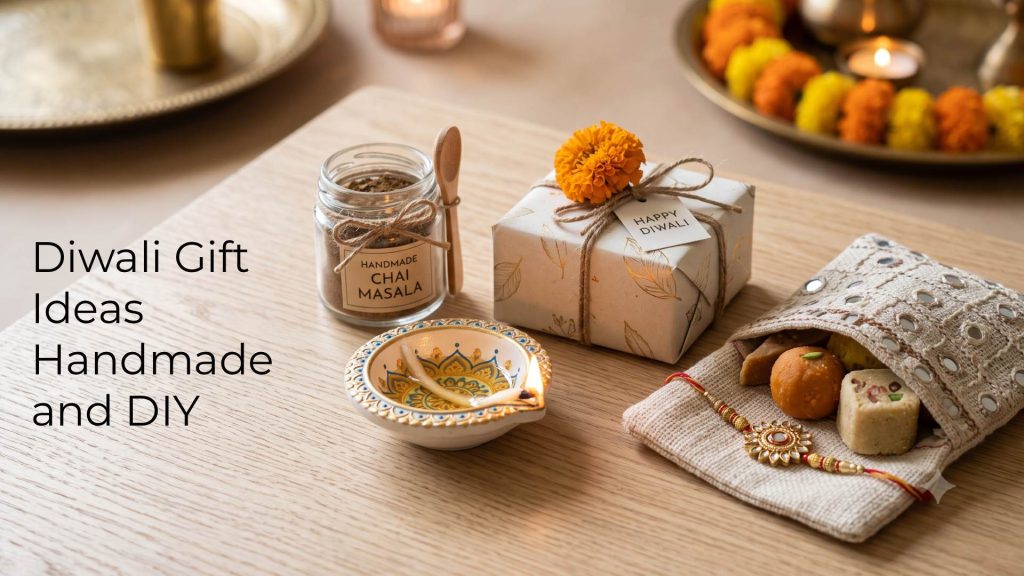
Why Handmade and DIY Diwali Gifts Win in 2026
Before the ideas, here is why “homemade Diwali gift ideas” keep trending on every search bar each October:- They feel personal. A handcrafted diya set or a hand-poured candle signals effort. That is the whole point of Diwali gifting.
- They are budget-friendly. Most DIY Diwali gifts cost between Rs. 80 and Rs. 400 per unit in materials, a fraction of a store-bought hamper.
- They are eco-friendly. Reusable jars, seed paper, cotton potlis, and terracotta cut down on the plastic and thermocol that pile up after every festive season.
- They are flexible. You can personalise every single one, which is impossible with a bulk-bought gift.
- They support local artisans. Buying handmade (when you cannot make it yourself) puts money directly into the hands of Indian craftspeople.
12 Easy Handmade and DIY Diwali Gift Ideas (With Indian Pricing)
Here are the most giftable, most doable DIY Diwali gift ideas for 2026, sorted roughly from easiest to most involved. Each includes an approximate material cost per piece so you can plan your budget.1. Hand-Painted Terracotta Diyas
The classic. Buy plain clay diyas in bulk and paint them with acrylics, add mirror work, or wrap them in gota patti.- What you need: Plain diyas, acrylic paints, brushes, glitter or kundan stones.
- Cost per set of 6: Rs. 90 to Rs. 150.
- Time: 30 to 40 minutes per set.
- Best for: Neighbours, colleagues, return gifts.
2. Hand-Poured Soy Wax Candles
Scented candles are one of the most searched handmade Diwali gifts, and they are surprisingly easy.- What you need: Soy wax, cotton wicks, fragrance oil, glass jars or small terracotta pots.
- Cost per candle: Rs. 120 to Rs. 250.
- Time: 20 minutes plus setting time.
- Best for: Friends, family, premium-feel gifts on a small budget.
3. DIY Diwali Gift Hamper in a Potli or Basket
Instead of making one item, curate a small hamper. This is the highest-impact idea on the list.- What to include: Homemade laddoos or dry fruits, a diya, a mini candle, a handwritten card, seed paper crackers.
- Cost per hamper: Rs. 250 to Rs. 600 depending on contents.
- Best for: Close family, seniors, and anyone you want to impress.
4. Homemade Sweets and Snacks (Edible Gifts)
Nothing beats besan laddoo, kaju katli, or chakli in a reusable jar.- What you need: Ingredients plus airtight glass jars and ribbon.
- Cost per jar: Rs. 150 to Rs. 350.
- Best for: Everyone. Edible homemade Diwali gifts are universally loved.
5. Decorated Sweet or Cookie Jars
If baking is not your thing, buy good-quality sweets and elevate the presentation with a hand-decorated jar and a custom label.- Cost per jar: Rs. 200 to Rs. 400.
- Best for: Last-minute gifts that still look handmade.
6. DIY Rangoli Stencil and Colour Kit
A thoughtful gift that keeps on giving every festive season.- What to include: Reusable rangoli stencils, small packets of rangoli powder, a diya.
- Cost per kit: Rs. 120 to Rs. 250.
- Best for: Newlyweds, new homeowners, families.
7. Handmade Paper Lanterns and Torans
Paper craft is beginner-friendly and photographs beautifully.- What you need: Coloured chart paper, glue, thread, beads.
- Cost per piece: Rs. 60 to Rs. 150.
- Best for: Kids to make, and to gift to schools, societies, and offices.
8. Upcycled Home Decor
Turn old glass bottles into painted vases, or repurpose jars into tealight holders. Zero-cost creativity.- Cost per piece: Rs. 40 to Rs. 120 (mostly paint).
- Best for: The eco-conscious friend who values sustainability.
9. DIY Bath and Wellness Kit
Homemade soaps, bath salts, or a natural ubtan packed in a small box.- What you need: Melt-and-pour soap base, essential oils, moulds, small containers.
- Cost per kit: Rs. 180 to Rs. 400.
- Best for: Self-care lovers and women colleagues.
10. Personalised Photo Frames or Fridge Magnets
Polymer clay magnets shaped like diyas or mandalas, or a decorated photo frame.- Cost per piece: Rs. 80 to Rs. 200.
- Best for: Long-distance family and sentimental gifts.
11. Plantable Seed Paper Cards and Crackers
The most sustainable idea on this list. Seed paper grows into herbs or flowers after use.- Cost per piece: Rs. 50 to Rs. 150.
- Best for: Corporate gifting, schools, and green Diwali celebrations.
12. DIY Chocolate Hampers
Melt, mould, and wrap chocolates at home, then box them with a ribbon.- Cost per box: Rs. 200 to Rs. 500.
- Best for: Kids, teens, and anyone with a sweet tooth.
Handmade Diwali Gifts by Recipient
Not sure which idea fits whom? Use this quick match:- For parents and grandparents: Homemade sweets jar, hand-painted diyas, a wellness kit.
- For friends: Soy candles, chocolate hampers, upcycled decor.
- For kids: Chocolate boxes, DIY craft kits they can decorate themselves.
- For colleagues and bosses: Curated potli hamper, seed paper stationery, a tea or coffee sampler.
- For clients and partners: A premium semi-handmade hamper with branded packaging (more on this below).
DIY vs Buying Handmade vs Bulk Gifting: How to Decide
This is the part most guides skip. Making everything by hand is lovely for 5 to 10 gifts. It falls apart at scale. Here is a simple framework. Choose full DIY when:- You are gifting fewer than 15 to 20 people.
- You have time in hand (start at least 2 weeks before Diwali).
- The personal, handmade touch matters more than perfect uniformity.
- You want the handmade look without the effort.
- You are gifting 20 to 50 people.
- You value supporting Indian craftspeople but cannot make items at volume.
- You are an office, HR team, or business gifting 50, 500, or 5,000+ units.
- You need consistent quality, branding, and on-time pan-India delivery.
- You still want that artisanal, thoughtful feel, just produced reliably at scale.
Handmade Diwali Gifting at Scale: For Offices, HR, and Businesses
If you are reading this from a procurement or HR desk in Bengaluru, Mumbai, Delhi NCR, Pune, or Hyderabad, a fully DIY plan for 800 employees is not realistic. But you do not have to settle for a soulless box either. Here is how to get the handmade feel at corporate volume:- Lead with artisan-made components. Hand-poured candles, hand-painted diyas, terracotta drinkware, hand-rolled incense, and hand-packed gourmet sweets all read as “handmade” even in a curated box.
- Personalise the packaging. A branded potli, a wooden crate, or eco-friendly kraft packaging with a handwritten-style note card lifts the entire gift.
- Go eco-friendly. Seed paper, jute, cotton, and terracotta signal a thoughtful, sustainable brand. Explore RidgeGap’s sustainable and eco-friendly gifting range.
- Match the budget band. Handmade-feel corporate hampers typically land at:
- Rs. 300 to Rs. 800 for employee gifting at volume.
- Rs. 800 to Rs. 2,000 for mid-tier client gifting.
- Rs. 2,000 and above for luxury and CXO gifting.
- Plan the timeline. Custom and handmade orders need lead time. Start early using RidgeGap’s Diwali gifting timeline and planning guide.
Presentation Tips That Make Any Handmade Gift Look Premium
The gift matters, but the wrap seals the impression. A few low-cost upgrades:- Swap plastic for a cotton potli or jute pouch. Instantly more festive and reusable.
- Add a handwritten note or a custom tag. The single cheapest way to add sentiment.
- Stick to a festive palette. Red, gold, orange, and maroon photograph well and feel traditional.
- Include one “hero” item. A standout piece (a candle or a decor object) anchors the hamper.
- Use natural fillers. Dried flowers or shredded kraft paper instead of plastic crinkle.
A Simple Handmade Diwali Gifting Timeline for 2026
With Diwali on 8 November 2026, here is a stress-free plan:- 3 to 4 weeks before (mid-October): Finalise the list, decide DIY vs curated, and buy or order materials.
- 2 weeks before: Start making or place your bulk order. Custom branding needs this window.
- 1 week before: Assemble, pack, and label. Do a quality check.
- 3 to 4 days before: Dispatch and deliver, especially for outstation and pan-India gifts.
Frequently Asked Questions (FAQ)
Q1. What are the best handmade Diwali gift ideas on a low budget? Hand-painted terracotta diyas (Rs. 90 to Rs. 150 a set), paper lanterns (Rs. 60 to Rs. 150), homemade sweets in a reusable jar (Rs. 150 to Rs. 350), and soy wax candles (Rs. 120 to Rs. 250) are the most budget-friendly. All look premium for what they cost. Q2. What are some easy DIY Diwali gifts to make at home? The easiest are decorated diyas, paper torans and lanterns, upcycled bottle vases, and sweet or cookie jars with custom labels. Most take under 40 minutes and need only basic craft supplies. Q3. How much does a DIY Diwali gift hamper cost in India? A well-put-together DIY hamper in a potli or basket usually costs Rs. 250 to Rs. 600 per hamper, depending on whether you include homemade sweets, a candle, a diya, and a card. Q4. Are handmade Diwali gifts good for corporate gifting? Yes, when done at the right scale. Full DIY is impractical beyond 15 to 20 units, but a semi-handmade model, artisan-made components curated into a branded, personalised hamper, delivers the handmade feel with reliable quality and delivery. This is ideal for employee and client gifting. Q5. What are the most eco-friendly handmade Diwali gift ideas? Seed paper cards and crackers, terracotta diyas and drinkware, cotton potlis, hand-rolled natural incense, and upcycled decor. These avoid plastic and thermocol and reflect a sustainable, thoughtful choice. Q6. When should I start preparing handmade Diwali gifts for 2026? With Diwali on 8 November 2026, begin 3 to 4 weeks ahead for DIY, and at least 2 weeks ahead for any bulk or custom-branded order that needs personalisation and pan-India delivery. Q7. Where can I get handmade Diwali gifts in bulk for my office? For volume orders that still feel handmade, a corporate gifting partner like RidgeGap curates artisan-led hampers with custom branding and pan-India delivery. You can request a quote here. Q8. What should I include in a handmade Diwali gift for colleagues? A safe, well-received mix is a curated potli with a candle or diya, a small box of good sweets or dry fruits, a tea or coffee sampler, and a handwritten note. Keep it useful and universally acceptable.Final Thoughts
Handmade and DIY Diwali gifts are not just a budget hack, they are the most genuine way to say “I thought about you” during the festival of lights. For a handful of people, roll up your sleeves and make something. For a whole office or client list, keep the handmade soul and let a gifting partner handle the scale. Whichever route you take, start early, personalise generously, and let every gift carry a little of that Diwali warmth.Helpful Resources from RidgeGap
- Corporate Diwali Gifts collection
- Curated Gift Boxes
- Sustainable and Eco-Friendly Gifting
- Luxury and CXO Gifting
- Diwali Gift Ideas Under Rs. 500 to Rs. 2000
- Diwali Return Gifts Ideas
- Diwali Gift Hampers and Baskets in Bangalore
- Diwali Gifting Timeline and Planning Guide
- Talk to the RidgeGap team for a custom quote
Diwali Gifting RFQ Template: Corporate Buying Guide 2026
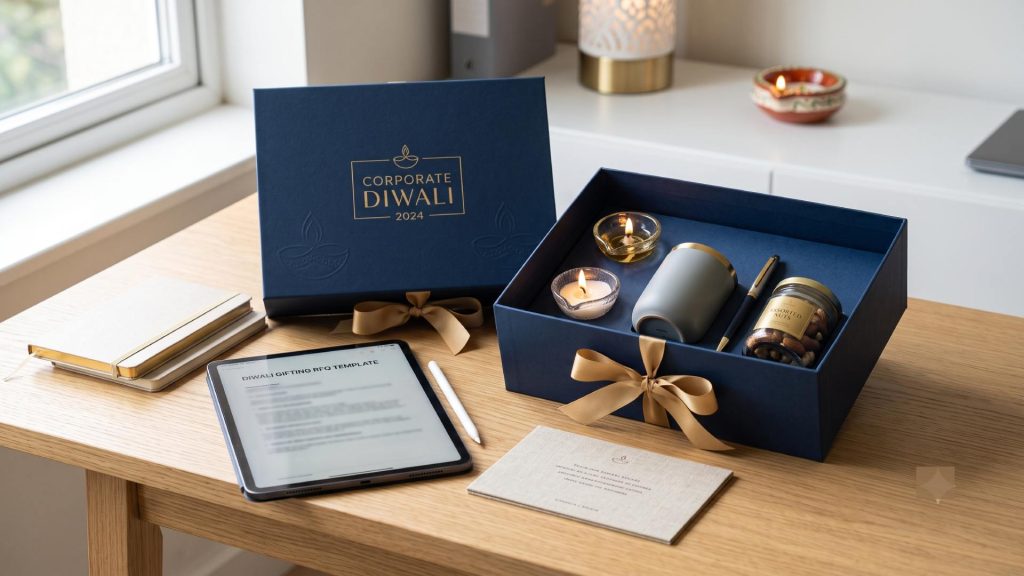
- Forces every vendor to quote on the same specification, so you compare like with like
- Splits pricing into per-piece + branding + packaging + freight + GST instead of one opaque number
- Pegs delivery to the actual Diwali date, not a vague “ASAP”
- Builds in compliance asks (GSTIN, DPDP data handling, itemised invoice) that Indian finance and legal teams need
- Creates a paper trail your audit and finance teams will thank you for
When to use an RFQ vs an RFP for Diwali gifting
These two get confused constantly, so here is the clean distinction for a gifting context:- Use an RFQ when you already know what you want — e.g. “500 branded gift boxes, each with a stainless-steel bottle, a diya set, dry fruits, and a personalised card, budget ₹1,200 per box.” You just need competing prices. This is the most common Diwali scenario.
- Use an RFP (Request for Proposal) when you want the vendor to design the solution — e.g. “We have ₹6 lakh and 400 recipients across three tiers; propose a creative concept.” Here you are buying ideas plus pricing.
The 8 building blocks of a strong Diwali gifting RFQ
Here is what every festive RFQ should contain, section by section. Copy the full template further down — this explains why each block earns its place.1. Buyer and issue details
Your company name, GSTIN, billing and delivery states, a single point of contact (name, email, mobile), the RFQ reference number, and the issue date. A named contact and reference number signal that you are a serious, organised buyer — and vendors quote their best price to serious buyers.2. Recipient tiers and quantities
Segment your list before you ask for a price. Most Indian companies split into:- All employees / staff (the largest, most price-sensitive tier)
- Team leads and managers (a mid tier)
- Key clients and VIP accounts (premium)
- CXO / VP / board and marquee clients (luxury)
- Vendors, channel partners, and dealers (often a separate practical tier)
3. Per-tier budget slabs (in INR)
Give a target per-piece budget for each tier. This is not “showing your hand” — it lets vendors curate to your number instead of over- or under-quoting. Common 2026 slabs seen across the Indian market:- ₹500-₹800: mass employee gifting for teams of 100+; a compact hamper (one branded item + one edible + a festive card)
- ₹800-₹1,500: the sweet spot for mid-size teams — premium without triggering audit questions or department-to-department disparity
- ₹1,500-₹2,500: senior staff, managers, and mid-tier clients; think smart bottles, quality drinkware sets, gourmet hampers
- ₹2,500-₹5,000+: CXO tier and marquee clients — presentation boxes, premium nuts, personalised note from leadership
4. Product and customisation specification
Be specific. For each tier, list the contents, the branding you want, and where the logo goes:- Contents: exact items in the box or hamper
- Branding method: screen print, UV print, laser engraving, embroidery, foiling, embossing — and on which item
- Personalisation: name on each item, individual recipient message, or a common festive card
- Packaging: rigid box vs kraft carton, ribbon, tissue, recipient-name tag, eco / plastic-free fillers
- Sample requirement: state clearly that a physical sample is required before bulk production
5. Itemised pricing table
This is the heart of the RFQ. Insist that every vendor fills a table with these columns, per tier:- SKU / item description
- Per-piece base price (before tax)
- Branding / customisation charge per piece
- Packaging per kit
- Freight per recipient or per consignment
- HSN code
- GST rate (%)
- All-in landed cost per piece (incl. GST)
6. Delivery timeline pegged to Diwali
Never write “ASAP.” Write the actual dates:- Sample approval deadline
- Bulk production window
- Dispatch date
- Required in-hand date (a safe 2-4 days before Diwali)
7. Compliance and documentation asks
For Indian procurement, this block is non-negotiable:- Active GSTIN (verifiable on the GST portal, not provisional)
- Itemised, HSN-coded, GST-split sample invoice
- DPDP Act 2023 data-handling note — where your recipient list is stored, who can access it, retention period (12 months post-delivery max), and destruction protocol. The vendor becomes a data processor the moment you share names and addresses
- Willingness to sign a mutual NDA covering recipient lists and artwork
- Replacement-at-vendor-cost clause for goods that fail QC against the approved sample
8. Submission deadline and quote validity
State the date and time by which quotes must arrive, the preferred format (a shared sheet is easiest), and a required quote validity (e.g. “valid for 30 days”). This prevents a vendor from re-pricing after you’ve made your decision.A worked example: filled RFQ pricing (so you know what “good” looks like)
Say you have 320 employees, 40 managers, and 25 key clients. A well-completed vendor response for the employee tier might read:- Item: branded gift box (steel bottle + diya set + 200g dry fruits + festive card)
- Per-piece base: ₹690 · Branding: ₹45 · Packaging: ₹60 · Freight: ₹35 · HSN: 2106 · GST: 18% · Landed ≈ ₹979 per box
- Item: rigid presentation box (premium nuts assortment + gourmet chocolate + leather-tag notebook + CEO note)
- Per-piece base: ₹2,850 · Branding: ₹120 · Packaging: ₹280 · Freight: ₹80 · HSN: 2106 · GST: 18% · Landed ≈ ₹3,930 per box
Common mistakes that sink a Diwali RFQ
- Sending it too late. After mid-September, customisation slots vanish and you get standard SKUs. Send the RFQ 6-8 weeks out.
- Accepting lump-sum quotes. “₹X per kit, all-inclusive” hides freight, branding, and GST. Reject it.
- Not asking for a sample. Digital mockups are not proof. Insist on a physical sample before bulk.
- Skipping HSN and GST split. This is where invoice pain and ITC (input tax credit) trouble start.
- Ignoring DPDP. Sharing 500 employees’ names and addresses with no data-handling agreement is a real compliance exposure.
- Inviting only one vendor. With no competing quote, you have no price band and no leverage. Invite at least three.
- Vague delivery date. “Before Diwali” is not a date. Write the in-hand date into the RFQ.
How RidgeGap responds to a Diwali gifting RFQ
At RidgeGap, we are built to answer exactly this kind of structured brief. With 10 years in corporate gifting, 300+ brands to choose from, and pan-India door delivery, we return itemised quotes by default — per-piece, branding, packaging, freight, HSN and GST split out — so your finance team never has to chase a hidden line. If you are shaping your festive brief, these RidgeGap resources map directly to the RFQ blocks above:- Curated Gift Boxes — the workhorse format for tiered Diwali hampers
- Luxury & CXO Gifting — presentation boxes for your ₹2,500+ tier
- Sustainable & Eco-Friendly Gifting — plastic-free packaging and recycled-content options
- Swag Packs and Customised T-Shirts — practical branded add-ons for the mass tier
- Corporate Diwali Gifts — our full festive range
- Contact Us — send us your filled RFQ and we will return a mapped, itemised quote
Frequently Asked Questions
What is a Diwali gifting RFQ template?
It is a standardised one-page document you send to gifting vendors to request comparable, line-item pricing for a bulk festive order. It captures buyer details, recipient tiers and quantities, per-tier budget slabs in INR, product and customisation specs, an itemised pricing table (with HSN and GST), a Diwali-pegged delivery timeline, compliance asks, and a submission deadline. It replaces a scattered WhatsApp price hunt with a clean, apples-to-apples comparison.When should I send a Diwali RFQ to vendors?
Send it 6-8 weeks before Diwali — practically, by mid-September. Most large custom orders in India close around then, and branded or personalised packaging needs an extra two weeks. Orders placed in the final week before the festival usually ship as standard SKUs with no customisation.How much do companies spend per employee on Diwali gifts in India?
Budgets typically range from ₹500 to ₹15,000+ per employee. The mass-employee sweet spot in 2026 sits around ₹800-₹1,500 per gift box; ₹500-₹800 works well for very large teams; managers and mid-tier clients land at ₹1,500-₹2,500; and CXO/VIP hampers run ₹2,500-₹5,000+. Actual spend depends on team size, customisation, and packaging.Is there a tax angle I should build into the budget?
Yes. Under current income-tax rules, non-cash gifts up to ₹5,000 per employee per financial year are generally exempt as a perquisite; the excess above ₹5,000 is taxable in the employee’s hands. Keeping mass employee gifts within roughly ₹500-₹2,500 keeps things clean. Always confirm the exact treatment with your finance team before large orders.What HSN code and GST rate apply to Diwali gift hampers?
There is no single “gift” HSN code — the rate follows the item. Mixed hampers are commonly classified under HSN 2106, chocolates under 1806, and dry fruits/nuts under 0802. A mixed hamper billed as one composite product often attracts 18% GST depending on the principal item. Ask the vendor to state and justify the HSN on the quote, and verify it yourself.RFQ or RFP — which should I use for corporate Diwali gifting?
Use an RFQ when you already know exactly what you want and just need competing prices — the most common festive scenario. Use an RFP when you want vendors to design the concept for a given budget and audience. Many teams run an RFP to shortlist, then send a tight RFQ to the final three vendors for pricing.How many vendors should I send the RFQ to?
At least three. One quote gives you no price band and no leverage. Three gives you a genuine market range and lets you disqualify outliers — the vendor who won’t itemise, won’t sample, or won’t sign a data-handling clause.What documents should I ask a Diwali gifting vendor for?
An active, portal-verifiable GSTIN; a sample HSN-coded, GST-split invoice; a DPDP Act 2023 data-handling note; willingness to sign a mutual NDA; and a replacement-at-vendor-cost clause for goods that fail QC against the approved sample.Resource: Download and adapt
Copy the template block above into Word, Excel, or Google Sheets and adapt the brackets to your order. For a ready itemised quote mapped to each RFQ block, share your filled template with the RidgeGap team at ridgegap.com/contact-us.Sources and references
- Income-tax perquisite treatment of employee gifts (₹5,000 exemption) — general guidance; confirm with your finance team
- GST/HSN classification for hampers, chocolates, and dry fruits — CBIC HSN directory and GST advisories
- DPDP Act 2023 — MeitY, for recipient-data handling
- Indian corporate Diwali budget benchmarks (2026) — market surveys from gifting suppliers