Personalization vs Standard Gifts: Corporate Guide India
The ₹12,000 Crore Question Every Indian Business Must Answer
Picture this: Diwali is three weeks away. Your procurement team has two options on the table. Option A — 500 branded dry-fruit boxes, the same ones you sent last year and the year before. Option B — 500 curated gift boxes, each carrying the recipient’s name, a handwritten note, and products selected by role (a tech gadget for your engineers, a premium notebook set for your client-servicing team, an eco-friendly kit for your sustainability-focused clients).Both options fit the budget. So which one should you choose?
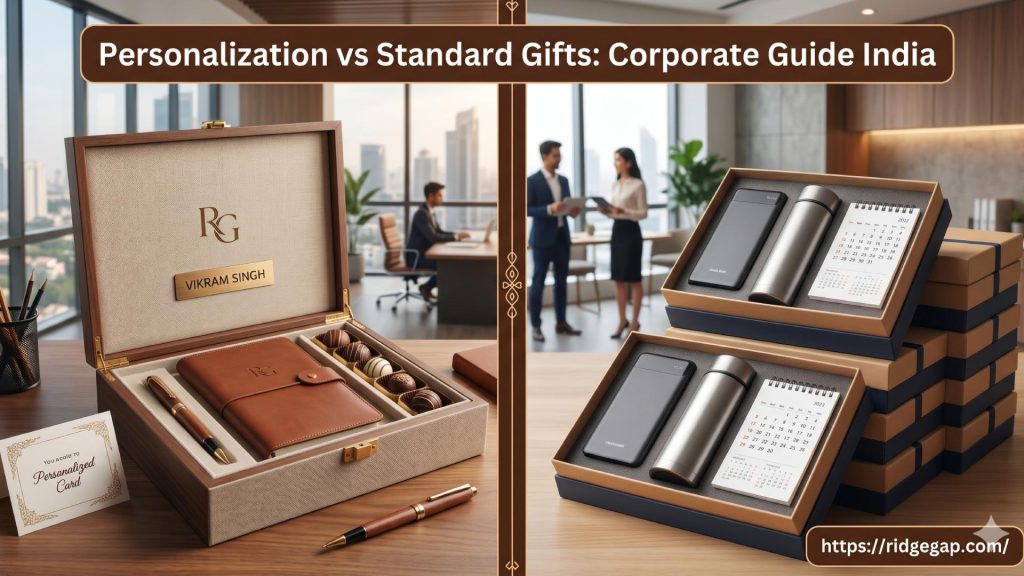
This is the central tension at the heart of personalization vs standard gifts — a debate that has become one of the most strategically important conversations in Indian corporate gifting today. As the Indian corporate gifting market crossed ₹12,000 crore in 2024 and is on a growth trajectory to reach ₹27,000 crore by 2030, the stakes of getting this decision right have never been higher. The answer isn’t simply “personalized is always better.” The real answer depends on your objectives, your audience, your budget, and the occasion. This article breaks it all down — with data, use cases, and a decision-making framework built for Indian businesses.What Are Standard Gifts? (And Why They Still Have a Place)
Standard gifts — also called generic or off-the-shelf corporate gifts — are pre-selected items ordered in bulk without recipient-specific customization. Think branded calendars, pen sets, dry-fruit boxes, generic diaries, or prepacked hampers distributed uniformly across a large audience.The Case for Standard Gifts
Standard gifts are not inherently bad. For the right scenario, they are the smart, practical choice.- Speed and scalability are where standard gifts truly shine. When you need to send 1,000 gifts across 15 cities with a two-week turnaround, a well-curated but uniform gift is infinitely more executable than a fully personalized campaign. Events like trade shows, product launches, or large conferences demand this kind of operational simplicity.
- Predictable cost control is another genuine advantage. When every recipient receives the same item, budgeting is straightforward, vendor negotiations are cleaner, and there’s no complexity around tiered pricing by recipient category.
- Brand consistency matters in certain contexts — particularly promotional giveaways and event merchandise. When your goal is brand visibility rather than individual connection, a uniform, well-branded item (a quality tote bag, a branded water bottle, a customised t-shirt) carries your logo into 500 different homes and offices with perfect consistency.
The Drawbacks of Going Generic
The downside is equally clear. Standard gifts carry a psychological limitation that even the best-quality generic item cannot fully escape: they signal that the giver didn’t think specifically about the recipient. In a country where gifting is deeply cultural — where the act of giving carries emotional weight during Diwali, Holi, work anniversaries, and onboarding milestones — a generic gift can feel transactional rather than thoughtful. Research from Gallup shows that employees who feel genuinely recognised are 23% more engaged and 31% less likely to leave, and a generic calendar on their desk isn’t driving that kind of recognition.What Are Personalized Corporate Gifts? (And Why India Is Embracing Them)
Personalized corporate gifts are items that have been tailored — through engraving, printing, curated selection, custom messaging, or individual packaging — to feel specific to the recipient. This can range from engraving an employee’s name on a premium water bottle to building entirely custom new joiner kits that reflect both company culture and individual role. Personalization exists on a spectrum:- Light personalization: Adding a name or the recipient’s initials to a standard item
- Medium personalization: Curating a gift set by role, preference, or tier (e.g., separate kits for CXOs vs. junior employees)
- Deep personalization: Fully bespoke items — custom-made projects, handcrafted pieces, or experience-based gifts — tailored to a specific individual’s preferences, interests, or milestones
Head-to-Head: Personalized vs Standard Gifts Across Key Dimensions
| Factor | Standard Gifts | Personalized Gifts |
| Cost per unit | Lower (₹300–₹800 typical) | Moderate to higher (₹700–₹5,000+) |
| Lead time | Short (3–7 days) | Longer (7–21 days depending on depth) |
| Emotional impact | Low to moderate | High |
| Employee recall | Low | High |
| Brand visibility | Moderate (via logo) | High (via personal connection) |
| Scalability | Very high | Moderate to high |
| Best for | Events, mass promotions | Onboarding, retention, CXO gifting |
| ROI on retention | Indirect | Direct and measurable |
| Perceived value | At face value | Above face value |
The Engagement Evidence: What the Data Tells Us
The business case for personalized corporate gifts is no longer anecdotal — it’s measurable. McKinsey research on B2B relationship management has found that well-timed, thoughtful gifting touchpoints can lift deal-closure rates by 10–15% during the sales cycle. In employee contexts, companies that run structured personalized gifting programs report 12–15% higher employee satisfaction scores and 8–10% better retention rates compared to companies that rely on generic gifting alone. In the Indian context, the shift is being driven by four overlapping forces:- Rising workforce expectations. India’s largest employed demographic is now millennials and Gen Z — a group that places high value on feeling seen, not just rewarded. A generic gift says “you matter as one of 500 employees.” A personalized gift says “we noticed you specifically.”
- The hybrid work gap. With millions of Indian employees working in hybrid or remote models, physical gifting has become one of the few tangible touchpoints between employer and employee. The quality and thoughtfulness of that touchpoint carries more weight than it did when everyone sat in the same office.
- Competitive talent markets. India’s IT, BFSI, and startup sectors face chronic attrition pressure. In sectors like IT and BPOs — where Bengaluru, Hyderabad, and Pune compete fiercely for talent — personalized recognition gifts serve a dual purpose: they reduce churn and reinforce culture simultaneously.
- Cultural resonance. India has a deeply embedded gifting culture. From the exchange of mithai during festivals to the ritual of gifting elders on auspicious occasions, giving something thoughtful is a cultural signal. A branded notepad for Diwali simply doesn’t carry the same meaning as a curated festive gift box with the recipient’s name on it.
Use Cases: When to Choose Personalization vs Standard Gifts
Employee Onboarding → Choose Personalization
A new employee’s first week is one of the highest-stakes moments in their tenure. Research consistently shows that the first 90 days determine whether an employee stays long-term. A thoughtfully assembled new joiner kit — featuring branded apparel in the right size, a personalized welcome card, a quality notebook, and a tech accessory relevant to their role — communicates cultural belonging from day one. Standard kits sent to all new joiners regardless of role or level can feel like an afterthought. Personalization here isn’t a luxury; it’s an onboarding investment.Employee Recognition & Milestones → Choose Personalization
Work anniversaries, performance awards, and promotion acknowledgements call for gifts that reflect the specific individual’s journey. A 5-year anniversary gift with the employee’s name engraved and a personal message from leadership makes that moment memorable. A generic gift box — no matter how premium — doesn’t deliver the same recognition signal.Festive Gifting (Diwali, Christmas, Holi) → Context-Dependent
Festive gifting in India is often large-scale — many companies gift hundreds or thousands of employees and clients simultaneously. Here, a hybrid approach works best: a well-chosen gift that is uniform in category but personalized at the packaging and messaging level (recipient name, department-specific note) gives you scale without sacrificing warmth. Curated gift boxes with customized wrapping and individual name tags are the sweet spot for festive campaigns in the ₹800–₹2,500 per unit range.CXO and Key Client Gifting → Choose Deep Personalization
For senior clients, C-suite executives, or strategic partners, generic gifts can actively undermine the relationship. A CFO receiving the same ₹1,500 gift hamper as an entry-level contact sends the wrong signal about how well you understand and value the relationship. Luxury and CXO gifting should be deeply personalized — bespoke, high-quality items that reflect genuine attention to the recipient’s preferences, interests, or background. Budget ₹3,000–₹15,000 per recipient and invest in the relationship, not just the item.Events, Conferences & Promotional Campaigns → Choose Standard (With Branding)
Trade shows, product launches, industry conferences, and large-scale promotional campaigns are where standard gifting is at its most rational. When the goal is brand impressions across a broad, heterogeneous audience — many of whom you haven’t met — a quality branded item does the job well. Event and conference gifts like branded swag packs, customised t-shirts, and quality merchandise carry your identity efficiently at scale.Client Retention Campaigns → Choose Personalization
In competitive B2B environments, the difference between a client renewing a contract and moving to a competitor can hinge on relationship quality. A mid-year personalized gift — timed to a business milestone or the client’s company anniversary rather than a generic festival — signals that you pay attention. It’s this kind of proactive personalization that drives the client retention numbers cited in McKinsey’s research.The Indian Pricing Reality: What Personalization Actually Costs
One of the most persistent myths in corporate gifting is that personalization is unaffordable for mid-market budgets. That’s no longer true. Here’s a realistic breakdown for Indian businesses in 2026:- Budget tier (₹300–₹800 per unit): Logo-printed drinkware, branded notebooks with name engraving, customised pens. Bulk quantities (500+) with standard personalization (name + logo). Ideal for large team festive gifting or events.
- Mid-range tier (₹800–₹2,500 per unit): Curated gift boxes by role or department. Custom-packaged hampers with recipient name, branded apparel in correct sizes, tech accessories. Minimum orders typically 50–100 units. The most popular category for employee gifting in India.
- Premium tier (₹2,500–₹6,000 per unit): Fully curated boxes with multiple items, premium branded packaging, handwritten cards, and role/preference-based curation. Ideal for key client gifting, senior employee recognition, and milestone celebrations.
- Luxury/CXO tier (₹6,000–₹25,000+ per unit): Bespoke gifts, premium branded merchandise from top brands, artisan items, high-end tech accessories, or experience-based gifts. Reserved for C-suite clients, board members, and strategic partners.
Corporate Gifting Trends in India: Where the Market Is Heading
Several macro-trends are accelerating the shift toward personalized corporate gifts in India:- Sustainability is now a baseline, not a differentiator. Eight out of ten procurement heads in Indian companies now prefer eco-friendly gifting options. Sustainable and eco-friendly gifting — bamboo products, seed paper kits, recycled packaging — is no longer a niche. When combined with personalization, it signals both thoughtfulness and values alignment.
- Tech-enabled personalization at scale. SaaS-based gifting platforms are making it possible to manage personalized gifting campaigns for thousands of recipients with CRM integration, real-time tracking, and analytics. Indian companies in the IT, BFSI, and e-commerce sectors are adopting these tools rapidly.
- Unboxing as a brand moment. The rise of social media has made the unboxing experience a genuine marketing channel. A beautifully personalized gift box shared on LinkedIn or Instagram by a grateful employee is organic brand visibility that no advertisement can replicate. Premium packaging — magnetic flap boxes, tissue wrap, custom ribbons — is increasingly seen as part of the gift itself.
- Cultural and regional personalization. Forward-thinking Indian companies are going beyond name-printing to regional personalization: gifting items that reflect the local culture of each office location, incorporating regional festivals into the gifting calendar, or selecting items crafted by local artisans. This is both an engagement strategy and a brand positioning move.
A Decision-Making Framework: Which Should You Choose?
If you’re planning your next corporate gifting campaign, use this framework to guide your decision: Go with personalized gifts when:- The recipient group is under 500 and relationship quality matters
- You’re onboarding new employees or celebrating milestones
- You’re gifting CXO-level clients or key account stakeholders
- You want to drive measurable retention or loyalty outcomes
- Budget is ₹800+ per unit and lead time is 2+ weeks
- Volume exceeds 1,000 units and lead time is under 10 days
- The occasion is a public event, trade show, or promotional campaign
- The goal is brand visibility rather than individual connection
- Budget is under ₹500 per unit
- It’s a major festive season (Diwali, Christmas) with mixed recipient tiers
- You want to combine brand consistency with individual warmth
- You have time for light personalization (name tags, custom messages) but not full curation
Real-World Scenarios from the Indian Market
- Scenario 1 — IT company, Bengaluru, 300 new joiners per quarter: A mid-sized software firm shifted from standard joining kits (uniform backpack + diary + pen) to role-segmented kits: developers received a premium laptop stand and cable organizer set; client-facing roles received a branded travel kit; design team members received a premium sketchbook and stylus. Named packaging was added for all. Employee satisfaction scores for onboarding improved by 18% over two quarters, with specific feedback citing the “welcome kit” as a highlight.
- Scenario 2 — BFSI firm, Mumbai, 50 key client gifts pre-contract renewal: Instead of standard festive hampers, the relationship team commissioned custom luxury gift sets for 50 decision-makers — premium branded items selected with the client’s industry and seniority in mind, delivered with a handwritten note from the account director. Renewal rate for that client cohort was 94% vs. 78% the previous year.
- Scenario 3 — E-commerce startup, pan-India, 2,000 employee Diwali gifts: With a budget of ₹1,200 per employee and a 10-day turnaround, the company opted for a uniform curated gift box but added: recipient’s first name on the outer packaging, a personalized digital card from their direct manager (QR-code embedded on the box), and tier-based product variants (senior employees received a premium variant). The social media response — employees posting unboxing photos — generated organic LinkedIn impressions equivalent to a paid campaign worth several lakhs.
Frequently Asked Questions (FAQs)
Q1. Is personalized gifting significantly more expensive than standard gifting in India?
Not necessarily. Light personalization — adding a name or custom message to a standard item — adds minimal cost (often ₹50–₹150 per unit). At scale (500+ units), this incremental spend is manageable for most mid-market budgets. The deeper the personalization (bespoke curation, premium packaging), the higher the per-unit cost, but the ROI in engagement and retention typically justifies it.Q2. What is the minimum order quantity for personalized corporate gifts in India?
Most reputable corporate gifting companies in India work with minimum orders of 50–100 units for fully personalized kits. For light personalization (name printing on a single item), minimums can be as low as 25–30 units. Bulk orders of 500+ units often unlock significant price advantages.Q3. How long does personalized corporate gifting take in India?
Lead times vary by complexity. Name engraving on a standard item: 5–7 days. Custom-curated gift boxes with branded packaging: 10–15 days. Fully bespoke/custom-made projects: 3–4 weeks. Planning ahead — especially for Diwali or year-end gifting seasons — is essential to avoid rushed production and compromised quality.Q4. What types of corporate gifts are most popular for employee engagement in India in 2026?
Tech accessories (wireless chargers, earbuds, cable organizers), branded drinkware (premium stainless bottles, copper mugs), custom apparel (t-shirts, hoodies with team branding), wellness kits, and curated hampers are the leading categories. Eco-friendly variants of all these categories are growing rapidly.Q5. Can standard gifting work for client retention in India?
For broad-base client portfolios at low per-unit budgets, standard gifting is still effective as a “top of mind” touchpoint — particularly for festive occasions. However, for high-value clients or strategic account management, personalized gifting consistently delivers stronger loyalty outcomes.Q6. What’s the best approach for Diwali corporate gifting in India — personalized or standard?
A hybrid approach is ideal for most companies. Choose a high-quality, thoughtfully curated product set (which provides baseline consistency and quality), then layer in personalization at the packaging and messaging level — recipient names, department-specific notes, or tiered product variants for senior recipients. This gives you scale without losing the warmth that makes Diwali gifting meaningful.Q7. How do I measure the ROI of personalized corporate gifting?
Track these metrics: employee NPS scores pre- and post-gifting campaigns; retention rates in the 6–12 months following a personalized gifting initiative; client deal-closure rates when gifting is integrated into the sales cycle; social media engagement when employees share their gifts; and direct feedback through post-gift surveys. Companies with structured gifting measurement frameworks consistently find positive ROI on personalized programs.The Verdict: Personalization Wins on Engagement, Strategy Wins Overall
The short answer: personalized gifts drive meaningfully better engagement, loyalty, and emotional impact than standard gifts — when the context calls for individual connection. But the smarter answer is this: the best corporate gifting strategies in India in 2026 are not binary. They combine the efficiency of standard gifting with the impact of personalization, deployed at the right tier, for the right audience, at the right moment. Standard gifts have their place — at events, for mass promotions, and where speed and volume are the primary constraints. Personalized gifts earn their premium — at onboarding, for key client relationships, during milestone recognition, and wherever you want the recipient to feel genuinely seen. India’s most respected companies — the ones building cultures that attract and retain talent, and client relationships that last decades — have already made the shift. They’re not asking “personalized or standard?” They’re asking “how do we make every gift feel personal, at whatever scale we’re operating?” That’s the standard worth aiming for.Ready to Upgrade Your Corporate Gifting Strategy?
Ridgegap has been helping Indian companies — from Bengaluru’s fastest-growing startups to established MNCs — design and execute corporate gifting campaigns that create real impact. With 10+ years of experience, 5,000+ curated products, and a track record with brands like Google, Amazon, and JP Morgan, we bring both the depth of catalog and the craftsmanship of personalization to every order. Whether you need new joiner kits, curated gift boxes, luxury CXO gifts, or sustainable gifting solutions, we handle everything from sourcing to packaging to pan-India delivery. Book a free consultation with the Ridgegap team today →Further Reading
- Corporate Gifting Industry Statistics: Trends & Insights for 2025–26
- Smart Office Gadgets for Employee Gifting 2026
- Corporate Holiday Gifts Under ₹500, ₹1,000, ₹1,500 in India
- Corporate Gifting for Gen Z Employees: A Complete 2026 Guide
- Explore Ridgegap’s Full Range of Corporate Gifting Solutions

No Comments yet!