Gift Hampers vs Digital Vouchers vs Gift Cards: A Guide
Introduction: The Decision Every HR Manager Dreads in October
It’s the third week of October. Diwali is 18 days away. Your leadership has approved a gifting budget of ₹8 lakhs for 600 employees spread across Bengaluru, Pune, and three remote locations. And now the question that lands in your inbox every single year lands again: “Should we go with hampers, gift cards, or just send digital vouchers this time?” If you’ve ever sat in that meeting where half the room says “hampers feel more personal” and the other half says “just send gift cards, people can choose what they want” — this article is for you. There is no universally right answer. But there is almost always a right answer for your situation. And that’s exactly what we’re going to help you find. In this guide, we break down the three most popular corporate gifting formats in India — gift hampers, digital vouchers, and gift cards — across every dimension that matters: cost, scalability, personalization, employee perception, logistics, and ROI. We’ll also cover specific use-cases, budget ranges, and the exact scenarios where one format clearly wins over the others. Let’s get into it.Understanding the Three Formats: A Quick Primer
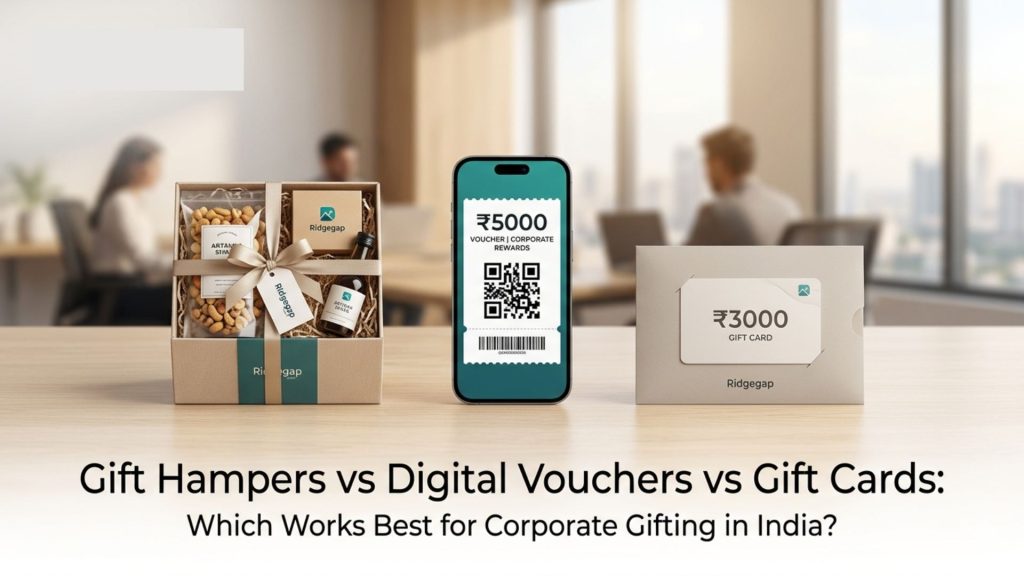
Before diving into comparisons, it’s worth getting precise about what each format actually means in the Indian corporate gifting context. The terms are often used interchangeably, but they’re meaningfully different. Gift Hampers are physically curated boxes or baskets containing a selection of products — think branded dry fruits, chocolates, artisanal snacks, skincare items, premium stationery, or lifestyle products. They can be standardized or fully customized with the company logo, personalized notes, and specific product themes. Digital Vouchers are electronically delivered codes or links redeemable on specific platforms — Swiggy, Amazon, BookMyShow, Flipkart, Myntra, Zomato, etc. They’re typically single-brand or category-specific and delivered via email or WhatsApp. No physical component involved. Gift Cards — the keyword “qwerty” of gifting decisions, in that many buyers type it into search without fully understanding what they’re getting — can be either physical or digital. They function like prepaid debit cards usable across a range of brands. Multi-brand gift cards (like those from Qwikcilver, Pine Labs, or Amazon Pay) give recipients the widest flexibility. Physical cards feel more tangible; digital cards are instant.The Head-to-Head Comparison
1. Personalization & Emotional Impact
This is where gift hampers win decisively, and it’s not even close. A beautifully curated hamper sitting on an employee’s desk — or arriving at their doorstep in branded packaging — creates a sensory experience that no digital voucher can replicate. The unboxing moment matters. In research conducted across Indian workplaces, physical gifts consistently score higher on “feeling valued” metrics than digital alternatives. That said, personalization on digital vouchers and gift cards is also possible — through custom branding on the delivery email, personalized messages, or allowing employees to choose from a curated catalogue. But it requires intentional design effort, and the emotional punch is lower. Winner: Gift Hampers (for high-impact, emotionally resonant gifting)2. Cost & Budget Flexibility
| Format | Typical Budget Range (India) | Per-Unit Cost |
| Gift Hampers | ₹800 – ₹5,000+ per unit | Higher (includes logistics, packaging, products) |
| Digital Vouchers | ₹250 – ₹3,000 per unit | Lowest (no physical delivery cost) |
| Gift Cards | ₹500 – ₹5,000+ per unit | Mid-range (physical cards add printing/delivery cost) |
3. Scalability & Logistics
Here’s where many companies get burned. A beautifully planned hamper initiative for 50 employees is manageable. The same exercise for 2,000 employees across 8 cities? A logistical nightmare if you don’t have the right partner. Digital vouchers are inherently scalable. You can send 10,000 vouchers as easily as you can send 10 — bulk generation, CSV upload, automated WhatsApp delivery. Zero warehousing, zero last-mile headaches. Gift cards fall in the middle. Physical cards require printing, personalization, and delivery logistics. Digital gift cards are as scalable as vouchers. Gift hampers require inventory planning, quality control, packing, and last-mile delivery management — especially for remote employees in Tier-2 and Tier-3 cities. This is exactly where working with an experienced gifting partner (rather than managing in-house) becomes critical. Winner: Digital Vouchers for pure scalability; Gift Hampers with the right gifting vendor4. Recipient Experience & Perceived Value
Ask any employee which gift they’d prefer, and the answer almost always trends toward physical gifts — especially among employees in the ₹4–12 LPA salary range where tangible recognition still carries significant weight. However, senior employees and CXOs often prefer flexibility. A ₹3,000 Amazon gift card is more useful to a VP who travels frequently than a hamper they might not need. Digital vouchers, while convenient, score lowest on perceived value — recipients are often aware of what it cost the company, and single-brand vouchers can feel restrictive (“I never order from Swiggy”). Winner: Gift Hampers on perceived value; Gift Cards on flexibility for senior staff5. Customization & Brand Integration
Gift hampers are the clear winner for brand building. Every element — the outer box, the tissue paper, the ribbon, the product labels, the handwritten card — is a branding touchpoint. For companies investing in culture-building and employer brand, hampers are brand marketing as much as they are gifting. Digital vouchers allow light customization (your logo on the delivery email, a message from the CEO), but there’s limited brand expression beyond that. Gift cards can be co-branded but typically require minimum order quantities from the platform to unlock that option, making it impractical for smaller gifting budgets. Winner: Gift Hampers6. Tax Implications & Compliance
This is a critical, often-overlooked factor in Indian corporate gifting. Under the Income Tax Act, gifts received by employees are taxable if the total value exceeds ₹5,000 per financial year. This applies to all three formats. However, there’s a key practical difference: digital vouchers and gift cards create a cleaner paper trail for accounting and compliance. Each transaction is logged, making it easier for finance teams to track, report, and stay within exemption thresholds. Gift hampers are harder to value precisely for tax purposes, especially if they contain custom items. Companies that do large-scale hamper gifting should ensure their vendor provides itemized invoicing. Winner: Digital Vouchers & Gift Cards (for cleaner compliance documentation)Use-Case Scenarios: Which Format Wins Where?
Scenario 1: Diwali Gifting for 300–500 Employees
Best Choice: Gift Hampers Diwali is India’s most emotionally significant gifting occasion. The right hamper — branded packaging, festive elements like dry fruits, sweets, and a handwritten note from leadership — creates a moment that employees talk about. It lands differently than a WhatsApp voucher message that gets lost between forwarded memes. Budget sweet spot: ₹1,200–₹2,500 per employee Partner with a vendor like Ridgegap who can handle end-to-end curation, packaging, and pan-India delivery.Scenario 2: New Employee Onboarding (New Joiner Kits)
Best Choice: Gift Hampers / Curated Kits First impressions in corporate culture matter enormously. A well-designed new joiner kit — laptop bag, branded notebook, a welcome card, maybe a coffee mug and a branded t-shirt — communicates culture immediately. A gift card on Day 1 says nothing about who your company is. Budget sweet spot: ₹1,500–₹4,000 per kit Explore: Ridgegap New Joiner KitsScenario 3: Employee Rewards & Spot Recognition (Monthly/Quarterly)
Best Choice: Digital Vouchers or Multi-Brand Gift Cards For ongoing recognition programs — employee of the month, performance milestones, quick peer recognition — speed and flexibility matter more than presentation. Digital vouchers can be sent within minutes. Multi-brand gift cards give recipients genuine choice. The “qwerty” search pattern here is telling — employees searching for what gift card they received often want to know where they can spend it. A multi-brand or open-loop gift card removes that friction entirely. Budget sweet spot: ₹500–₹2,000 per rewardScenario 4: CXO and Client Gifting
Best Choice: Premium Gift Hampers (Luxury Tier) When you’re gifting a board member, a senior client, or a business partner — the gift communicates how much you value the relationship. Generic gift cards at this level feel transactional, even insulting. A bespoke, luxury hamper — premium dry fruits, artisanal products, fine writing instruments, personalized notes — lands as an investment in the relationship. Budget sweet spot: ₹3,500–₹10,000+ Explore: Ridgegap Luxury CXO GiftingScenario 5: Large-Scale Festive Gifting Across Remote Locations (1,000+ Employees)
Best Choice: Digital Gift Cards (with Optional Physical Hampers for Key Roles) For companies with distributed teams across Tier-2 and Tier-3 cities, or a large WFH workforce, digital gift cards are the most practical choice. Logistics for physical hampers at this scale can be complex without a strong vendor, and delivery failures during peak festive season (courier backlogs around Diwali are notorious) create negative experiences. A practical hybrid: digital gift cards for the general workforce, curated hampers for team leads and managers. Budget sweet spot: ₹700–₹1,500 per person (digital); ₹2,500–₹5,000 for manager tierScenario 6: Events, Conferences & Corporate Giveaways
Best Choice: Branded Gift Hampers or Swag Packs Event gifting is pure brand marketing. The goal isn’t just to make someone feel good — it’s to keep your brand visible after the event ends. A branded bag, a quality pen, a product they’ll use daily — this is where physical gifting pays dividends that no voucher can match. Explore: Ridgegap Events & Conference GiftingThe “Best For Your Situation” Quick Decision Framework
Use this to make your call in under 2 minutes: Choose Gift Hampers if:- You’re running festive gifting (Diwali, New Year, Holi, Raksha Bandhan)
- You want brand visibility and a premium unboxing experience
- You’re gifting CXOs, senior clients, or key hires
- You have a trusted vendor handling logistics
- You need to gift quickly at scale (within 24–48 hours)
- Your team is fully remote or distributed across cities
- Your budget is ₹500–₹1,000 per person
- You want zero logistics overhead
- It’s a quick recognition or spot reward
- You want recipient flexibility without the complexity of voucher platforms
- You’re running a recurring rewards program
- Your employees are senior and value choice over presentation
- You want clean accounting and compliance documentation
The Hybrid Approach: What Smart Companies in India Are Doing
The most sophisticated corporate gifting programs in India no longer see this as an either/or decision. They’re running tiered gifting strategies:- All employees: Digital gift card or voucher (₹750–₹1,500)
- Team leads / managers: Curated hamper (₹2,000–₹3,500)
- Senior leadership / CXOs: Luxury curated hamper (₹5,000–₹10,000+)
What to Watch Out For: Common Mistakes in Corporate Gifting
- Choosing the cheapest hamper option A poorly curated hamper with low-quality products does more damage than no gift at all. Employees notice when the sweets taste cheap or the box looks flimsy.
- Ignoring dietary and lifestyle preferences India’s workforce is increasingly health-conscious, and dietary restrictions are common. If you’re sending hampers with ghee-heavy sweets to employees who observe specific diets or health goals, you’ve missed the mark. Look for vendors who offer wellness, organic, or diet-specific options.
- Sending single-brand vouchers without knowing the recipient A Swiggy voucher is useless to an employee who doesn’t use Swiggy. Multi-brand or open-category vouchers solve this problem elegantly.
- Managing gifting in-house at scale If you’re trying to coordinate 1,000 hampers via a WhatsApp group and Excel sheet, something will go wrong. Vendor management, quality control, packing, and delivery tracking require infrastructure that most HR teams don’t have internally.
- Missing the delivery window For festive gifting, timing is everything. Hampers arriving a week after Diwali feel like an afterthought. Plan 4–6 weeks ahead for large-scale gifting campaigns.
India-Specific Trends Shaping Corporate Gifting in 2026–2027
- Sustainability is no longer optional. A growing number of Indian companies — especially in the tech sector — are switching to eco-friendly hampers with biodegradable packaging, sustainable products, and local artisan brands. This trend is accelerating. Explore Ridgegap’s Sustainable Gifting options →
- Regional personalization is gaining traction. Gifting an employee in Chennai the same hamper as someone in Ludhiana is a missed opportunity. Regionally relevant products — local sweets, regional craft items — create a stronger personal connection.
- “Experience” gifting is emerging. Some forward-thinking companies are moving away from product gifting entirely for senior roles — gifting experiences like spa vouchers, fine dining, or curated travel packages instead.
- Digital-first doesn’t mean digital-only. Even digitally native companies are finding that physical hampers during milestone gifting moments (work anniversaries, promotions, Diwali) carry disproportionate emotional weight with employees.
Frequently Asked Questions
Q1: Which is better for Diwali corporate gifting — hampers or gift cards?
For Diwali specifically, gift hampers win. Diwali is a tactile, celebratory occasion — the unboxing experience, the festive packaging, and the act of receiving something physical resonates deeply with Indian employees. Gift cards work if your team is entirely remote and delivery is logistically complex, but even then, pairing a digital card with a personalized message from leadership adds warmth.Q2: What’s the average cost of a corporate gift hamper in India?
Corporate gift hampers in India typically range from ₹800 to ₹5,000 per unit depending on product selection and customization. For basic festive hampers, ₹1,200–₹2,000 is a common sweet spot. For premium or CXO-level hampers, ₹4,000–₹10,000 is typical.Q3: Are digital vouchers taxable for employees in India?
Yes. Gifts received by employees — including digital vouchers and gift cards — are taxable under the Income Tax Act if the aggregate value in a financial year exceeds ₹5,000. The amount above ₹5,000 is added to the employee’s taxable income.Q4: Can gift hampers be delivered pan-India, including Tier-2 cities?
Yes, provided you work with the right gifting vendor. Companies like Ridgegap handle pan-India delivery including remote locations. However, it’s critical to plan 4–6 weeks ahead for large-scale festive orders to avoid courier delays, especially during peak Diwali season.Q5: What are the best multi-brand gift card options for corporate gifting in India?
Popular options include Amazon Pay gift cards, Pine Labs multi-brand cards, Qwikcilver-powered cards, Woohoo (Sbi Cards), and EazyDiner for experience gifting. For maximum flexibility, Amazon Pay or open-loop Visa/Mastercard prepaid cards give recipients the widest spending options.Q6: How early should I start planning corporate Diwali gifting?
Start planning at least 6–8 weeks before Diwali. Vendor shortlisting and design approvals take 1–2 weeks; production and customization take 2–3 weeks; delivery logistics (especially for 500+ units pan-India) need another 2–3 weeks buffer. Starting in October for a November Diwali is already cutting it close.Q7: Is there a minimum order quantity for gift hampers in India?
This varies by vendor. Most professional corporate gifting companies have a minimum of 25–50 units for customized hampers. For orders below that, some vendors offer standard (non-customized) hamper options. If you’re looking at 100+ units, you unlock better pricing and full customization options.Q8: What’s the best format for recognizing remote or WFH employees?
For fully remote teams, a combination works well: digital multi-brand gift cards for immediate delivery + a handwritten digital note from leadership. For milestone gifting (anniversaries, promotions), home delivery hampers via a reliable vendor create stronger impact than pure digital alternatives.Making the Final Call: A Letter to the HR Manager Writing This Brief
Here’s the honest truth: the “best” gift format is the one that fits your audience, your budget, and your logistics reality. If you’re a 50-person startup in Bengaluru sending Diwali gifts for the first time — a beautifully curated hamper in the ₹1,500–₹2,000 range will make an enormous impression and is completely manageable. If you’re a 2,000-person IT company with employees in 15 cities — you need a combination strategy with a trusted gifting partner who can handle the complexity, offer quality guarantees, and deliver on time. If you’re trying to run a quarterly recognition program that keeps employees feeling seen throughout the year — digital gift cards are your most scalable, most sustainable tool. The worst outcome isn’t choosing the “wrong” format. It’s choosing no format at all, or defaulting to the same uninspired hamper you’ve been sending for five years because no one had the bandwidth to rethink it. Corporate gifting in India is changing. The companies winning the talent war aren’t just paying better — they’re making people feel better. And thoughtful gifting is one of the highest-ROI levers HR has at its disposal.Explore More from Ridgegap
Looking to put this framework into action? Here’s where to start:- Curated Gift Boxes & Hampers →
- New Joiner Kits for Employee Onboarding →
- Luxury & CXO Gifting →
- Swag Packs for Teams →
- Events, Conferences & Promotional Gifts →
- Sustainable & Eco-Friendly Gifting →
- Corporate Diwali Gifts →
- All Blog Articles →

No Comments yet!