Diwali Gifting RFQ Template: Corporate Buying Guide 2026
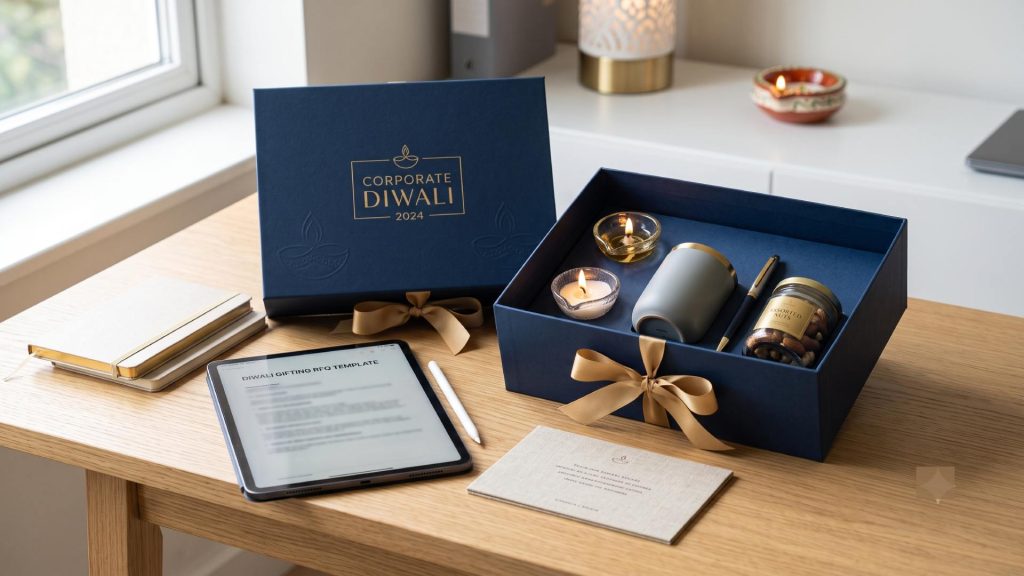
- Forces every vendor to quote on the same specification, so you compare like with like
- Splits pricing into per-piece + branding + packaging + freight + GST instead of one opaque number
- Pegs delivery to the actual Diwali date, not a vague “ASAP”
- Builds in compliance asks (GSTIN, DPDP data handling, itemised invoice) that Indian finance and legal teams need
- Creates a paper trail your audit and finance teams will thank you for
When to use an RFQ vs an RFP for Diwali gifting
These two get confused constantly, so here is the clean distinction for a gifting context:- Use an RFQ when you already know what you want — e.g. “500 branded gift boxes, each with a stainless-steel bottle, a diya set, dry fruits, and a personalised card, budget ₹1,200 per box.” You just need competing prices. This is the most common Diwali scenario.
- Use an RFP (Request for Proposal) when you want the vendor to design the solution — e.g. “We have ₹6 lakh and 400 recipients across three tiers; propose a creative concept.” Here you are buying ideas plus pricing.
The 8 building blocks of a strong Diwali gifting RFQ
Here is what every festive RFQ should contain, section by section. Copy the full template further down — this explains why each block earns its place.1. Buyer and issue details
Your company name, GSTIN, billing and delivery states, a single point of contact (name, email, mobile), the RFQ reference number, and the issue date. A named contact and reference number signal that you are a serious, organised buyer — and vendors quote their best price to serious buyers.2. Recipient tiers and quantities
Segment your list before you ask for a price. Most Indian companies split into:- All employees / staff (the largest, most price-sensitive tier)
- Team leads and managers (a mid tier)
- Key clients and VIP accounts (premium)
- CXO / VP / board and marquee clients (luxury)
- Vendors, channel partners, and dealers (often a separate practical tier)
3. Per-tier budget slabs (in INR)
Give a target per-piece budget for each tier. This is not “showing your hand” — it lets vendors curate to your number instead of over- or under-quoting. Common 2026 slabs seen across the Indian market:- ₹500-₹800: mass employee gifting for teams of 100+; a compact hamper (one branded item + one edible + a festive card)
- ₹800-₹1,500: the sweet spot for mid-size teams — premium without triggering audit questions or department-to-department disparity
- ₹1,500-₹2,500: senior staff, managers, and mid-tier clients; think smart bottles, quality drinkware sets, gourmet hampers
- ₹2,500-₹5,000+: CXO tier and marquee clients — presentation boxes, premium nuts, personalised note from leadership
4. Product and customisation specification
Be specific. For each tier, list the contents, the branding you want, and where the logo goes:- Contents: exact items in the box or hamper
- Branding method: screen print, UV print, laser engraving, embroidery, foiling, embossing — and on which item
- Personalisation: name on each item, individual recipient message, or a common festive card
- Packaging: rigid box vs kraft carton, ribbon, tissue, recipient-name tag, eco / plastic-free fillers
- Sample requirement: state clearly that a physical sample is required before bulk production
5. Itemised pricing table
This is the heart of the RFQ. Insist that every vendor fills a table with these columns, per tier:- SKU / item description
- Per-piece base price (before tax)
- Branding / customisation charge per piece
- Packaging per kit
- Freight per recipient or per consignment
- HSN code
- GST rate (%)
- All-in landed cost per piece (incl. GST)
6. Delivery timeline pegged to Diwali
Never write “ASAP.” Write the actual dates:- Sample approval deadline
- Bulk production window
- Dispatch date
- Required in-hand date (a safe 2-4 days before Diwali)
7. Compliance and documentation asks
For Indian procurement, this block is non-negotiable:- Active GSTIN (verifiable on the GST portal, not provisional)
- Itemised, HSN-coded, GST-split sample invoice
- DPDP Act 2023 data-handling note — where your recipient list is stored, who can access it, retention period (12 months post-delivery max), and destruction protocol. The vendor becomes a data processor the moment you share names and addresses
- Willingness to sign a mutual NDA covering recipient lists and artwork
- Replacement-at-vendor-cost clause for goods that fail QC against the approved sample
8. Submission deadline and quote validity
State the date and time by which quotes must arrive, the preferred format (a shared sheet is easiest), and a required quote validity (e.g. “valid for 30 days”). This prevents a vendor from re-pricing after you’ve made your decision.A worked example: filled RFQ pricing (so you know what “good” looks like)
Say you have 320 employees, 40 managers, and 25 key clients. A well-completed vendor response for the employee tier might read:- Item: branded gift box (steel bottle + diya set + 200g dry fruits + festive card)
- Per-piece base: ₹690 · Branding: ₹45 · Packaging: ₹60 · Freight: ₹35 · HSN: 2106 · GST: 18% · Landed ≈ ₹979 per box
- Item: rigid presentation box (premium nuts assortment + gourmet chocolate + leather-tag notebook + CEO note)
- Per-piece base: ₹2,850 · Branding: ₹120 · Packaging: ₹280 · Freight: ₹80 · HSN: 2106 · GST: 18% · Landed ≈ ₹3,930 per box
Common mistakes that sink a Diwali RFQ
- Sending it too late. After mid-September, customisation slots vanish and you get standard SKUs. Send the RFQ 6-8 weeks out.
- Accepting lump-sum quotes. “₹X per kit, all-inclusive” hides freight, branding, and GST. Reject it.
- Not asking for a sample. Digital mockups are not proof. Insist on a physical sample before bulk.
- Skipping HSN and GST split. This is where invoice pain and ITC (input tax credit) trouble start.
- Ignoring DPDP. Sharing 500 employees’ names and addresses with no data-handling agreement is a real compliance exposure.
- Inviting only one vendor. With no competing quote, you have no price band and no leverage. Invite at least three.
- Vague delivery date. “Before Diwali” is not a date. Write the in-hand date into the RFQ.
How RidgeGap responds to a Diwali gifting RFQ
At RidgeGap, we are built to answer exactly this kind of structured brief. With 10 years in corporate gifting, 300+ brands to choose from, and pan-India door delivery, we return itemised quotes by default — per-piece, branding, packaging, freight, HSN and GST split out — so your finance team never has to chase a hidden line. If you are shaping your festive brief, these RidgeGap resources map directly to the RFQ blocks above:- Curated Gift Boxes — the workhorse format for tiered Diwali hampers
- Luxury & CXO Gifting — presentation boxes for your ₹2,500+ tier
- Sustainable & Eco-Friendly Gifting — plastic-free packaging and recycled-content options
- Swag Packs and Customised T-Shirts — practical branded add-ons for the mass tier
- Corporate Diwali Gifts — our full festive range
- Contact Us — send us your filled RFQ and we will return a mapped, itemised quote
Frequently Asked Questions
What is a Diwali gifting RFQ template?
It is a standardised one-page document you send to gifting vendors to request comparable, line-item pricing for a bulk festive order. It captures buyer details, recipient tiers and quantities, per-tier budget slabs in INR, product and customisation specs, an itemised pricing table (with HSN and GST), a Diwali-pegged delivery timeline, compliance asks, and a submission deadline. It replaces a scattered WhatsApp price hunt with a clean, apples-to-apples comparison.When should I send a Diwali RFQ to vendors?
Send it 6-8 weeks before Diwali — practically, by mid-September. Most large custom orders in India close around then, and branded or personalised packaging needs an extra two weeks. Orders placed in the final week before the festival usually ship as standard SKUs with no customisation.How much do companies spend per employee on Diwali gifts in India?
Budgets typically range from ₹500 to ₹15,000+ per employee. The mass-employee sweet spot in 2026 sits around ₹800-₹1,500 per gift box; ₹500-₹800 works well for very large teams; managers and mid-tier clients land at ₹1,500-₹2,500; and CXO/VIP hampers run ₹2,500-₹5,000+. Actual spend depends on team size, customisation, and packaging.Is there a tax angle I should build into the budget?
Yes. Under current income-tax rules, non-cash gifts up to ₹5,000 per employee per financial year are generally exempt as a perquisite; the excess above ₹5,000 is taxable in the employee’s hands. Keeping mass employee gifts within roughly ₹500-₹2,500 keeps things clean. Always confirm the exact treatment with your finance team before large orders.What HSN code and GST rate apply to Diwali gift hampers?
There is no single “gift” HSN code — the rate follows the item. Mixed hampers are commonly classified under HSN 2106, chocolates under 1806, and dry fruits/nuts under 0802. A mixed hamper billed as one composite product often attracts 18% GST depending on the principal item. Ask the vendor to state and justify the HSN on the quote, and verify it yourself.RFQ or RFP — which should I use for corporate Diwali gifting?
Use an RFQ when you already know exactly what you want and just need competing prices — the most common festive scenario. Use an RFP when you want vendors to design the concept for a given budget and audience. Many teams run an RFP to shortlist, then send a tight RFQ to the final three vendors for pricing.How many vendors should I send the RFQ to?
At least three. One quote gives you no price band and no leverage. Three gives you a genuine market range and lets you disqualify outliers — the vendor who won’t itemise, won’t sample, or won’t sign a data-handling clause.What documents should I ask a Diwali gifting vendor for?
An active, portal-verifiable GSTIN; a sample HSN-coded, GST-split invoice; a DPDP Act 2023 data-handling note; willingness to sign a mutual NDA; and a replacement-at-vendor-cost clause for goods that fail QC against the approved sample.Resource: Download and adapt
Copy the template block above into Word, Excel, or Google Sheets and adapt the brackets to your order. For a ready itemised quote mapped to each RFQ block, share your filled template with the RidgeGap team at ridgegap.com/contact-us.Sources and references
- Income-tax perquisite treatment of employee gifts (₹5,000 exemption) — general guidance; confirm with your finance team
- GST/HSN classification for hampers, chocolates, and dry fruits — CBIC HSN directory and GST advisories
- DPDP Act 2023 — MeitY, for recipient-data handling
- Indian corporate Diwali budget benchmarks (2026) — market surveys from gifting suppliers

Pingback:Diwali Gifts for Startups: Best Ideas for 20–50 Employees
Pingback:MOQ for Customised Diwali Gift Boxes: Bulk Order Guide
Pingback:Are Diwali Gifts to Clients Tax Deductible in India?