Author Archives: ridgegap_user
Bulk Diwali Gifting: Planning, Budget and Pan-India delivery
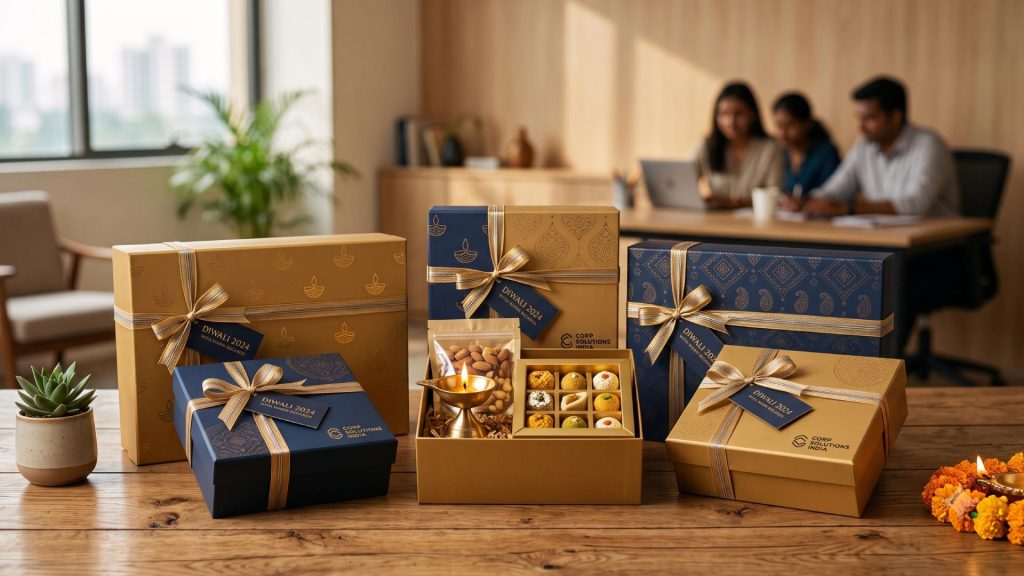
What Is Bulk Diwali Gifting?
Bulk Diwali gifting refers to ordering festive gifts, hampers, or curated gift boxes in large quantities – typically 50 units and above – for an organisation’s employees, clients, vendors, or business partners. Unlike retail Diwali shopping, bulk corporate gifting involves:- Volume-based pricing and slab discounts
- Company branding or logo placement on the gift or packaging
- Centralised billing with GST invoicing
- Pan-India or multi-city delivery, often to individual home addresses for remote and hybrid teams
- A dedicated timeline that works backwards from the festival date
Why Bulk Diwali Gifting Matters for Indian Businesses
Diwali gifting is not just a festive gesture in India; it is a cultural signal. Getting it right or wrong is noticed.- It boosts employee morale and retention. A well-timed, thoughtful Diwali gift tells employees their contribution is seen, especially heading into year-end appraisal season.
- It strengthens client and vendor relationships. Diwali is one of the few occasions where sending a gift to a client feels natural rather than transactional.
- It reflects brand identity. Branded packaging, custom hampers, and thoughtful curation communicate the same care a company puts into its products or services.
- It is cost-efficient at scale. Bulk pricing, festive-season vendor slabs, and combined logistics make per-unit costs significantly lower than individual gifting.
- It builds goodwill during India’s biggest festive period, when families, colleagues, and partners are all in a gift-giving mindset.
When to Start Planning Bulk Diwali Gifts (Timeline for 2026)
The single biggest reason bulk Diwali gifting goes wrong is a late start. Vendors get booked out, customisation slots fill up, and courier networks get congested closer to the festival. Here is a realistic planning timeline working backwards from 8 November 2026:- Early-mid August 2026: Finalise your budget per recipient category and shortlist 2-3 vendors.
- Late August – early September 2026: Request samples, confirm SKUs, and lock in your final hamper design or product mix.
- Mid-September 2026: Place your bulk order with confirmed quantities. Most vendors need 4-6 weeks for sourcing, branding, and packaging at scale.
- First week of October 2026: Confirm delivery addresses, especially for remote employees and multi-city offices.
- Mid-to-late October 2026: Dispatch begins so hampers reach recipients before Dhanteras (6 November) and definitely before the long weekend.
- Early November 2026: Buffer week for last-mile delivery delays, since courier volumes peak sharply in the two weeks before Diwali.
How to Budget for Bulk Diwali Gifting (Indian Pricing Guide)
One of the most searched questions around this topic is simply: how much should we spend per person? Indian corporate Diwali budgets are usually structured in slabs, and the right slab depends on the recipient’s relationship to the company.- Under ₹500 per person: Practical for large-scale employee gifting across factories, retail staff, or interns. Typically includes a diya, small sweets box, or a branded utility item.
- ₹500 to ₹1,000 per person: The most common slab for general employee gifting. Covers dry fruit boxes, mini gourmet hampers, or a branded desk item combined with festive sweets.
- ₹1,000 to ₹2,500 per person: Popular for mid-management, long-tenure employees, and regular clients. This range allows for curated gift boxes with a mix of gourmet items, home decor, and personalisation.
- ₹2,500 to ₹5,000 per person: Suited for senior leadership gifting, key clients, and strategic partners. Expect premium hampers, branded drinkware or travel accessories, and higher-end packaging.
- ₹5,000 and above per person: Reserved for CXO-level relationships, top-tier clients, or landmark business anniversaries, often involving luxury or fully bespoke gifting.
Best Bulk Diwali Gift Ideas by Recipient Type
Not every hamper works for every audience. Segmenting your bulk order by recipient type is one of the easiest ways to make a large gifting program feel personal rather than generic. For employees:- Dry fruit and gourmet snack hampers
- Personalised diyas, candles, or home decor pieces
- Branded desk accessories combined with festive sweets
- Wellness kits (aromatic candles, herbal teas, stress-relief items)
- Utility items such as branded bottles, backpacks, or travel accessories
- Premium dry fruit and chocolate combination hampers
- Curated gift boxes with a mix of gourmet and lifestyle items
- Branded drinkware or executive desk sets
- Handcrafted or artisanal decor pieces that reflect Indian culture
- Luxury hampers with premium chocolates, imported dry fruits, and fine drinkware
- Personalised leather accessories or premium travel kits
- Limited-edition or bespoke gift boxes with custom packaging
- Compact hampers that ship well and do not require refrigeration
- Combined utility-and-festive kits that work for home delivery
- Digital gift cards paired with a small physical token, for teams spread across multiple cities
How Bulk Ordering Actually Works: MOQ, Customisation, and Timelines
Most companies ordering Diwali gifts for the first time are unfamiliar with how bulk gifting workflows differ from retail purchases. Here is what to expect:- Minimum Order Quantity (MOQ): Most corporate gifting vendors set an MOQ for bulk pricing and branding to be viable, typically starting between 25 and 50 units. Below this, you may be charged closer to retail rates.
- Sample approval: Reputable vendors will send a physical sample of the proposed hamper before mass production or packing begins. Always insist on this step, especially for first-time orders.
- Branding and customisation: Logo printing, custom ribbons, branded tags, and personalised messages are usually available, but complex branding (embossing, custom packaging design) needs longer lead times than a simple logo sticker.
- Invoicing: Bulk corporate orders are billed with proper GST invoicing, which matters for both compliance and input tax credit where applicable. Confirm this upfront, particularly if you are working with a smaller or newer vendor.
- Delivery model: You can choose centralised delivery (all units to one office for internal distribution) or decentralised delivery (individual home addresses), which is now the default for hybrid and remote teams. Decentralised delivery needs a clean, verified address list well in advance.
How to Choose a Vendor for Bulk Diwali Gifting
With dozens of gifting companies competing for festive-season business, the right vendor is the one that treats your bulk order as a logistics project, not just a sale. Use this checklist before signing off:- Does the vendor have prior experience handling orders of your volume (100, 500, 1,000+ units)?
- Can they confirm a realistic delivery window and commit to it in writing?
- Do they offer sample approval before full production?
- Can they handle pan-India delivery, including tier-2 and tier-3 cities if your team is distributed?
- Do they provide GST-compliant invoicing for corporate procurement?
- Is customisation (branding, packaging, personalised notes) genuinely available, or just advertised?
- Do they have a track record with recognisable corporate clients?
- Is there a dedicated point of contact for your account during the festive rush, when response times elsewhere slow down?
Customisation and Branding Options for Bulk Orders
Branding is what separates a generic festive hamper from a gift that reinforces your company identity. Common customisation options for bulk Diwali orders include:- Logo printing on the outer box or hamper lid
- Branded ribbons, tags, or wax seals
- Custom Diwali greeting cards with a personalised message from leadership
- Co-branded packaging for gifts going to clients or partners
- Colour-matched packaging aligned to brand guidelines
- Personalised name tags for individual recipients within a large order
Pan-India Delivery and Logistics for Bulk Diwali Orders
Logistics is where most bulk Diwali gifting programs actually succeed or fail, not the gift selection itself. A few practical considerations:- Courier congestion peaks in the two weeks before Diwali. Dispatch early rather than aiming for the last possible date.
- Address verification matters more than people expect. With hybrid teams, a single outdated address can hold up an entire batch of dispatches.
- Multi-city and multi-office delivery needs a single point of coordination, ideally the vendor’s account manager, rather than split conversations across branches.
- Fragile items (glassware, ceramic diyas, certain gourmet products) need extra packaging consideration for long-distance shipping, especially to smaller towns.
- Track shipment status centrally so your HR or admin team can respond to delivery queries without chasing the vendor for updates individually.
Eco-Friendly and Sustainable Bulk Diwali Gifting
Sustainability has moved from a nice-to-have to an expectation in Indian corporate gifting, particularly for companies with ESG commitments. Eco-conscious bulk Diwali options include:- Reusable or upcycled packaging instead of single-use plastic wrapping
- Terracotta or clay diyas instead of plastic decor
- Organic and natural dry fruit or tea hampers
- Products from local artisans and small-scale manufacturers
- Seed paper greeting cards or plantable stationery
Common Mistakes to Avoid in Bulk Diwali Gifting
- Starting the process in late October. By then, most reliable vendors are fully booked for customisation and dispatch slots.
- Skipping the sample approval step to save time, only to receive a mass-produced batch that does not match expectations.
- Ignoring GST invoicing requirements until the finance team asks for it after the order is placed.
- Treating all recipients the same, which makes a one-size-fits-all gift feel impersonal for senior clients or long-tenure employees.
- Underestimating delivery timelines for remote employees or smaller towns, where courier networks are slower even in normal weeks.
- Not confirming a real point of contact at the vendor’s end for the festive period, when response times across the industry slow down significantly.
How RidgeGap Helps with Bulk Diwali Gifting
RidgeGap has spent 10 years managing corporate gifting at scale for organisations across Bangalore and pan-India, having delivered over 20,000 packages and completed 200+ projects for clients including Google, Amazon, JPMorgan, and BigBasket. For bulk Diwali gifting, that experience translates into:- Curated hampers across every budget slab, from under ₹500 to premium CXO-level gifting
- In-house branding and customisation, including logo placement, packaging, and personalised messaging
- Pan-India delivery with tracking, built for both centralised office delivery and individual home addresses
- A dedicated team managing sourcing, packing, and shipping end to end, so internal HR and admin teams are not managing vendor logistics themselves
- Transparent, GST-compliant bulk pricing with volume-based discounts
Frequently Asked Questions
What is considered a bulk Diwali gift order?
Most corporate gifting vendors treat orders of 50 units or more as bulk, with pricing and customisation benefits typically improving further at 100, 500, and 1,000+ unit thresholds.How much should a company budget per employee for Diwali gifts in India?
Most Indian businesses budget between ₹500 and ₹2,500 per employee, depending on seniority and company size, while client and leadership gifting often falls in the ₹2,500 to ₹5,000+ range.How far in advance should we place a bulk Diwali gift order?
Ideally 8-10 weeks before Diwali. For 2026, that means finalizing your order by mid-September so hampers can be sourced, branded, packed, and dispatched before the last-mile courier rush in early November.Can bulk Diwali gifts be customised with our company logo?
Yes, most vendors offer logo printing on packaging, branded tags, and personalised greeting cards as standard bulk-order customisation, with more complex branding like embossing or bespoke packaging needing longer lead times.Is it possible to deliver bulk Diwali gifts to employees working from home across different cities?
Yes, decentralised or individual home delivery is now the standard model for hybrid and remote teams, provided the vendor is given a verified address list well in advance of dispatch.Are eco-friendly Diwali gift options available for bulk corporate orders?
Yes, many vendors, including RidgeGap, offer sustainable options such as terracotta diyas, organic hampers, and recyclable packaging that scale to bulk order volumes.Do bulk Diwali gift orders come with GST invoicing?
Reputable corporate gifting vendors provide GST-compliant invoices for bulk orders, which is important for procurement compliance and, where applicable, input tax credit claims.What is the minimum order quantity for corporate Diwali gifts?
This varies by vendor, but most set an MOQ between 25 and 50 units for bulk pricing and branding to apply economically. Diwali 2026 falls on Sunday, 8 November, based on the Kartik Amavasya lunar calendar. For the full five-day festival calendar and regional variations, refer to established panchang and calendar sources when finalising your internal gifting and delivery timeline.Diwali Gifting for BFSI Companies Guide India 2026
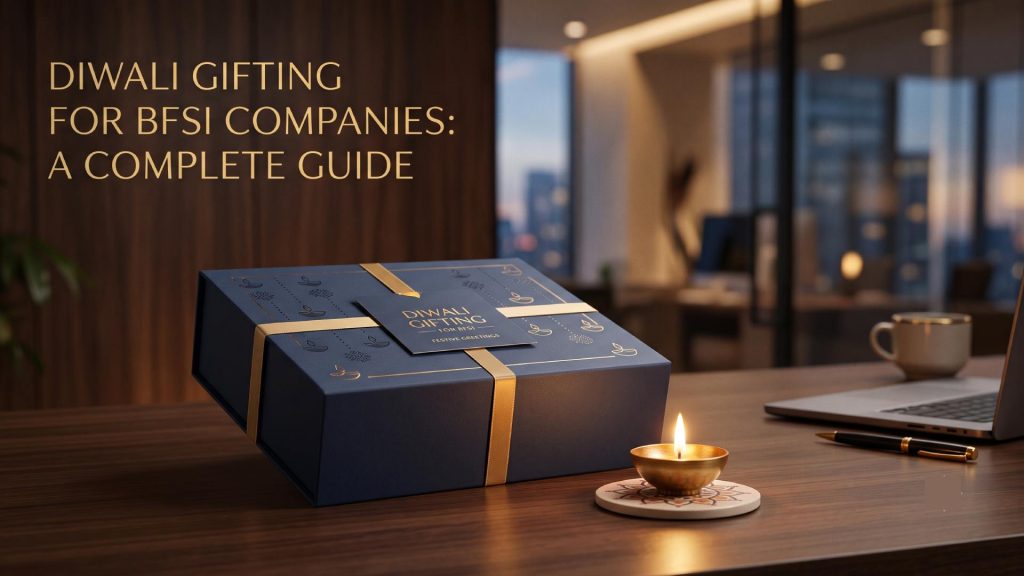
Why Diwali Gifting Works Differently in BFSI
Banking, financial services, and insurance companies operate under conditions that a typical corporate gifting vendor rarely plans around:- Scale and geography – A mid-sized private bank or NBFC can have branch staff, relationship managers (RMs), and field agents spread across 50 to 500+ locations, from metro hubs to Tier-2 and Tier-3 towns.
- Hierarchy sensitivity – The gift for a CXO, a zonal head, a branch manager, and a front-desk executive cannot be identical, but it also cannot look obviously unequal within the same grade.
- Client relationships that carry regulatory weight – Gifting a client, a channel partner, a DSA (Direct Selling Agent), or a broker in BFSI is not purely a goodwill gesture; it intersects with anti-bribery and conflict-of-interest norms.
- Vendor and partner ecosystems – Banks and NBFCs work with auditors, valuers, DSAs, and technology vendors who also expect festive acknowledgement, but within strict value ceilings.
- Tax and payroll implications – Any gift routed through payroll or given “in kind” to employees has income tax consequences that HR and finance teams have to account for before Diwali orders are even finalised.
The Compliance Layer Most Vendors Miss
This is where Diwali gifting for banks and financial institutions genuinely differs from gifting in any other sector.- Internal vigilance and gift policies – Public sector banks, several private banks, and NBFCs enforce internal vigilance guidelines that cap the value of gifts an employee can accept from a vendor, borrower, or business associate, and often require gifts above a nominal threshold to be declared or deposited with the institution.
- RBI and IRDAI expectations around inducement – Regulators discourage any gifting practice that could be read as an incentive linked to loan sanctions, insurance mis-selling, or preferential treatment of a client. Diwali gifts to clients or intermediaries should be modest, uniform, and clearly festive rather than transactional.
- Segregation between employee gifting and client/vendor gifting – Most compliant BFSI organisations run two separate gifting tracks: a warmer, higher-value track for employees (governed mainly by tax rules) and a conservative, value-capped track for external stakeholders like clients, auditors, and channel partners.
- Documentation – Finance and compliance teams typically want a clean invoice trail, per-unit costing, and a defined approval matrix before bulk Diwali orders go out – something worth confirming with your gifting vendor upfront.
Income Tax Angle: What HR and Finance Teams Should Know
Under current income tax provisions, gifts to employees up to Rs. 5,000 per employee per financial year are generally treated as a tax-exempt perquisite. Anything beyond this threshold gets added to taxable income for that employee. This is exactly why most BFSI Diwali gifting programmes are structured around three clean pricing bands:- Rs. 500 to Rs. 2,000 – safe, high-volume gifting for large branch and back-office teams, keeping the total well under the exemption limit even when combined with other festive gifts through the year.
- Rs. 2,000 to Rs. 5,000 – a mid-tier band for RMs, branch managers, and mid-level staff, still within exemption limits if it is the only major gift of the year.
- Above Rs. 5,000 – reserved largely for CXOs, zonal/regional heads, and top-performing relationship managers, where the taxable component is accepted and budgeted by HR in advance.
Diwali Gift Budgets for BFSI Teams (Indian Pricing)
| Recipient Group | Suggested Budget (INR) | What Works Best |
| Branch and back-office staff (bulk) | Rs. 500 – Rs. 1,500 | Festive hampers, dry fruits, diyas, desk items |
| Relationship Managers & field staff | Rs. 1,500 – Rs. 3,000 | Curated gift boxes, drinkware, tech accessories |
| Branch Managers & mid-management | Rs. 2,500 – Rs. 5,000 | Personalised gift sets, gourmet hampers, backpacks |
| Zonal/Regional Heads & CXOs | Rs. 5,000 – Rs. 15,000+ | Luxury CXO gifting, premium hampers, curated experiences |
| Clients, DSAs, auditors, vendors | Rs. 500 – Rs. 2,000 | Modest, branded, uniform across the group |
| New joiners onboarded pre-Diwali | Rs. 1,000 – Rs. 2,500 | Combined welcome + festive gifting |
Diwali Gift Ideas by Recipient in BFSI
For Bank & NBFC Employees (Branch and Corporate Office)
- Festive curated gift boxes with dry fruits, sweets, and a personalised Diwali card
- Desk accessories and diyas for employees who split time between branch and home
- Branded drinkware or lunch boxes that stay useful well past the festival
- Wellness-led hampers (herbal teas, skincare, healthy snacks) for a more contemporary feel
For Relationship Managers & Field Sales Teams
- Practical, travel-friendly gifting since RMs are constantly on the move between client visits
- Corporate laptop bags and backpacks with subtle branding
- Power banks, wireless chargers, or tech accessories that support a mobile working style
For Branch Managers & Mid-Management
- Personalised gift sets with the recipient’s name or designation
- Premium stationery, desk organisers, or engraved items for the cabin
- A short handwritten Diwali note from leadership – a small touch that lands well in relationship-driven roles
For CXOs, Zonal Heads & Senior Leadership
- Move into luxury and CXO gifting – premium hampers, curated experiences, or high-end lifestyle products
- Prioritise presentation and packaging as much as the product itself
- Keep the gesture personal rather than mass-produced, even at higher volumes
For Clients, Channel Partners, DSAs & Auditors
- Keep this track modest and uniform to stay compliance-safe
- Festive dry fruit boxes, sweets, or eco-friendly desk items work well
- Avoid anything that could be perceived as high-value or linked to a pending transaction
For New Joiners Who Onboard Just Before Diwali
- Combine a new joiner kit with a festive touch so the first impression doubles as a warm welcome
Segment-Specific Gifting Notes
- Private and public sector banks – High headcount, strict vigilance frameworks, and branch-level dispatch needs. Uniform, value-capped gifting for large groups is the safest and most efficient approach.
- NBFCs – Often have a large, geographically spread field force (collections, credit, sales). Practical, travel-friendly gifts tend to outperform decorative ones.
- Insurance companies – Agent and advisor networks are large and commission-linked, so gifting to this group should stay modest and clearly festive, separate from performance-linked rewards.
- Fintech and payments companies – Younger, tech-savvy workforce; tech accessories, sustainable products, and personalised swag resonate strongly.
- Wealth management and broking firms – Smaller, high-touch client base; this is where premium, personalised gifting for top clients makes the most business sense.
Logistics: Gifting Across Branches, Cities and Pin Codes
BFSI companies rarely gift from a single office. A realistic Diwali gifting plan needs to account for:- Pan-India, address-level delivery across branches, regional offices, and even individual employee homes for hybrid teams
- A single point of coordination so HR or admin does not have to manage 40 different branch-level vendors
- Bulk order handling with the ability to take a CSV of employee or branch addresses and ship without manual follow-up
- Quality consistency across every shipment, regardless of city or branch size
- On-time, trackable delivery, since a Diwali gift that arrives after the festival loses most of its value
Branding and Personalisation for BFSI Gifts
- Keep branding subtle on client-facing and DSA gifts – a small embossed logo works better than loud packaging
- Use personalisation (name, designation, or years of service) generously for employee gifts, since it drives the highest perceived value per rupee spent
- For deeper guidance on where to draw the line between personalised and standard gifting, see our comparison of personalisation versus standard gifts
Sustainable and Eco-Friendly Options
ESG commitments are now standard across listed banks, NBFCs, and insurers, and Diwali gifting is a visible, low-cost way to demonstrate that commitment.- Reusable diyas, plantable stationery, and organic sweets are increasingly common in BFSI hampers
- Explore our sustainable and eco-friendly gifting range if your CSR or ESG team wants this reflected in the festive budget
Gift Hampers vs Vouchers vs Gift Cards for BFSI Teams
Many BFSI HR teams debate between physical hampers and digital gift cards, especially for large, distributed workforces. Vouchers are easier to distribute digitally but can feel impersonal for a relationship-driven sector. Hampers carry more warmth but need tighter logistics planning. We have covered this trade-off in detail in our guide on gift hampers vs digital vouchers vs gift cards, which is worth reading before finalising your format.When Should BFSI Companies Start Planning Diwali Gifting?
- 8 to 10 weeks before Diwali – Finalise budget bands, get compliance/vigilance sign-off, and shortlist your gifting partner
- 6 to 8 weeks before Diwali – Lock product selection, branding, and personalisation requirements
- 4 to 6 weeks before Diwali – Share address lists (branch-wise or employee-wise) and confirm delivery windows
- 2 weeks before Diwali – Buffer period for quality checks and last-mile delivery, especially for Tier-2 and Tier-3 branch locations
Why BFSI Companies Choose RidgeGap for Diwali Gifting
RidgeGap has worked with corporate clients including JPMorgan and other large organisations on festive and everyday corporate gifting, with pan-India delivery, in-house customisation, and a live catalog spanning 20+ product categories. For BFSI clients specifically, this means:- Clear, tiered pricing that maps neatly to income-tax-safe budget bands
- The ability to run two parallel gifting tracks – a warmer employee track and a conservative client/vendor track
- Branch-level, address-level delivery across India with tracking
- A dedicated Diwali corporate gifting catalogue with price ranges from Rs. 500 to Rs. 7,000+
- Options ranging from curated gift boxes for bulk employee gifting to luxury CXO gifting for senior leadership
Frequently Asked Questions
- What is the best Diwali gift budget for BFSI employees in India?
- Are there restrictions on gifting clients or vendors in banks and NBFCs?
- Is Diwali gifting to employees taxable in India?
- What are good Diwali gift ideas for bank relationship managers?
- Can Diwali gifts be personalised for large BFSI teams across multiple branches?
- How do BFSI companies handle Diwali gifting across multiple cities and branches?
- Are eco-friendly Diwali gifts suitable for BFSI companies with ESG goals?
- Should Diwali gifts for clients differ from gifts for employees in BFSI?
- What is the ideal time to start planning Diwali corporate gifting for a bank or NBFC?
Diwali Gifts for Manufacturing and Factory Workers
| Note: Quick stat: Companies that invest in meaningful Diwali gifting for blue-collar employees see up to 28% improvement in retention rates during the post-festive season — one of the highest-attrition periods in Indian manufacturing. |
Why Factory Workers Deserve Thoughtful Diwali Gifts
In Indian corporate culture, Diwali gifting for office employees and senior management is well-established. What is still catching up is equivalent thoughtfulness for the workers on the production floor — the machinists, welders, assembly operators, quality inspectors, loading staff, and plant housekeeping teams who keep the business running. Gifting on Diwali is not merely a cultural obligation. For manufacturing businesses specifically, it serves four strategic purposes:- Retention: Post-Diwali attrition spikes as workers who visit their hometowns sometimes do not return. A meaningful gift signals that the organisation values them, making them more likely to come back.
- Morale and productivity: Acknowledged workers are engaged workers. Studies from Gallup and Aon Hewitt consistently show that recognition directly correlates with discretionary effort.
- Brand culture: How you treat your factory floor defines your employer brand — especially important as India competes globally for manufacturing investment.
- Legal and social compliance: Several labour laws and PSU guidelines require employers to demonstrate worker welfare, and Diwali gifting is a widely accepted form of that expression.
What Makes a Good Diwali Gift for Factory Workers?
Before diving into specific products, it helps to know the three lenses through which a factory worker evaluates a Diwali gift. Understanding these will help you choose wisely regardless of budget.1. Practicality Over Aesthetics
Factory workers — especially migrant workers who travel back to their hometowns for Diwali — value gifts they can use every day or carry home easily. A stainless steel thermos flask, a quality blanket, or a branded backpack will be remembered long after an ornamental showpiece has gathered dust.2. Durability
Life on the factory floor is physical. Gifts that survive rugged daily use — a Milton thermos, a Wildcraft backpack, a stainless steel tiffin — feel appropriate and respectful of the worker’s environment. Fragile glassware or electronic gadgets without warranties can backfire.3. Cultural Relevance
Traditional festive elements — diya sets, mithai, dry fruits, and anything auspicious linked to Lakshmi and Ganesha — carry deep emotional resonance. A gift that acknowledges the festival itself, not just the transaction of giving, lands much better. The combination of a practical item inside a festively designed hamper box is the sweet spot.| Note: Pro Tip from RidgeGap: If your factory has workers from multiple states — say, UP, Bihar, Rajasthan, and Tamil Nadu — choose culturally neutral gifts. Avoid region-specific sweets or attire that may not be familiar. Dry fruits, branded apparel, and utility items cross every regional preference smoothly. |
Budget Guide: Diwali Gifts by Price Range (Indian Pricing)
The single biggest question HR teams in manufacturing ask is: How much should we spend per person? Here is an honest breakdown based on our experience handling bulk Diwali orders across factory clients in Bengaluru, Pune, and NCR.| Budget per Person | Best Suited For | Top Gift Options |
| Rs.299 – Rs.500 | Contract labour, helpers, housekeeping staff | Dry fruit potlis, diya set with sweets, branded mug, small tiffin box |
| Rs.501 – Rs.1,000 | Floor workers, machine operators, assembly line staff | Thermos flask, sweet and dry fruit hamper, branded T-shirt, curated gift box |
| Rs.1,001 – Rs.2,000 | Technicians, quality inspectors, team leaders | Apparel + flask combo, Bluetooth speaker, gourmet hamper, branded backpack |
| Rs.2,001 – Rs.3,500 | Supervisors, senior technicians, shift managers | Power bank + charger kit, luxury curated hamper, branded backpack + thermos, electric kettle |
| Rs.3,501+ | Plant managers, senior supervisors, long-tenure employees | Premium branded bags, smartwatch, high-end gourmet hamper, kitchen appliances |
20+ Best Diwali Gift Ideas for Manufacturing and Factory Workers
Here is our curated list, built from years of handling corporate Diwali gifting for manufacturing clients across India. We have sorted these by category so your procurement team can plan segment-wise.Category 1: Food and Festive Hampers [Most Popular]
Food gifts are universally accepted, cross every religious and cultural boundary, and feel festive by nature. They work especially well for large workforces because they are easy to scale and personalise with festive packaging.- Premium Dry Fruit Hamper (From Rs.349 per unit) — Cashews, almonds, raisins, and pistas in a branded box or potli. A classic that never fails.
- Assorted Mithai Box (From Rs.299 per unit) — Desi ghee sweets, laddoos, barfi, and halwa — deeply auspicious and loved across all regions.
- Festive Combo Hamper (From Rs.499 per unit) — Sweets + dry fruits + a diya set in a branded box. The most gifted format for factory floor workers.
- Chocolate and Dry Fruit Mix (From Rs.399 per unit) — Handcrafted chocolates combined with premium dry fruits. Appeals to younger workers especially.
Category 2: Drinkware and Daily Essentials [Top Pick for Blue-Collar]
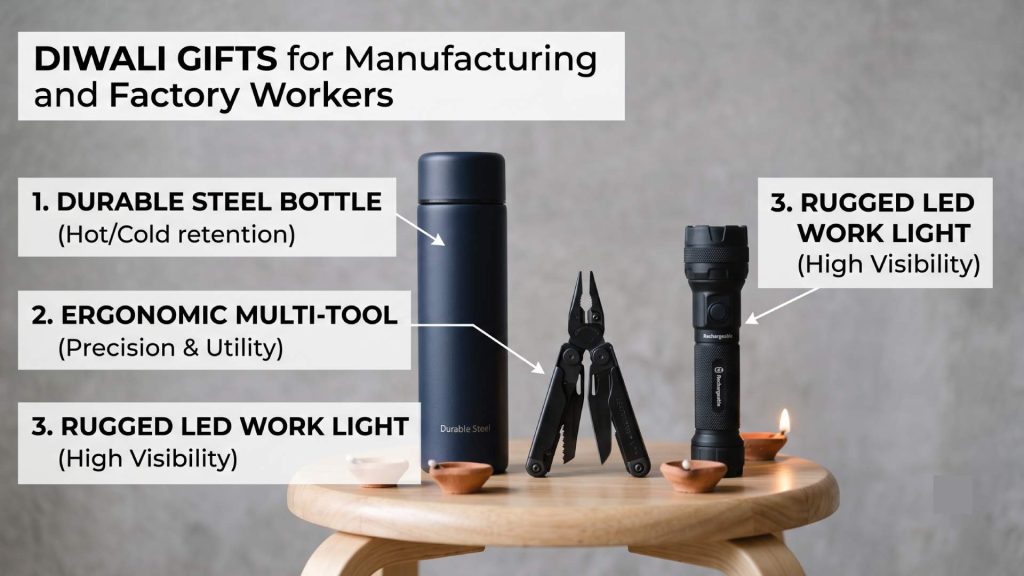
For factory and plant workers, nothing beats a gift they reach for every single day. Stainless steel drinkware is the single most appreciated category for this workforce segment, hands down.- Stainless Steel Thermos Flask (From Rs.549 per unit) — Branded vacuum-insulated flask. Keeps chai hot on cold morning shifts. Milton, Cello, and Borosil are top choices.
- Steel Water Bottle (From Rs.349 per unit) — Durable, BPA-free, branded with company logo. Practical on the production floor every shift.
- Stainless Steel Tiffin Box (From Rs.499 per unit) — 3-tier branded tiffin — practical for the daily commute, usable by the whole family at home.
Category 3: Apparel and Clothing [Diwali Tradition]
Gifting new clothes on Diwali is one of the oldest traditions in Indian culture. For factory workers, new clothing carries deep emotional meaning — it is a sign of prosperity and care. This is particularly powerful for migrant workers heading home for the festival.- Branded T-shirts or polo shirts (Rs.499 to Rs.999) — Can carry the company logo subtly on the chest. Van Heusen, Jack & Jones, and Wildcraft are popular choices. See ridgegap.com/customised-tshirts
- Kurtas for men (Rs.599 to Rs.1,299) — Cotton or khadi kurtas feel festive and appropriate for Diwali.
- Shawls or stoles for women workers (Rs.499 to Rs.899) — Warm and practical as winter begins.
- Blankets or fleece throws (Rs.699 to Rs.1,499) — Diwali falls at the onset of winter, making blankets an extremely thoughtful choice for plant floor workers.
Category 4: Bags and Travel Accessories [Bulk-Friendly]
Many factory workers are migrant workers who travel between their place of work and their hometown — especially around Diwali. A quality bag is one of the most genuinely useful things you can give them.- Branded Backpack (From Rs.999 per unit) — Durable 25L backpack from Skybags or Wildcraft. Used daily for commute and travel. A gift they will carry for years.
- Tote or Jute Bag (From Rs.299 per unit) — Eco-friendly branded tote. Lighter on budget, practical for daily grocery runs and travel.
- Multi-Purpose Duffel Bag (From Rs.799 per unit) — Perfect for the home-trip. Spacious, branded, and built to survive public transport travel.
Category 5: Tech and Electronics
Smartphone penetration among factory workers in India crossed 70% in 2023. Practical tech gifts are now more relevant than ever for this workforce segment, particularly among workers under 35.- Power banks (10,000 mAh) (Rs.799 to Rs.1,499) — One of the most requested gifts. Workers who commute long distances or face power cuts value a reliable power bank enormously.
- Earbuds or wired headphones (Rs.499 to Rs.1,299) — Portronics and Ambrane offer good quality at accessible price points.
- USB charging adapters or fast charger kits (Rs.399 to Rs.699) — Extremely practical for the daily routine.
- Portable Bluetooth speaker (Rs.999 to Rs.1,999) — A festival favourite — music during Diwali celebrations at home.
Category 6: Home and Kitchen Appliances
For Diwali, gifting something the entire family can use at home is deeply meaningful. These are particularly appreciated by workers who have families to gift-in-turn when they return home for the festival.- Electric kettle (Rs.799 to Rs.1,299) — Pigeon and Prestige are trusted brands at good price points.
- Sandwich toaster or hand blender (Rs.999 to Rs.1,799) — Practical kitchen additions the entire family benefits from.
- Casserole or insulated serving vessel (Rs.599 to Rs.1,199) — Serves the whole family at festive meals.
- Non-stick cookware set (small) (Rs.799 to Rs.1,499) — One of the highest-sentiment gifts for workers with families.
Category 7: Festive and Traditional Gifts [Culturally Resonant]
Do not underestimate the power of a gift that honours the spirit of Diwali itself. Traditional items have deep meaning and signal respect for the culture your workers come from.- Diya sets (handcrafted or LED) (Rs.149 to Rs.499) — Meaningful when paired with another item in a hamper.
- Lakshmi-Ganesha idol set (Rs.299 to Rs.799) — Auspicious and always welcomed. Opt for compact brass or resin versions that travel well.
- Pooja thali set (Rs.499 to Rs.1,099) — A complete festive offering that is genuinely used every year.
- Scented candles and incense set (Rs.299 to Rs.699) — A popular modern addition to traditional Diwali gifting. Easy to pair with other items in a curated box.
Category 8: Eco-Friendly Gifts [Sustainable Choice]
For manufacturing companies with ESG commitments or sustainability mandates, eco-friendly Diwali gifting is the way to go. These options pair well with your CSR narrative and increasingly appeal to younger workers.- Seed-paper greeting cards with a message from plant leadership
- Jute or organic cotton tote bags
- Bamboo flask or bamboo pen set
- Organic dry fruit hamper in reusable fabric wrapping
- Plantable diyas (embedded with flower seeds)
The Smart Choice: Curated Hamper Boxes for Factory Workers
If you are managing Diwali gifting for a factory of 200 to 10,000 workers, a pre-curated hamper box is the most efficient route. It saves procurement time, ensures consistency, looks professional, and can be fully branded with your company logo and a personalised festive message. The winning formula for a factory worker Diwali hamper, regardless of budget, is:- One practical item — thermos flask, bag, T-shirt, or similar
- One food item — dry fruit potli, mithai box, or gourmet snack mix
- One festive element — diya, small idol, or scented candle
- Branded packaging — a box printed with your company name and a Diwali message from leadership
Bulk Ordering for Manufacturing Plants — What You Need to Know
Ordering Diwali gifts for a large factory workforce is a logistics challenge as much as a gifting exercise. Here is what experienced procurement teams keep in mind:- Start 6-8 weeks before Diwali. Personalisation, sourcing, and pan India distribution takes time. Last-minute orders sacrifice quality and cost more.
- Segment your workforce. Use at least three tiers — floor workers, supervisors, and managers — with different gift values for each.
- GST and tax compliance. Gifts up to Rs.5,000 per employee per financial year are typically tax-exempt for the recipient. Amounts above that threshold attract tax as a perquisite.
- Minimum order quantities (MOQ). Most premium gifting solutions have an MOQ of 50-100 units. For branded customisation, plan for at least 100 units per SKU to get good pricing.
- Delivery address management. For pan India plants, a good gifting partner will handle centralised dispatch to multiple locations. RidgeGap delivers across Bengaluru, Pune, Chennai, Hyderabad, NCR, Mumbai, Ahmedabad, Surat, Ludhiana, Coimbatore, and more.
- Branded packaging minimum lead time. Custom printed boxes need 10-14 working days minimum for production. Factor this in.
| Note: RidgeGap advantage for manufacturing clients: With 10 years of corporate gifting experience and 20,000+ packages delivered, we handle everything from sourcing and branding to packaging and pan India logistics. Contact us at ridgegap.com/contact-us for a free quote. |
5 Common Mistakes to Avoid When Gifting Factory Workers This Diwali
- Going too generic with only sweets. A box of mithai shows minimal thought if that is the only thing in the package. Pair it with something functional.
- Choosing fragile items without proper packaging. Decorative glassware or diyas that arrive broken after shipping is a PR disaster, not a gift.
- Ignoring the packaging experience. A premium product in a plain brown box feels like a supply delivery. Branded, festive packaging transforms the perception of the gift entirely.
- Ordering too late. Last-minute bulk orders invariably suffer from poor quality control, limited product options, and premium shipping costs.
- A one-size-fits-all approach across all employee levels. Gifting the plant director the same thing as the maintenance worker sends the wrong signal on both sides.
Gifting Factory Workers Across India — City-Specific Notes
India’s manufacturing workforce is spread across distinct industrial belts, and the right gift can vary slightly by region and industry type:- Bengaluru and Karnataka: Manufacturing hubs for electronics, aerospace, and engineering. Workers here appreciate branded tech accessories and quality drinkware. RidgeGap is headquartered in Bengaluru and offers the fastest turnaround for Karnataka-based factories.
- Pune, Nashik, and Maharashtra: Automobile and auto ancillary belt. Practical gifts — bags, utility kits, home appliances — work best here.
- Gujarat (Ahmedabad, Surat, Vadodara): Textile and chemical manufacturing. Apparel gifts and eco-friendly options resonate strongly in Gujarati business culture.
- Chennai and Tamil Nadu: Auto, electronics, and garment factories. Branded polo shirts and steel drinkware are very well received.
- Ludhiana, Faridabad, Gurgaon, NCR: Garments, hardware, and light engineering. Blankets and warm apparel are ideal given the colder winters.
- Hyderabad and Telangana: Pharma and FMCG manufacturing. Health and wellness hampers are a natural fit given the industry.
Explore More from RidgeGap
- Corporate Diwali Gifts — Full Collection: ridgegap.com/corporate-diwali-gifts
- Curated Gift Boxes — Ready-to-Order Hampers: ridgegap.com/curated-gift-boxes
- Sustainable and Eco-Friendly Gifting: ridgegap.com/sustainable-eco-friendly-gifting
- Customised T-Shirts for Factory Workforce: ridgegap.com/customised-tshirts
- Drinkware — Thermos, Bottles and Tiffins: ridgegap.com/drinkwares
- Events and Promotional Gift Ideas: ridgegap.com/events-conference-promotional-gifts
- Swag Packs — Branded Multi-Product Kits: ridgegap.com/swag-packs
- Get a Free Quote: ridgegap.com/contact-us
Useful Resources for Planning Factory Diwali Gifting
- RidgeGap Corporate Diwali Gifts Page — Download Price Catalogues (Rs.500 to Rs.7,000 range): ridgegap.com/corporate-diwali-gifts
- Request a Free Quote and Consultation for Bulk Factory Orders: ridgegap.com/contact-us
- RidgeGap Blog — More Corporate Gifting Guides: ridgegap.com/blog
- Sustainable Gifting Options for Factories with ESG Goals: ridgegap.com/sustainable-eco-friendly-gifting
Frequently Asked Questions — Diwali Gifts for Factory Workers
Q: What are the best Diwali gifts for factory workers in India?
A: The best Diwali gifts for factory workers include stainless steel thermos flasks, dry fruit hampers, branded apparel (T-shirts, kurtas), curated hamper boxes, power banks, diya sets, and home utility items like electric kettles. Practical, durable gifts that workers can use daily are the most appreciated in this workforce segment. A budget of Rs.499 to Rs.1,000 per person is typical for floor-level workers, with higher tiers for supervisors and managers.Q: How much should I spend on Diwali gifts for manufacturing employees?
A: A typical Diwali gift budget in the Indian manufacturing sector is Rs.299-Rs.500 for contract and helper staff, Rs.501-Rs.1,000 for machine operators and assembly line workers, Rs.1,001-Rs.2,000 for technicians and team leaders, and Rs.2,001-Rs.3,500 for supervisors and senior staff. Bulk ordering of 500+ units usually reduces the per-unit cost by 20-30%.Q: How far in advance should I order Diwali gifts for a large factory?
A: For orders of 500+ units with branding, plan at least 6-8 weeks before Diwali. For orders of 100-499 units, 4-5 weeks is usually sufficient. Last-minute orders (under 2 weeks) typically sacrifice product quality, personalisation options, and delivery reliability — particularly problematic for multi-location pan India distribution.Q: Can I brand Diwali gifts for factory workers with our company logo?
A: Yes. Most corporate gifting providers offer full branding through screen printing, laser engraving, embossing, or embroidery depending on the product. Common items that accept branding include thermos flasks, T-shirts, bags, tiffin boxes, mugs, power banks, and the outer hamper box. Minimum quantities for branding are typically 50-100 units depending on the product and technique.Q: Are Diwali gifts to employees taxable in India?
A: Gifts up to Rs.5,000 per employee per financial year are generally exempt from tax in the hands of the employee under Indian income tax rules. Any amount above Rs.5,000 is treated as a taxable perquisite and must be added to the employee’s income. For the company, gifts to employees may be tax-deductible under Section 37(1) if they qualify as business expenses for employee welfare. Always verify with your CA for your specific company structure.Q: What eco-friendly Diwali gift ideas work for factory workers?
A: Eco-friendly Diwali gift options that work well for factory workers include jute or organic cotton tote bags, bamboo flask or stationery sets, plantable diya sets (embedded with flower seeds), organic dry fruit hampers in reusable fabric wrapping, and seed-paper greeting cards. These are particularly meaningful for manufacturing companies with CSR, ESG, or sustainability commitments and resonate well with younger workers.Q: Does RidgeGap deliver Diwali gifts pan India for factory clients?
A: Yes. RidgeGap handles bulk Diwali gift procurement, branding, packaging, and pan India door delivery for manufacturing clients across Bengaluru, Pune, Chennai, Hyderabad, NCR, Mumbai, Ahmedabad, Ludhiana, Coimbatore, and other industrial cities. For multi-plant companies, we coordinate dispatch to multiple locations from a single order. Contact the team at ridgegap.com/contact-us to plan your factory Diwali gifting programme.Diwali Gift Box Customisation Options for Indian Corporates 26
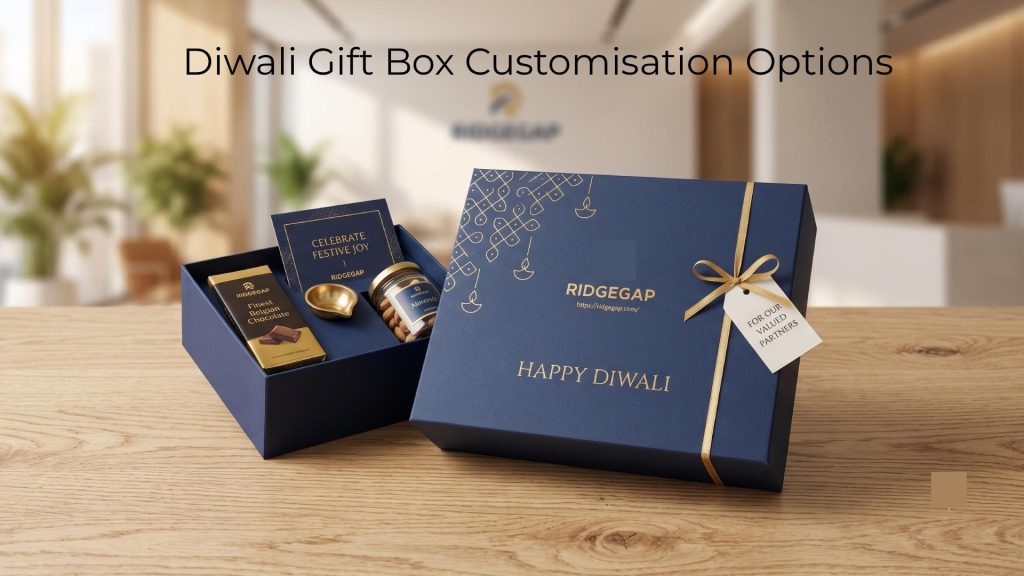
Why Gift Box Customisation Matters More Than the Gift Itself
Think about the last generic box of dry fruits and sweets you received. You probably do not remember the brand that sent it. Now think about a beautifully structured hamper that arrived with your name on a tag, a hand-picked assortment inside, and your vendor’s logo subtly placed on the sleeve. That one you remember. Corporate Diwali gifting in India has evolved from a transactional obligation to a strategic brand-building exercise. Companies that get it right see measurable returns: stronger client retention, higher employee satisfaction scores, and better employer brand visibility during the peak hiring season that follows Diwali. Customisation is the lever that makes all of this possible.The 7 Core Customisation Options for Corporate Diwali Gift Boxes in India
1. Box Design and Packaging Customisation
The packaging is the first impression. In the Indian corporate gifting market, packaging customisation typically includes:- Custom printed boxes with your company colours, logo, and festive artwork
- Branded sleeve wraps or belly bands — a cost-effective branding layer that slides over a standard box; typically priced at Rs. 30 to Rs. 80 per box depending on design complexity and quantity, making it ideal for orders of 250 and above
- Rigid gift boxes with magnetic closures for premium and CXO-level gifting
- Eco-friendly kraft paper boxes for brands with a sustainability mandate
- Festive potlis and fabric pouches that carry a distinctly Indian aesthetic, ideal for clients who value cultural resonance
2. Logo Branding and Brand Identity Integration
Logo placement is the most commonly requested customisation. Indian corporates typically choose from the following methods:- UV printing on rigid boxes and bottles for a clean, premium finish
- Screen printing on fabric pouches, tote bags, and apparel items inside the hamper
- Laser engraving on premium drinkware, pen sets, and metal accessories for a luxury feel
- Digital full-colour printing on sleeves, inserts, and greeting cards
- Embossing and debossing on leather or leatherette items for a CXO-grade look
3. Product Curation by Audience and Budget
The contents of the gift box should be curated based on who receives it. A one-size-fits-all approach no longer works for modern Indian companies with distributed, diverse workforces. For employees (mass gifting, budget range Rs. 500 to Rs. 2,000 per box):- WFH productivity kits: branded notebook, pen, cable organiser, and a premium mug
- Wellness hampers: herbal teas, essential oil candles, and a reusable glass bottle
- Snack and dry fruit assortments: premium salted nuts, trail mixes, and artisanal chocolates
- Desk refresh kits: sticky note pads, a branded tumbler, and a compact desk organiser
- Premium drinkware: insulated stainless steel flasks or copper bottles with laser engraving
- Artisanal food hampers: saffron honey, premium dark chocolates, gourmet nuts, and specialty teas
- Executive stationery: a leather-look diary with the recipient’s name debossed, a premium rollerball pen
- Tech accessories: wireless chargers, compact Bluetooth speakers, or branded power banks
- Luxury drinkware sets with crystal glasses and a branded decanter
- Premium lifestyle products: aromatherapy sets, spa kits, or artisan home decor
- Curated gourmet baskets with imported dry fruits, single-origin chocolates, and aged cheeses
- Custom-made, one-of-a-kind keepsakes unique to your brand
4. Personalisation at the Individual Level
The most impactful form of customisation in Indian corporate gifting is individual-level personalisation. This goes beyond putting a company logo on the box.- Recipient name tags: Printed or hand-written name tags attached to the ribbon or placed as an insert
- Personalised greeting cards: A message from the CEO, the HR head, or a team lead that addresses the recipient by name
- Name embossed on the primary item: A diary, mug, or bottle with the individual’s name makes the gift feel truly personal
- Custom message cards in regional languages: For pan-India employee teams, a greeting in the recipient’s regional language (Hindi, Kannada, Tamil, Telugu, Marathi) goes a long way in building cultural connection
5. Thematic Customisation: Aligning the Box with Your Brand Story
Forward-thinking Indian companies are now using the Diwali gift box as a brand storytelling medium. Thematic customisation means the entire box, from packaging to product selection to inserts, is built around a single narrative. Popular themes for corporate Diwali gift boxes in India:- Sustainability theme: Zero-waste packaging, reusable products, and organic or natural food items. Ideal for companies with ESG commitments. Browse RidgeGap’s Sustainable and Eco-Friendly Gifting collection for options that align with green mandates.
- Made in India theme: Products sourced exclusively from Indian artisans and local manufacturers, packaged in handloom fabric or jute. A powerful choice for companies that want to express cultural pride.
- Wellness and self-care theme: Essential oils, herbal teas, fitness accessories, and a mindfulness journal. Popular with tech companies whose employees work long hours.
- Celebration of lights theme: Diyas, candles, rangoli kits, and a sweet assortment that echoes the spirit of the festival without feeling generic.
- Brand colour theme: The entire box, including packaging, ribbon, tissue paper, and selected products, is coordinated in the company’s brand colours for a striking visual impact.
6. Packaging Format Variations for Different Gifting Scenarios
Not every Diwali gift box needs to be a traditional rectangular box. Indian corporates in 2026 are experimenting with a wider range of formats:- Hamper baskets: Ideal for festive display; products are arranged openly in a wicker or fabric basket, often used for client visits and in-office gifting
- Mailer boxes: Flat-packed, easy to ship, and cost-efficient for pan-India delivery to remote employees
- Rigid drawer boxes: A premium format with a sliding drawer mechanism, popular for CXO-level gifting
- Tin gift boxes: Reusable and visually distinctive; great for dry fruit and sweet assortments
- Festive crates: Wooden or MDF crates with a rustic aesthetic, popular for startup culture brands
7. Add-On Customisation: The Small Details That Create Big Impact
The details inside and around the box are often what make the biggest impression:- Custom tissue paper in brand colours with a subtle logo pattern printed on it
- Branded ribbon or twine in brand colours
- Wax seals with a company monogram for a premium, old-world touch
- Festive stickers and labels with Diwali artwork incorporating the company logo
- QR codes on inserts linking to a personalised video message from leadership
- Festive e-cards sent alongside the physical gift for remote employees who cannot receive the box on time
Indian Pricing Guide: What to Budget for Customised Diwali Gift Boxes
One of the most searched questions among Indian procurement teams is: how much should we spend on Diwali gifts for employees and clients? Here is a realistic benchmark for the Indian market in 2026:| Recipient Category | Budget Per Box (Rs.) | Recommended Customisation Level |
| General staff and blue-collar employees | Rs. 300 to Rs. 700 | Standard box, company sleeve, printed card |
| Office staff and junior employees | Rs. 700 to Rs. 1,500 | Branded box, personalised tag, 3 to 4 curated items |
| Senior employees and managers | Rs. 1,500 to Rs. 3,000 | Custom rigid box, name embossed item, premium curation |
| Clients and business partners | Rs. 2,500 to Rs. 5,000 | Full branding, luxury packaging, high-end products |
| CXOs, key accounts, and VIP clients | Rs. 5,000 and above | Bespoke box, luxury items, individual personalisation |
Minimum Order Quantities (MOQs) for Custom Diwali Boxes in India
MOQs vary by customisation level and gifting partner. Here is what Indian corporates can generally expect:- Standard branded sleeve or belly band: MOQ typically 100 to 250 boxes
- Custom printed box (digital print): MOQ typically 100 to 200 boxes
- Fully custom rigid box (offset print): MOQ typically 300 to 500 boxes
- Individual name embossing on products: MOQ varies by product; diaries and drinkware usually start at 50 to 100 pieces
- Custom made specialty packaging: MOQ typically 500 pieces and above
Procurement Timeline: When to Start Planning Your Diwali Gift Boxes
This is the section most companies skip reading until it is too late. Diwali 2026 falls on 20 October. Here is what the procurement calendar looks like for customised gift boxes:- June to July: Begin shortlisting gifting partners and finalising themes
- August (first two weeks): Lock vendor, finalise product selection, and submit branding assets
- August (last two weeks): Review digital mockups and approve sampling
- Early September: Place confirmed bulk order with all customisation details
- Mid September: Production begins; branded boxes and custom items go into manufacturing
- Late September to early October: Quality check, kitting, and packaging
- First week of October: Pan-India distribution begins for remote employees
- Second week of October: In-office and local deliveries completed before Diwali
What Indian Corporates Often Get Wrong in Diwali Gift Box Customisation
Learning from common mistakes is as valuable as knowing best practices:- Over-branding the box: Turning the gift box into a marketing billboard with the logo on every surface dilutes the warmth of the gesture. Aim for tasteful and strategic brand presence.
- Ignoring dietary and cultural inclusivity: India’s corporate workforce is diverse. Always offer a non-vegetarian-free and nut-allergy-friendly variant. Avoid items that may conflict with the dietary preferences of different religious communities.
- Skipping the packaging quality check: A beautifully curated hamper that arrives with crushed packaging destroys the unboxing experience. Always insist on a physical sample before approving the bulk order.
- Underestimating logistics complexity: Shipping 500 boxes to 12 cities with 500 different addresses is a logistics operation in itself. Work with a partner who has pan-India distribution capability, not just local delivery.
- Generic message cards: A standard “Happy Diwali from [Company Name]” card is the easiest element to personalise and yet the most commonly left generic. A short, sincere message from senior leadership, even if not individually addressed, dramatically improves how the gift is received.
RidgeGap’s Diwali Gift Box Customisation Advantage for Indian Corporates
RidgeGap is a Bangalore-based end-to-end corporate gifting partner trusted by companies including Google, Amazon, JP Morgan, Bigbasket, Unacademy, and Mercedes-Benz for their gifting requirements. For Diwali specifically, RidgeGap offers:- Full-service ideation, curation, customisation, kitting, and pan-India delivery under one roof
- Tiered gifting solutions across budget ranges from Rs. 500 to Rs. 15,000 and above
- Individual-level personalisation scalable from 50 to 5,000 boxes
- Eco-friendly and sustainable packaging options for brands with green commitments
- Dedicated account management so HR and procurement teams do not have to manage multiple vendors
- On-time delivery track record built over 200-plus projects and 20,000-plus packages delivered
Resources
- Corporate Diwali Gifts by RidgeGap
- Curated Gift Boxes
- Luxury and CXO Gifting
- Sustainable and Eco-Friendly Gifting
- Events, Conference and Promotional Gifts
- Swag Packs
- RidgeGap Blog: Corporate Gifting Insights
- Contact RidgeGap
Frequently Asked Questions (FAQs)
Q1. What are the best Diwali gift box customisation options for Indian corporates?
The most impactful customisation options for Indian corporates include custom printed packaging with company branding, individual name personalisation on premium items like diaries and drinkware, personalised message cards from leadership, and product curation that aligns with the recipient’s role and relationship with the company. For the best results, combine tasteful logo branding with thoughtful product selection and high-quality packaging.Q2. What is the minimum order quantity for customised Diwali gift boxes in India?
MOQs vary by customisation type. Branded sleeve wraps typically start at 100 to 250 boxes. Fully custom printed rigid boxes usually require a minimum of 300 to 500 boxes. For premium add-ons like individual name embossing on products, many vendors start at 50 to 100 pieces. Always discuss your exact requirements with your gifting partner to understand what is achievable within your quantity and timeline.Q3. How much should an Indian corporate spend on Diwali gifts per employee?
The most practical budget range for mass employee gifting in India is Rs. 700 to Rs. 2,500 per box. This range delivers good product quality, allows for meaningful customisation, and stays well within the Rs. 5,000 per employee per financial year income tax exemption limit. For senior staff, budgets of Rs. 2,500 to Rs. 5,000 are appropriate. CXO and key client gifting typically starts at Rs. 5,000 and can go significantly higher.Q4. When should Indian companies start planning Diwali gift box orders?
Ideally, planning should begin in June or July, with orders confirmed and submitted by August. Most vendors with customisation capability close their large bulk orders by mid-September each year. Companies that begin planning in September or October face limited customisation options, higher rush premiums, and greater delivery risk. Early planning gives you access to the full range of branding, packaging, and personalisation options.Q5. Can Diwali gift boxes be shipped across India for remote employees?
Yes. End-to-end corporate gifting partners like RidgeGap can manage pan-India distribution, including address-level delivery to remote employees in multiple cities. It is important to finalise employee address lists well in advance and discuss delivery timelines with your gifting partner. Some vendors also offer direct-to-employee shipping where each box is individually dispatched based on a CSV address file submitted by the company.Q6. Are eco-friendly Diwali gift box customisation options available in India?
Absolutely. Sustainable Diwali gifting is a growing priority for Indian companies with ESG mandates or green values. Options include kraft paper and recycled cardboard packaging, reusable jute or cotton potlis, plastic-free tissue paper, and products made from natural or organic materials. Brands committed to sustainability can build an entire Diwali gift box around a zero-waste theme without compromising on aesthetics or quality.Q7. What items should go inside a customised corporate Diwali gift box for clients?
For clients, the focus should be on quality over quantity. Premium drinkware with subtle branding, gourmet food items like artisanal chocolates and specialty nuts, a personalised message card from leadership, and an elegant outer box all combine to create a strong impression. Avoid items that are too generic or that every other company is likely to send. Uniqueness and quality create the lasting recall that strengthens the business relationship.Q8. How long does production take for customised Diwali gift boxes?
Standard customisation such as branded sleeves and printed cards can be turned around in five to seven working days. Fully custom printed rigid boxes typically require two to three weeks. Premium customisation like laser engraving, individual name embossing, and bespoke packaging designs can take three to four weeks or more, especially during the peak Diwali season when vendors are at full capacity. Always add a buffer of at least one to two weeks to your production estimate. Ready to start planning your Diwali gift boxes for this year? Get in touch with the RidgeGap team to discuss your brief, budget, and timeline. With 200-plus projects completed and 20,000-plus packages delivered, we bring the expertise, creativity, and operational capability to make your Diwali gifting program exceptional.Diwali Corporate Gifting for IT and Tech Firms 2026
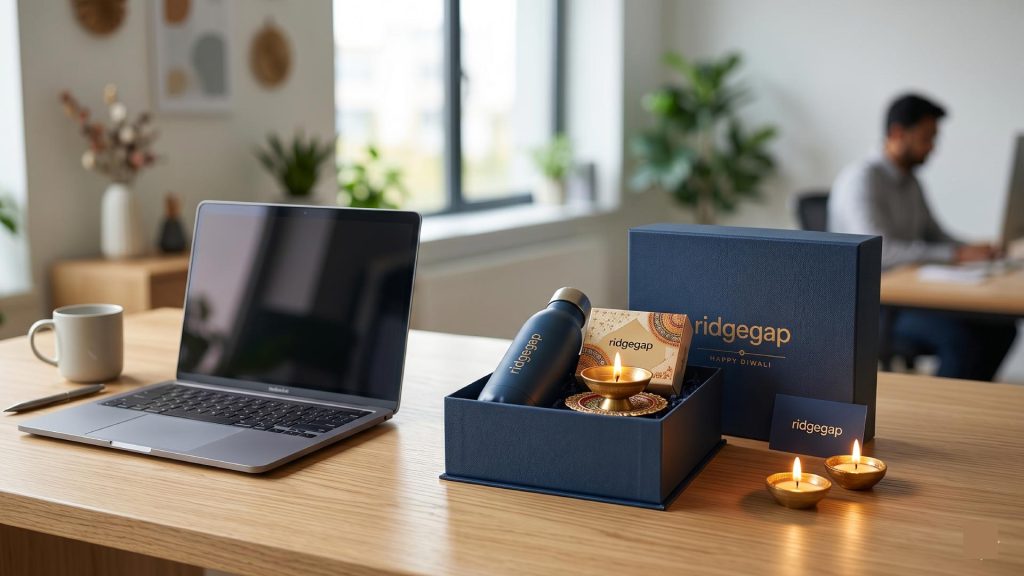
Why Diwali Gifting Matters More for Tech Companies Than You Think
India’s corporate gifting industry is valued at approximately Rs. 14,000 crore as of 2026, and the IT and technology sector is one of its largest and fastest-growing contributors. The reason is simple: tech companies employ large, diverse, and often geographically distributed workforces. Many of these employees — developers, QA engineers, product managers, data scientists, and DevOps professionals — work in high-pressure environments where recognition and appreciation are not always expressed in day-to-day interactions. A well-thought-out Diwali gift does several things at once:- It reinforces to employees that their contribution is seen and valued
- It strengthens loyalty, which is critical in a sector with notoriously high attrition
- It creates a positive, emotionally resonant brand touchpoint with clients and partners
- It aligns with annual performance cycles, since Diwali typically falls in Q3 and serves as a natural midyear morale moment
What IT and Tech Employees Actually Want as Diwali Gifts
This is the question most gifting guides skip, but it is the most important one. Tech employees are a specific audience. They tend to be:- Practical and utility-driven — they appreciate things they will actually use
- Brand-aware — they notice quality and can tell the difference between good and cheap
- Often working in hybrid or remote setups — gifts need to work both at a desk and at home
- Young and diverse — the gifting solution must feel inclusive and not culturally narrow
1. Tech Gadgets and Accessories (Rs. 1,500 to Rs. 5,000)
Nothing lands better with a tech professional than a well-chosen gadget. The key is to avoid generic gimmicks and focus on items with real daily utility.- Wireless Bluetooth earbuds or earphones from brands like Noise, JBL, boAt, or Sony
- Portable power banks — compact, high-capacity models from Ambrane or Portronics
- Wireless charging pads and multi-device charging stations
- USB-C hubs and laptop stands — increasingly popular with the remote and hybrid workforce
- Branded wireless mice and keyboards for home office setups
2. Premium Desk Accessories (Rs. 800 to Rs. 2,500)
For employees who spend most of their day at a workstation, a curated desk setup gift can be genuinely exciting. Think beyond a single pen or notepad.- Desk organizer sets with branded stationery
- Premium wireless charging desk pads
- Personalized leather or leatherette notebooks from brands like Sheaffer or Staedtler
- Cable management kits and desktop cable boxes
- Custom mouse pads with the employee’s name or a Diwali design
3. Curated Festive Gift Boxes and Hampers (Rs. 1,000 to Rs. 7,000)
The gift hamper format works especially well for Diwali because it allows you to combine functional items with festive elements — creating a sense of occasion that a single product cannot. A well-designed Diwali hamper for a tech employee might include:- A branded insulated flask or tumbler (Milton, Borosil, InstaCuppa)
- Premium dry fruits or artisan chocolates from brands like Smoor or a local gourmet supplier
- A custom Diwali greeting card with the employee’s name
- A small festive diya or tealight holder as a nod to the occasion
- A branded notebook or planner for the coming year
4. Swag Packs (Rs. 1,200 to Rs. 4,000)
Tech companies love swag, and Diwali is a perfect moment to combine festive gifting with branded merchandise. A well-assembled swag pack for Diwali typically includes:- A branded premium T-shirt or hoodie (Wildcraft, Van Heusen, Rare Rabbit)
- A branded laptop bag or backpack (Skybags, Wildcraft, American Tourister, Targus)
- A stainless steel or vacuum-insulated bottle
- A branded pen or Moleskine-style notebook
- Optional: a small festive token like a brass diya or festive sweet box
5. Luxury and CXO Gifts (Rs. 5,000 to Rs. 20,000+)
For senior leadership, key clients, and strategic partners, Diwali gifting needs to move into a different league entirely. The gift should communicate exclusivity, thoughtfulness, and premium quality. Popular luxury Diwali gift ideas for IT company leadership and clients include:- Premium leather laptop bags or briefcases with custom embossing
- Branded executive gift sets (pen, card holder, desk accessory in a luxury box)
- High-end audio gear like noise-canceling headphones from Sony or JBL
- Curated gourmet hampers with international chocolates, premium teas, and artisan nuts
- Customized crystal or metalwork showpieces
6. Eco-Friendly Diwali Gifts (Rs. 500 to Rs. 3,000)
For tech companies with strong ESG commitments or sustainability policies, eco-friendly gifting is not just a trend — it is a brand statement. Options in this space include:- Bamboo or recycled-material stationery sets
- Seed-paper Diwali greeting cards that can be planted after use
- Organic herbal teas, hand-poured soy candles, or natural skincare sets
- Jute or canvas branded tote bags
- Reusable stainless steel or bamboo drinkware sets
Diwali Gift Budget Guide for IT Companies: What to Spend on Whom
One of the most common questions from procurement and HR teams is how to structure the budget. Here is a practical framework used by many of Ridgegap’s tech company clients:| Recipient Tier | Suggested Budget (Per Person) | Recommended Gift Category |
| All employees (general) | Rs. 500 – Rs. 1,200 | Branded hamper, drinkware + sweet box, desk kit |
| Team leads and senior engineers | Rs. 1,500 – Rs. 3,000 | Tech accessory or premium swag pack |
| Managers and senior managers | Rs. 2,500 – Rs. 5,000 | Curated gift box or luxury hamper |
| Directors and VPs | Rs. 5,000 – Rs. 10,000 | Luxury CXO gift set or premium tech bundle |
| C-suite and strategic clients | Rs. 10,000 – Rs. 25,000 | Bespoke luxury gifting with premium packaging |
| Vendor and partner companies | Rs. 1,500 – Rs. 4,000 | Branded hampers or premium drinkware sets |
Diwali Gifting Planning Timeline for Tech Companies
The single biggest mistake IT companies make with Diwali corporate gifting is starting too late. Diwali 2026 falls in October, and the demand peak for corporate gifting suppliers hits in September. If your order is not placed by mid-August, you risk stock shortages, longer customization lead times, and delayed delivery — all of which reflect poorly on the company’s planning and employee experience. Here is a recommended planning timeline:- June to July — Strategy and budgeting Define the gifting tiers, total headcount, and per-person budget. Get internal approvals from finance and leadership.
- August — Vendor shortlisting and product selection Request catalogs, review product samples, compare pricing, and finalize your gifting partner. This is the ideal window to engage Ridgegap for a personalized consultation.
- Early September — Order placement and branding approval Confirm your order, submit logo files, approve packaging mockups, and lock in quantities. Custom branding and packaging typically require 10 to 15 working days.
- Late September to early October — Production and quality check Your order is in production. Request a sample batch for quality review before full-scale dispatch.
- 2 to 3 weeks before Diwali — Delivery window Coordinate delivery schedules for office-based and remote employees. For pan-India teams, staggered dispatch by location ensures everyone receives their gift before the holiday.
Why IT Companies in Bangalore Choose Ridgegap for Diwali Corporate Gifting
Ridgegap, based in Bengaluru, has spent more than 10 years building a reputation as the most reliable corporate gifting partner for IT and technology companies in the city and across India. Trusted by companies including Google, Amazon, JP Morgan, Bigbasket, Unacademy, Citrix, and Embibe, Ridgegap brings several distinct advantages to festive season gifting:- A catalog of 5,000+ products across 20+ categories, from tech gadgets and drinkware to apparel and luxury sets
- 300+ brand partnerships including Sony, JBL, Apple, Noise, Borosil, Milton, Wildcraft, Portronics, Targus, and more
- In-house customization for branding, packaging, and messaging on every order
- Pan-India delivery, including doorstep delivery for remote and hybrid employees
- Bulk order pricing with dedicated account management for IT company procurement teams
- Tiered Diwali catalogs at price ranges of Rs. 500-1000, Rs. 1000-2000, Rs. 2000-4000, and Rs. 2000-7000
- Eco-friendly gifting catalog from Rs. 500 to Rs. 2,000 for sustainability-first companies
Content Gap Insights: What Most Gifting Guides Miss for IT Companies
After reviewing the top-ranking articles on this topic, one major gap stands out: most guides treat corporate Diwali gifting as a one-size-fits-all exercise. They miss the specific operational, cultural, and logistical nuances that matter to IT and tech companies. Here are three areas that deserve more attention:- Remote and distributed team delivery. IT companies often have employees spread across Bengaluru, Hyderabad, Pune, Chennai, NCR, and even international locations. A gifting partner must offer individual doorstep delivery to all these pin codes, not just bulk delivery to one office address. Ridgegap’s pan-India delivery network supports this requirement with tracking and delivery confirmation.
- Tax implications of Diwali gifts in India. Under Indian income tax rules, gifts received by employees are exempt up to Rs. 5,000 per financial year. Gifts above this threshold are taxable in the hands of the employee as income from salary. Many IT companies are not aware of this, and it affects gifting tier decisions. Planning your Diwali gift per employee at or below Rs. 5,000 per financial year is both generous and tax-efficient for the recipient.
- Inclusion in diverse tech teams. Modern IT company workforces span multiple religions, dietary preferences, and cultural backgrounds. This means gifts that include alcohol, certain food items, or festival-specific religious symbols may not be appropriate for every employee. A thoughtfully curated tech-focused or lifestyle-focused gift avoids this issue while remaining universally appreciated.
New Joiner Kits + Diwali: A Smart Combination for Growing Tech Teams
Many IT companies hire aggressively in Q2 and Q3, meaning a significant portion of the workforce joining in August and September will experience their first Diwali at the company within weeks of onboarding. This is an enormous opportunity. Combining a new joiner welcome kit with a Diwali gift creates a powerful first impression — a moment that is both a functional welcome (here are the tools and branded items you need) and a warm cultural recognition (welcome to our team, and happy Diwali). This dual-purpose approach is increasingly popular among fast-growing startups and mid-sized IT companies. Ridgegap’s New Joiner Kits can be customized with festive elements for Diwali deliveries, and existing employee gifting can be coordinated to arrive at the same time for a unified moment of appreciation across the team.Resources
- Corporate Diwali Gifts for Employees and Clients — Ridgegap
- Annual Corporate Gifting Calendar for Indian Businesses — Ridgegap Blog
- Curated Gift Boxes — Ridgegap
- Luxury and CXO Gifting — Ridgegap
- Swag Packs — Ridgegap
- Tech Gadgets for Corporate Gifting — Ridgegap
- Eco-Friendly Corporate Gifts — Ridgegap
- New Joiner Kits — Ridgegap
- Contact Ridgegap for a Custom Quote
Frequently Asked Questions: Diwali Corporate Gifting for IT and Tech Companies
Q1. What are the best Diwali gifts for IT company employees in India?
The most popular and well-received Diwali gifts for IT employees are tech gadgets (wireless earbuds, power banks, charging hubs), curated gift hampers combining drinkware with gourmet items, premium swag packs with branded apparel and accessories, and desk kits. The best choice depends on the budget per person and the team profile.Q2. How much should IT companies spend on Diwali gifts per employee?
Most mid-to-large IT companies in India spend between Rs. 1,000 and Rs. 4,000 per employee for general Diwali gifts, with higher tiers (Rs. 5,000 to Rs. 25,000) reserved for senior management, CXOs, and key clients. The average budget per employee across the sector has grown from approximately Rs. 2,500 to Rs. 4,000 in recent years.Q3. Are Diwali corporate gifts taxable in India?
Yes, under Indian income tax rules, gifts to employees are tax-exempt up to Rs. 5,000 per financial year. Anything above this limit is treated as a perquisite and taxable as part of salary income. Gifts to clients and business partners are generally treated as business expenses and may be deductible under Section 37 of the Income Tax Act, subject to conditions.Q4. When should IT companies place Diwali gifting orders?
Ideally, orders should be placed between early August and mid-September. Placing orders this early ensures adequate time for product sourcing, customization, quality checks, and pan-India delivery before the Diwali week. Orders placed after September face longer lead times and potential stock shortages.Q5. Can Diwali gifts be delivered directly to remote employees at their homes?
Yes. Ridgegap offers pan-India doorstep delivery to individual employee addresses, which is essential for IT companies with distributed or hybrid workforces. You provide the address list, and the gifting partner manages last-mile delivery with tracking.Q6. What tech gifts work best for Diwali corporate gifting in 2026?
Wireless Bluetooth earbuds, power banks, USB-C multi-port hubs, laptop stands, wireless charging pads, and branded wireless mice are among the top-performing tech gifts for IT employees in 2026. These are practical, high-perceived-value items that employees use daily. Q7. Can we brand Diwali gifts with our company logo? Absolutely. Almost all items in Ridgegap’s catalog — including drinkware, apparel, tech accessories, bags, stationery, and packaging — can be branded with your company logo through screen printing, laser engraving, or UV printing. Custom packaging boxes with your brand colors and Diwali messaging are also available.Q8. Is there a minimum order quantity for Diwali corporate gifting?
Yes, most corporate gifting suppliers including Ridgegap have a minimum order quantity (MOQ) requirement, which varies by product type. For high-customization items like branded apparel or curated gift boxes, the MOQ is typically 50 to 100 units. Contact Ridgegap directly to discuss your specific requirements.Q9. What eco-friendly Diwali gift options are suitable for tech companies?
Eco-friendly options ideal for tech companies include bamboo drinkware sets, recycled-material stationery, organic herbal tea collections, soy wax candles, seed-paper greeting cards, and jute or canvas tote bags. These align well with ESG commitments and are appreciated by environmentally conscious tech workforces.Q10. How does Ridgegap handle large Diwali orders for IT companies?
Ridgegap assigns a dedicated account manager for large orders, handles end-to-end sourcing and customization, provides branded packaging, and coordinates dispatch and delivery with real-time tracking. Companies like Google, Amazon, Citrix, and Unacademy trust Ridgegap for their festive gifting needs. To start planning your Diwali order, get in touch here.Diwali Gift Hamper Quotes: Personalized Wishes and Captions for Corporates
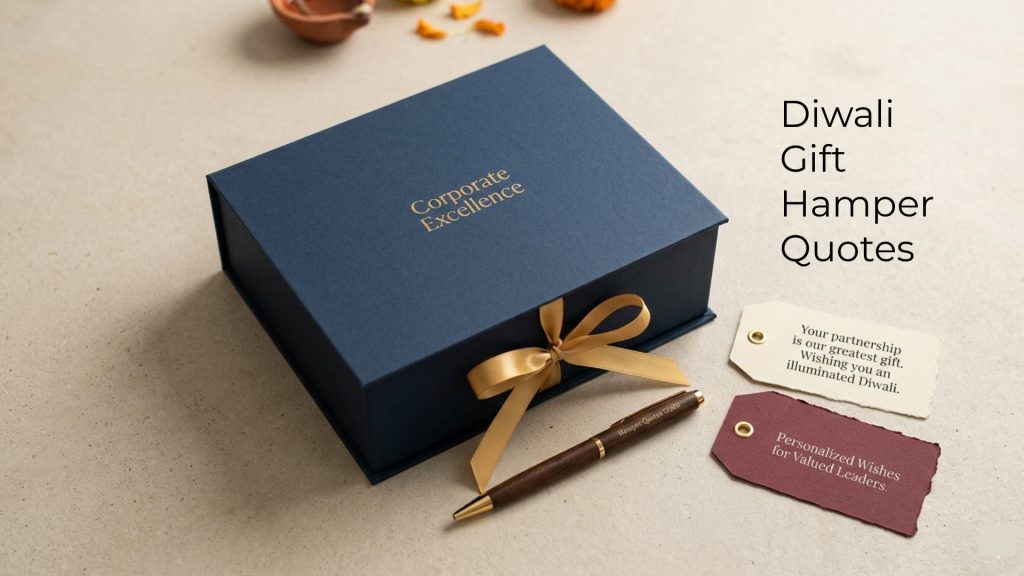
Why the Message Card Matters as Much as the Hamper
Before diving into the quotes, it helps to understand the psychology at play. In the Indian corporate gifting market, the average spend per employee during Diwali ranges from Rs 500 to Rs 3,000, while CXO-level and key client hampers often go up to Rs 5,000 to Rs 10,000. But research consistently shows that recipients remember the gesture – and specifically the personal touch – far more than the price of the product. A handwritten or personalised printed note inside a hamper achieves three things that the hamper itself cannot:- It addresses the recipient by name, making the gift feel individual rather than mass-distributed
- It communicates your brand’s values – warmth, professionalism, gratitude – in your own voice
- It gives the recipient something to share on LinkedIn or with their team, extending your brand’s reach organically
Diwali Gift Hamper Quotes for Employees
These messages work well on printed cards inside hampers going to your team – whether it is 10 people or 10,000. Keep the tone warm, appreciative, and genuine. Short and Professional:- “Your dedication lights up this organisation every single day. Wishing you a Diwali filled with joy, health, and everything you deserve. Happy Deepavali!”
- “This Diwali, we celebrate not just the festival of lights – but the brilliant people who make our workplace shine. Thank you for everything. Shubh Deepavali!”
- “Behind every milestone we achieved this year, there was your hard work. Here is a small token of our immense gratitude. Wishing you and your family a very Happy Diwali.”
- “May this Diwali bring you the same brightness, energy, and enthusiasm you bring to work each day. From all of us at [Company Name].”
- “You are not just a team member – you are the reason we grow. Wishing you a prosperous and joyful Deepavali. Happy Diwali!”
- “Diwali is a reminder to count our blessings – and you are among ours. Thank you for your trust, your effort, and your spirit. Wishing you a luminous celebration with your loved ones.”
- “As diyas illuminate homes this season, your contributions illuminate this company. Here is to you and to a year full of new opportunities. Shubh Deepavali!”
- “We hope this little hamper adds a little more sweetness to your Diwali. You have earned it and so much more. Happy Deepavali from the [Company Name] family.”
- “The lights of Diwali remind us that even the smallest flame can brighten the darkest room. Thank you for being that light for us this year.”
- “Celebrating Diwali is all the more meaningful when we do it with people who truly matter. Glad to have you on the team. Wishing you abundant joy this festive season.”
- “As we celebrate another Diwali together, I want to personally thank you for your resilience, creativity, and commitment this year. May this season bring your family peace, health, and prosperity. – [Founder Name]”
- “Great companies are built by great people. This Diwali, we celebrate you. Thank you for being the foundation of everything we have built together.”
- “On behalf of the entire leadership team, we wish you and your family a very Happy Diwali. Your work has made us proud – enjoy this well-deserved celebration.“
Diwali Gift Hamper Quotes for Clients and Business Partners
Client-facing messages require a slightly more formal but equally warm tone. These quotes work well for premium hampers sent to key accounts, long-term partners, or prospective clients you want to deepen relationships with. Professional and Brand-Aligned:- “Thank you for your trust, your partnership, and the privilege of working alongside you. Wishing you a Diwali filled with prosperity and new beginnings. With gratitude, Team [Company Name].”
- “Our partnership has been one of the highlights of this year. As we celebrate Diwali, we look forward to many more years of growing together. Shubh Deepavali!”
- “May the lights of this Diwali illuminate a path to new opportunities for your business and your team. Warm festive wishes from [Company Name].”
- “In the spirit of Diwali – a festival that celebrates victory of light over darkness – we are grateful for the light your partnership has brought to our journey. Happy Deepavali!”
- “Partnerships are built on trust, and trust is built on commitment. Thank you for both. Wishing your organisation a bright and prosperous Diwali.”
- “As Diwali approaches, we take a moment to reflect on the relationships that truly matter – and yours is among the most valued. Wishing you and your leadership team a celebration full of warmth and success.”
- “This Diwali, we express our deepest appreciation for your continued confidence in us. May this season mark the beginning of even greater things ahead for your company and ours.”
- “From our team to yours – thank you for a year of exceptional collaboration. We are grateful, inspired, and proud to call you a partner. Shubh Deepavali.”
Diwali Captions for Social Media and Corporate Communications
If your company posts Diwali wishes on LinkedIn, Instagram, or sends a branded email blast, these captions and one-liners are crafted to perform well – professional, warm, and shareable. LinkedIn and Email-Friendly Captions:- “This Diwali, we are grateful for every client who trusted us, every team member who showed up, and every partner who believed in what we are building. Wishing everyone a bright Deepavali!”
- “Lights, sweets, and the joy of giving – that is Diwali for us at [Company Name]. Happy Diwali to our clients, partners, and team across India!”
- “From our family to yours – may this Diwali bring warmth, prosperity, and every blessing you deserve. Shubh Deepavali!”
- “Behind every festival is a story of people coming together. This Diwali, we celebrate ours. Happy Deepavali!“
- “Lighting up the season with gratitude. Happy Diwali!”
- “May your Diwali be as bright as your achievements. Shubh Deepavali!”
- “Here is to new light, new goals, and new victories. Happy Deepavali!”
- “Celebrate big. Gift thoughtfully. Diwali 2025 is here.”
- “Warmth, joy, and a little something extra – that is what we are sending your way this Diwali.”
- “This Diwali, let the diyas do the talking. But just in case – thank you for everything. Happy Deepavali!“
How to Personalise Diwali Hamper Quotes at Scale
For corporates sending anywhere from 50 to 5,000 hampers, personalisation at scale is both a challenge and an opportunity. Here is how leading companies across Bengaluru, Hyderabad, and Delhi NCR do it:- Use the recipient’s first name wherever possible. A card that reads “Dear Priya” lands 3x better than one that says “Dear Valued Employee.” Most corporate gifting platforms – including RidgeGap – allow you to submit a data file with names and auto-generate personalised printed cards.
- Segment your messages by recipient group. Keep at least three versions of your message:
- One for employees (warmer, team-centric)
- One for clients and vendors (professional, gratitude-focused)
- One for senior leadership / CXO contacts (brief, high-quality language, leadership signature)
- Align tone with hamper price point. A Rs 500 to Rs 800 hamper for all employees can carry a cheerful, inclusive message. A Rs 4,000 luxury hamper for a key client deserves a bespoke, handcrafted note – even if it costs extra.
- Print, do not handwrite at bulk scale. For orders above 100 units, high-quality digital printing on thick card stock looks more professional and consistent than handwritten notes. RidgeGap’s curated gift boxes come with options for custom-printed inserts with your logo and message.
- Double-check for typos and cultural sensitivity. Diwali message cards go through zero editorial layers at most companies. A typo or an awkward phrase on a card being sent to 2,000 employees is a brand crisis waiting to happen. Always review a print proof before bulk production.
Diwali Hamper Price Guide for Indian Corporates (2025)
One of the most common questions HR managers and procurement heads ask is: “How much should we spend per person on Diwali gifts?” Here is a practical Indian market guide:| Recipient Category | Recommended Budget (INR) | Suggested Hamper Type |
| Support Staff / Field Teams | Rs 500 – Rs 800 | Sweets + Dry Fruits + Diya Set |
| Executive Employees | Rs 1,000 – Rs 2,000 | Premium Snacks + Branded Utility Items |
| Senior Managers | Rs 2,000 – Rs 4,000 | Curated Lifestyle Hamper + Branded Box |
| Key Clients / Vendors | Rs 3,000 – Rs 5,000 | Premium Gift Hamper + Custom Message Card |
| CXO / Strategic Partners | Rs 5,000 – Rs 10,000+ | Luxury Hamper + Artisan Products + Personalised Packaging |
What to Include in a Corporate Diwali Gift Hamper (Beyond the Usual)
Most generic Diwali hampers in the Indian market include kaju katli and a box of mithai. In 2025, the best corporate hampers go further. Here is what differentiates a memorable hamper from a forgettable one:- Branded packaging: Your company logo on the box or ribbon makes the hamper feel intentional, not off-the-shelf
- Personalised message card: As covered above – this is now table stakes for premium gifting
- A mix of functional and festive items: Premium dry fruits, artisan chocolates, diyas or candles, and one or two useful items (a diary, a tote bag, or branded stationery) create a hamper that has staying power
- Sustainable or eco-friendly elements: More and more Indian corporates are opting for sustainable gifting – jute packaging, bamboo products, and recyclable materials align with ESG commitments and resonate with environmentally conscious recipients
- GST invoice: Any Diwali gifting spend above Rs 50 per person needs a proper GST invoice for accounting. Ensure your vendor provides one – RidgeGap does this as standard for all corporate orders
Diwali Gift Hamper Etiquette for Indian Corporates
A few practical reminders that experienced corporate gifting managers in India always follow:- Order early. The Diwali gifting window in India runs from mid-September to the week of Diwali. Stock runs out fast for premium items, and delivery timelines can stretch to 10-15 days for customised orders. Most companies in Bengaluru and Hyderabad start placing bulk orders in August.
- Avoid alcohol in hampers unless you know the recipient personally. Many organisations have strict policies, and in a diverse workforce, it is safer to default to non-alcoholic gourmet options.
- Check your company’s gifting policy. Several listed companies and MNCs have limits on the value of gifts that can be received – typically Rs 2,500 to Rs 5,000 per individual. Staying within this range for client gifts is good governance.
- Plan for excess. Always order 5-10% more hampers than your confirmed count to account for last-minute additions, new joiners, or missed deliveries.
Why RidgeGap is Bengaluru’s Preferred Corporate Diwali Gifting Partner
RidgeGap has delivered over 20,000 corporate gift packages across India, working with companies like Google, Amazon, JP Morgan, Mercedes-Benz, and BigBasket. For Diwali, they offer:- Full-service hamper curation from Rs 500 to Rs 7,000+ per unit
- Branded packaging with your company logo and custom inserts
- Personalised message cards printed with recipient names
- Bulk order discounts for orders of 50 units and above
- GST invoicing for all corporate orders
- Pan-India delivery coordination for distributed teams
- End-to-end project management – from concept to doorstep
FAQ: Diwali Gift Hamper Quotes and Corporate Gifting India
Q1. What is a good personalised Diwali message for employees?
A good Diwali message for employees should address them warmly, acknowledge their contributions during the year, and extend genuine wishes for the festive season. Keep it between 2-4 sentences. An example: “This Diwali, we celebrate not just the festival of lights – but the brilliant people who make our workplace shine. Thank you for your dedication and passion. Wishing you and your family a very Happy Diwali!”Q2. What should I write on a Diwali gift hamper card for clients?
For clients, keep the tone professional yet warm. Thank them for their partnership, acknowledge the year gone by, and wish them prosperity. Avoid overly familiar language. A solid example: “Thank you for your continued trust and partnership. Wishing your team a Diwali filled with new opportunities and lasting success.”Q3. How do I personalise Diwali hamper messages for 500+ employees?
Submit a name list to your gifting vendor. Most providers like RidgeGap can print personalised message cards that include each recipient’s first name and a common company message. This approach balances personalisation with operational efficiency for large bulk orders.Q4. What is the average Diwali gift hamper price per employee in India?
In 2025, Indian corporates typically spend Rs 800 to Rs 2,500 per employee on Diwali hampers, depending on seniority and company policy. For key clients and CXO-level contacts, the range extends to Rs 5,000 and above.Q5. Should I include a Diwali quote in English or Hindi on the card?
For pan-India corporate teams, English is the safest choice as it is universally understood across regions. However, adding a short Hindi or regional language phrase – like “Shubh Deepavali” or “Subh Diwali” – adds cultural warmth without creating confusion.Q6. How early should I place my corporate Diwali hamper order in India?
Most experienced procurement managers place orders 6-8 weeks before Diwali – typically in August or early September – to secure stock, allow time for custom branding, and avoid last-minute delivery issues. For orders above 500 units, start even earlier.Q7. Can RidgeGap handle customised Diwali hampers with printed message cards?
Yes. RidgeGap offers end-to-end Diwali gifting solutions including branded packaging, printed personalised message cards, and GST invoicing for bulk corporate orders. Contact them at https://ridgegap.com/contact-us/ to get a custom quote.Q8. What is the GST rate on corporate Diwali gifts in India?
GST on corporate gifts in India varies by product category – typically 5% to 18% depending on the item. It is advisable to get a line-item GST invoice from your gifting vendor. Note that gifts to employees above Rs 50,000 per year may be subject to perquisite tax under the Income Tax Act. Consult your finance team for specifics.Resources
- Corporate Diwali Gifts for Employees and Clients – RidgeGap
- Curated Gift Boxes – RidgeGap
- Luxury and CXO Corporate Gifting – RidgeGap
- Sustainable and Eco-Friendly Corporate Gifts – RidgeGap
- Swag Packs for Teams – RidgeGap
- Special and Custom-Made Gifting Projects – RidgeGap
- Contact RidgeGap for a Bulk Gifting Quote
Corporate Gifting vs Promotional Merchandising Strategy 2026

What Is Corporate Gifting?
Corporate gifting is the practice of sending a thoughtfully selected, often personalised gift to a specific individual, usually an employee, a client, a business partner, or a senior stakeholder, as a deliberate act of appreciation, relationship-building, or recognition. The keyword here is intent. A corporate gift is meant to make one person feel genuinely valued. It is a communication tool that says: “We see you, we appreciate you, and we want this relationship to continue.”Common scenarios where corporate gifting applies:
- Welcoming a new employee with an onboarding kit
- Thanking a key client after a successful project
- Recognising an employee milestone, like a work anniversary or performance award
- Sending Diwali or festive hampers to senior stakeholders
- Gifting CXOs, directors, or investors during important business moments
- Curated gift boxes for a company retreat or offsite
What Is Promotional Merchandising?
Promotional merchandising, on the other hand, is about reach and recall at scale. Promotional products are branded items distributed to a wide, often anonymous audience with the primary goal of increasing brand visibility, capturing attention, and leaving a lasting impression on as many people as possible. The keyword here is volume. Promotional merchandise works best when quantity matters more than personalisation.Common scenarios where promotional merchandising applies:
- Product launch events and trade fairs
- Conference and expo giveaways
- Event and conference promotional gifts at industry summits
- Brand activations on college campuses or retail touchpoints
- Distributing branded items to walk-in customers or social media contest winners
- Large-scale employee engagement drives where everyone gets the same item
The Core Differences: A Side-by-Side Breakdown
Understanding where one ends and the other begins is the single most valuable decision a procurement or marketing head can make before allocating budget.1. Purpose and Primary Goal
Corporate gifting is fundamentally a relationship investment. The goal is to deepen a specific bond with a known individual. Promotional merchandising is a brand awareness tool. The goal is to maximise impressions across a broad audience. A personalised leather journal gifted to your top client during their company anniversary is corporate gifting. A hundred branded pens handed out at a startup expo stall is promotional merchandising.2. Recipient Profile
- Corporate gifts go to known, named individuals: employees, clients, CXOs, channel partners, or suppliers. The recipient is someone the company actively wants to retain or reward.
- Promotional merchandise goes to a broad, often undefined group: event attendees, prospective customers, social media followers, or trade show visitors. The recipient is someone the brand is trying to attract.
3. Budget and Pricing in the Indian Market
This is where the difference becomes very practical. Indian pricing benchmarks differ significantly between the two categories. Corporate gifting budget per person in India:- Entry-level (for junior employees or mass festive gifting): Rs 300 to Rs 800 per unit
- Mid-range (for clients, partners, senior employees): Rs 800 to Rs 3,000 per unit
- Premium (for CXOs, key clients, luxury hampers): Rs 3,000 to Rs 15,000 per unit and above
- Luxury / custom executive gifting: Rs 15,000 and above per unit
- Standard giveaways (pens, keychains, badges, lanyards): Rs 30 to Rs 150 per unit
- Mid-range promotional products (T-shirts, caps, tote bags, notebooks): Rs 150 to Rs 500 per unit
- Premium event merchandise (branded backpacks, drinkware, tech accessories): Rs 500 to Rs 1,500 per unit
4. Customisation and Personalisation
Corporate gifts often carry a personal touch beyond just a logo. They may include the recipient’s name, a handwritten note, curated product choices reflecting individual preferences, or premium packaging that conveys thoughtfulness. Promotional merchandise is typically logo-branded only. A large, prominent brand logo on a T-shirt or cap is perfectly acceptable and actually desirable because the goal is visibility, not personal connection.5. Quality Expectations
Because a corporate gift reflects how much a company values the recipient, quality cannot be compromised. A low-quality gift can damage a relationship more than sending no gift at all. This is why premium curated gift boxes and luxury CXO gifting solutions have become some of the fastest-growing categories in the Indian market. Promotional merchandise, by contrast, prioritises utility and reach over prestige. A branded cotton tote bag that hundreds of people use daily across a city is a branding success even if it costs Rs 120 per unit.6. Timing and Frequency
Corporate gifts are typically occasion-driven: Diwali, a work anniversary, a business milestone, a project closure, or onboarding. They are intentional and timed. Promotional merchandise is ongoing and campaign-driven. It is distributed whenever there is a brand touchpoint, a product launch, or an event, independent of any specific relationship moment.7. Branding Approach
For corporate gifts, subtle or understated branding tends to work better, especially for senior recipients. A discreetly engraved logo on a premium pen or a small embossed brand mark on a leather journal signals sophistication. A loud, oversized logo on a luxury hamper feels like advertising, not appreciation. For promotional merchandise, bold, visible branding is the point. The more prominently your logo appears, the more brand impressions it generates every time the item is used in public.When Should Indian Companies Use Each Strategy?
The honest answer is: most companies need both, but at different times and for different audiences.Use corporate gifting when:
- You are onboarding a new employee and want them to feel welcomed from day one (a quality new joiner kit sets the tone for the entire employment journey)
- You are recognising a client who just renewed a significant contract
- You are running an employee retention initiative and want to reward long-service achievers
- Your organisation observes major festivals like Diwali, Holi, or New Year and wants to send meaningful, personalised hampers
- You want to differentiate your brand with senior partners or investors
- You are building a strong workplace culture through sustainable and eco-friendly gifting that reflects your company values
Use promotional merchandising when:
- You are exhibiting at an industry conference or trade fair
- You are launching a new product and want mass-market recall
- You are running a campus recruitment drive
- You want your brand to travel beyond the office through everyday wearables like customised T-shirts or branded bags
- You are building a community of brand advocates through event swag packs
- You are executing a marketing campaign that needs wide reach within a fixed budget
The Indian Market Context: Why This Distinction Matters More Here
India’s corporate gifting and promotional merchandise landscape is uniquely layered. A few factors make the Indian market distinct from Western markets. Festival-driven gifting cycles: Diwali remains the single largest corporate gifting occasion in India. During the October-November window, companies across Bengaluru, Mumbai, Delhi, and Chennai simultaneously need both personalised gifts for key stakeholders and branded merchandise for wider employee populations. Understanding which category to use for which group is critical to budget efficiency. Hierarchy sensitivity: Indian corporate culture tends to be hierarchy-conscious. A uniform gift sent to a CEO and a junior associate carries very different signals. Corporate gifting in India often needs to be tiered, with higher-value, more personalised gifts going upward and branded merchandise distributed more broadly. Vendor relationships: In India, vendor gifting is a meaningful part of maintaining supply chain relationships. This falls squarely in the corporate gifting category, not promotional merchandise, and should be budgeted accordingly. Growing startup culture in Bengaluru, Hyderabad, and Pune: Young, fast-scaling companies are increasingly using both strategies simultaneously. Swag packs serve as recruiting tools and culture signals, while personalised gifts for investors and key clients position the brand as credible and premium.Can the Two Overlap? Understanding Hybrid Gifting Strategies
Yes, and the overlap is becoming more common in India’s evolving market. Some products work beautifully in both categories depending on how they are executed. For example, a corporate laptop bag or custom backpack can be a high-quality corporate gift when personalised with a name, packed with curated accessories, and sent to a key client. The same backpack, printed with just a brand logo and distributed to 500 attendees at a tech conference, becomes promotional merchandise. Similarly, a premium branded jacket is a corporate gift when sent to a valued employee with their name on it. The same jacket, distributed at a company offsite to all employees, sits in promotional merchandise territory. The item itself does not define the category. The intent, the level of personalisation, the recipient profile, and the budget per unit define it.Measuring ROI: How to Evaluate Success Differently
The metrics for each are fundamentally different, and mixing them up leads to poor decisions.Measuring corporate gifting ROI:
- Client retention rate before and after a gifting initiative
- Employee satisfaction and engagement scores after a recognition programme
- Net Promoter Score changes among key accounts that received gifts
- Repeat business or contract renewal rates from clients who were gifted
- Anecdotal relationship quality improvements reported by account managers
Measuring promotional merchandise ROI:
- Number of impressions generated per branded item (a branded cotton tote bag used three times a week creates significant daily brand exposure)
- Increase in brand recall scores post-event (survey-based)
- Lead generation volumes from trade show booths where merchandise was distributed
- Social media mentions and user-generated content from event giveaways
- Cost per impression compared with traditional advertising channels
Common Mistakes Indian Companies Make
Treating all gifting as the same budget line: Many finance teams lump corporate gifts and promotional merchandise under one “gifting budget.” This leads to either overspending on promotional items or underspending on relationship gifts, both of which damage the intended outcome. Using promotional merchandise for relationship moments: Sending a branded pen with a large logo to your most important client on Diwali signals that they are not worth a more thoughtful gesture. This is one of the most common, and most damaging, mistakes in Indian corporate gifting. Personalising promotional merchandise too much: Spending extra on individual names for items meant for mass distribution wastes budget and delays delivery timelines without proportional benefit. Ignoring GST implications: In India, corporate gifts above Rs 5,000 per person per year may attract GST treatment as a non-deductible expense. Promotional merchandise, when used as part of a marketing campaign, is often classified differently. Consult your finance team before finalising large gifting campaigns. Choosing the wrong vendor for each category: A vendor who specialises in bulk promotional merchandise may not be equipped to handle the sourcing, personalisation, packaging, and delivery requirements of premium corporate gifting, and vice versa. RidgeGap, based in Bengaluru, handles both with dedicated in-house teams and a curated product catalogue of 5,000-plus options across both categories.Why RidgeGap Handles Both Categories Differently
At RidgeGap, we take this distinction seriously. In 10-plus years of working with companies like Google, Amazon, JP Morgan, and hundreds of Indian startups and enterprises, we have seen first-hand what happens when the wrong tool is used for the wrong job. Our corporate gifting solutions are built around personalisation, quality sourcing, premium packaging, and relationship intent. Our curated gift boxes, luxury CXO gifting, and new joiner kits are all designed to make individual recipients feel genuinely valued. Our promotional and event merchandise solutions, particularly our event, conference, and promotional gifts range and swag packs, are designed for visibility, volume, and brand recall at scale. We also help clients with special and custom-made projects that sit in the hybrid space, where a creative branded merchandise campaign needs the quality finish of corporate gifting. All orders, both corporate and promotional, are delivered pan-India with some of the lowest turnaround times in the Bengaluru market.Quick Reference Summary: Corporate Gifting vs Promotional Merchandising
| Factor | Corporate Gifting | Promotional Merchandising |
| Primary Goal | Relationship building and retention | Brand awareness and reach |
| Recipients | Named individuals (employees, clients, partners) | Broad / anonymous audience |
| Budget per unit (India) | Rs 300 to Rs 15,000 and above | Rs 30 to Rs 1,500 |
| Personalisation level | High (name, message, curated selection) | Low (logo print only) |
| Quality standard | Premium | Functional and cost-efficient |
| Branding style | Subtle and tasteful | Bold and prominent |
| Frequency | Occasion-driven | Campaign and event-driven |
| Key metric | Relationship quality, retention, NPS | Impressions, reach, leads |
Final Thoughts
Both corporate gifting and promotional merchandising have a rightful place in a well-rounded Indian business strategy. The companies that get the most value from both are the ones who are clear about which tool they are using, for whom, and why. If you are building a relationship, invest in a gift that feels like one. If you are building a brand presence across a wide audience, invest in merchandise that travels. And if you need help figuring out which is which for your next campaign, RidgeGap’s in-house team is ready to guide you from brief to delivery. Contact RidgeGap today for a free consultation and quote, whether you need one premium gift or ten thousand branded items delivered across India.Resources and Further Reading
- Events, Conference and Promotional Gifts by RidgeGap
- Curated Gift Boxes for Employees and Clients
- New Joiner Kits for Employee Onboarding
- Luxury and CXO Gifting Solutions
- Swag Packs for Teams and Events
- Budget-Friendly vs Premium Corporate Gifting Guide India
- Corporate Gifting Industry Statistics in India
- Branding Ideas for Corporate Gifts in 2026
Frequently Asked Questions
Q1. What is the main difference between corporate gifting and promotional merchandising? Corporate gifting focuses on building or deepening a specific relationship with a known individual through a personalised, high-quality gift. Promotional merchandising focuses on building brand awareness among a wide, often anonymous audience through lower-cost, logo-branded items distributed at volume. The distinction lies in intent, audience, budget, and the level of personalisation involved. Q2. Which is more expensive, corporate gifts or promotional merchandise? Corporate gifts are generally more expensive on a per-unit basis, typically ranging from Rs 300 to Rs 15,000 or more per recipient in India depending on the occasion and seniority of the recipient. Promotional merchandise typically ranges from Rs 30 to Rs 1,500 per unit, since the value per unit is less important than the volume of distribution and the number of brand impressions generated. Q3. Can the same product be used as both a corporate gift and promotional merchandise? Yes. Many products, like branded backpacks, premium drinkware, or customised apparel, can serve both purposes depending on how they are executed. A backpack with a personalised name tag and curated accessories inside it is a corporate gift. The same backpack with a bold company logo distributed to 500 conference attendees is promotional merchandise. The intent and level of personalisation define the category, not the product itself. Q4. When should Indian companies use promotional merchandise instead of corporate gifts? Promotional merchandise is the right choice when you are trying to reach a large, undefined audience, such as trade show attendees, event participants, campus recruits, or potential customers. It is also appropriate for large-scale, uniform employee distributions where personalisation is not feasible at scale. Corporate gifts are better suited for targeted, relationship-driven occasions like client appreciation, employee recognition, or festive gifting for senior stakeholders. Q5. What are the most popular corporate gifting items in India in 2026? The most popular corporate gifting categories in India currently include curated gift boxes, new joiner or onboarding kits, customised backpacks and laptop bags, tech accessories, premium drinkware, luxury hampers for CXOs and senior clients, eco-friendly and sustainable gifts, and branded apparels for teams. Personalisation is a growing expectation across all categories. Q6. How does Diwali gifting fit into the corporate gifting vs promotional merchandise debate? Diwali gifting in India typically falls under corporate gifting for employees, clients, and partners, since it is occasion-driven and relationship-focused. However, brands that run Diwali product launches or consumer-facing campaigns may also use promotional merchandise to drive brand awareness. For most B2B companies in India, Diwali gifts should be treated as corporate gifts with appropriate budget, quality, and personalisation, not as generic branded giveaways. Q7. Are there any tax implications in India for corporate gifts vs promotional merchandise? In India, corporate gifts valued above Rs 5,000 per employee per year may be treated as a taxable perquisite under income tax rules. On the GST side, input tax credit may not be available on gifts. Promotional merchandise used as part of a marketing or advertising campaign is typically treated differently and may qualify for input tax credit. It is strongly recommended to consult your company’s finance or tax team before planning large gifting budgets. Q8. How do I choose the right vendor for corporate gifting vs promotional merchandise in Bangalore? Look for a vendor who understands the distinction between the two and has separate capabilities for each. For corporate gifting, prioritise vendors with strong personalisation, premium packaging, and quality sourcing capabilities. For promotional merchandise, prioritise vendors who can handle large volumes, meet tight event deadlines, and offer competitive bulk pricing. RidgeGap, based in Bengaluru with pan-India delivery, offers both capabilities under one roof with a catalogue of 5,000-plus products and dedicated project management for each type of order.Branding Ideas for Corporate Gifts for Indian Brands 26
What Does “Branded Corporate Gifting” Actually Mean?
Before diving into ideas, it is important to clear up a common misconception. Branded corporate gifting does not simply mean slapping your logo on a product. It means:- Choosing products that align with your brand values (for example, eco-friendly gifts for a sustainability-focused company)
- Designing a gifting experience that matches the quality and tone of your brand
- Using colour, typography, and packaging that reflect your visual identity
- Adding personalisation — the recipient’s name, a custom message, or a product curated for their preferences
- Ensuring brand visibility without making it feel like an advertisement
Top Branding Ideas for Corporate Gifts in 2026
1. Logo-Engraved or Embroidered Premium Products
The most enduring branding technique in corporate gifting is also the most elegant — quiet, precise, permanent branding through engraving, debossing, or embroidery. In 2026, companies across India are moving away from screen-printed logos (which can fade or peel) toward more premium finishing techniques. Best products for this branding style:- Custom engraved stainless steel water bottles and tumblers (Starting price: Rs. 350 to Rs. 800 per unit)
- Debossed leather journals and organisers (Rs. 450 to Rs. 1,200 per unit)
- Embroidered premium backpacks and laptop bags (Rs. 900 to Rs. 3,500 per unit)
- Metal pens with laser engraving from brands like Parker or Sheaffer (Rs. 600 to Rs. 2,000 per unit)
2. Branded Curated Gift Boxes with Custom Packaging
One of the most powerful and underutilised branding touchpoints in corporate gifting is the outer box itself. In 2026, leading companies are treating the gift box as a canvas — featuring the brand’s colours, tagline, QR codes linking to a personalised video message, and tissue paper or inserts in brand-appropriate hues. What makes a branded curated box stand out:- Custom-printed rigid box with brand logo and colour palette
- Branded ribbon or twine in company colours
- Custom insert cards with personalised messages (the recipient’s name, a note from leadership)
- Curated product selection that tells a story — for example, a “work smarter” box with a branded notebook, pen, mug, and phone stand
- Budget tier: Rs. 800 to Rs. 1,500 per box
- Mid-range: Rs. 1,500 to Rs. 3,500 per box
- Premium: Rs. 3,500 to Rs. 8,000 per box
- Luxury / CXO tier: Rs. 8,000 to Rs. 25,000 and above
3. Custom Branded Apparel as a Walking Billboard
Customised t-shirts, hoodies, and polo shirts with tasteful logo placement continue to be among the highest-impact branded gifting options in India — especially for employee onboarding, team offsites, and large corporate events. In 2026, the trend is shifting from “logo-forward” apparel to “culture-forward” designs — where the brand shows up through design language (typography, colour, patterns, illustrations) rather than just a printed logo. Key branding techniques for corporate apparel:- Embroidered logos on chest pocket or sleeve — cleaner and more premium than screen printing
- Heat-transfer printing for detailed full-colour designs
- Custom neck labels replacing manufacturer labels with the company’s own branding
- Limited-edition design themes (anniversary prints, milestone collections, event-specific designs)
- Standard cotton tshirts with logo print: Rs. 350 to Rs. 600 per unit
- Premium cotton or pique polo with embroidery: Rs. 750 to Rs. 1,500 per unit
- Performance/dri-fit with sublimation print: Rs. 500 to Rs. 900 per unit
4. New Joiner Kits as Branded Onboarding Experiences
Among the most strategic branded gifting moments for any company is Day One of a new employee’s journey. A well-branded new joiner kit tells the new hire: “you belong here, we thought about you, and this is who we are.” What goes into a high-impact branded new joiner kit in 2026:- A welcome letter on branded letterhead or a custom postcard
- Branded t-shirt or hoodie with the company’s design
- Custom notebook and pen with company logo
- Branded mug or tumbler
- A tech accessory (USB hub, cable organiser, or earbuds) with subtle branding
- Branded tote or drawstring bag as the outer packaging
- Basic kit (4 to 5 items): Rs. 1,200 to Rs. 2,500
- Standard kit (6 to 8 items): Rs. 2,500 to Rs. 4,500
- Premium kit (8 to 10 items, premium box): Rs. 4,500 to Rs. 9,000
5. Branded Tech Accessories — The High-Recall Category
In 2026, tech accessories have become the most consistently used corporate gifts in India’s IT, BFSI, and startup sectors. The reason is simple — people use their phone, laptop, and desk setup every single day, which means your brand gets daily impressions at no additional cost. Top branded tech gift ideas with pricing:- Branded wireless chargers: Rs. 800 to Rs. 2,500 per unit
- Logo-printed Bluetooth earbuds (Noise, Portronics, Pebble): Rs. 1,200 to Rs. 3,500 per unit
- Custom-branded USB hubs and cable organisers: Rs. 500 to Rs. 1,500 per unit
- Branded power banks: Rs. 700 to Rs. 2,000 per unit
- Desk organisers with laser-etched logo: Rs. 600 to Rs. 1,800 per unit
6. Swag Packs for Events, Conferences, and Product Launches
India’s corporate events calendar — from tech summits in Bangalore to banking conferences in Mumbai and product launches in Delhi — offers companies repeated branding opportunities through well-designed event swag. Branding ideas for event swag packs in 2026:- Custom tote bags featuring event name and sponsor logo (reusable, eco-friendly)
- Branded lanyards and badge holders
- Notebook + pen combo in a co-branded sleeve
- Custom drinkware (sipper bottles or insulated mugs) with event branding
- Branded USB drives pre-loaded with event material or company content
- Light swag pack: Rs. 400 to Rs. 900
- Mid-range event pack: Rs. 900 to Rs. 2,000
- Premium conference swag: Rs. 2,000 to Rs. 5,000
7. Sustainable and Eco-Branded Gifts — The 2026 Imperative
One of the most significant gifting shifts in India in 2026 is the rise of eco-conscious branding. Companies — especially those in the ESG reporting space, or those with sustainability mandates — are choosing gifts that reflect environmental responsibility. The branding opportunity here is significant. An eco-friendly gift says far more about your company’s values than a conventional plastic-packaged product ever could. Trending eco-branded corporate gift ideas:- Seed paper notepads and plantable greeting cards with branded printing
- Bamboo drinkware sets with laser-engraved logos
- Recycled cotton tote bags with custom screen printing
- Jute or organic canvas pouches in brand colours
- Wooden desk accessories with engraved branding
- Branded stainless steel straws and reusable cutlery sets
- Eco-friendly branded gifts: Rs. 300 to Rs. 2,500 per unit depending on the product
8. Luxury and CXO-Level Branded Gifting
When you are gifting senior leadership, key clients, or high-value partners, standard branded merchandise is not enough. Luxury gifting in India in 2026 is a carefully curated segment that requires a completely different approach to branding — think refined, exclusive, and deeply personal. High-end branding ideas for CXO-level corporate gifts:- Premium branded leather goods — wallets, cardholders, passport covers (Rs. 2,500 to Rs. 8,000)
- Custom engraved luxury pen sets from brands like Cross or Sheaffer (Rs. 3,000 to Rs. 12,000)
- Branded premium drinkware — crystal whisky glasses, insulated decanters (Rs. 4,000 to Rs. 15,000)
- Curated gourmet hampers in custom wooden or fabric-lined boxes (Rs. 3,500 to Rs. 20,000)
- Personalised leather-bound planners with name embossing (Rs. 2,000 to Rs. 6,000)
How to Build a Branded Corporate Gifting Strategy for 2026
Moving beyond individual product ideas, here is a practical framework that Indian companies can use to build a year-round branded gifting strategy: Step 1 — Define your gifting calendar Map out all gifting occasions across the year: Diwali, New Year, employee onboarding, work anniversaries, client milestones, company anniversary, events, and product launches. Each occasion calls for a different gifting tone and budget. Step 2 — Segment your audience Not all recipients are the same. Employees at different levels, clients at different relationship stages, and event attendees all deserve appropriately differentiated gifts. Segment your gifting into at least three tiers: employees, clients, and CXO/VIP. Step 3 — Establish your brand guidelines for gifting Define which colours, fonts, logo placements, and messaging tone should appear on gifting materials. Create a simple one-page brand guide specifically for gifting. This ensures consistency across all your vendors and printing partners. Step 4 — Choose utility-first products Always prioritise products the recipient will actually use daily — bags, drinkware, tech accessories, apparel, and desk items. A useful gift with subtle branding creates far more brand impressions over time than a decorative gift that sits in a corner. Step 5 — Nail the unboxing experience The outer packaging, the insert card, the tissue paper, the ribbon — these details elevate the perception of your brand before the recipient has even touched the product. Do not underestimate the unboxing moment. Step 6 — Plan for bulk, order early In India, gifting seasons like Diwali and New Year see massive spikes in demand. The best vendors — the ones who can guarantee quality, customisation, and on-time delivery — book up fast. Plan at least 6 to 8 weeks in advance for bulk branded orders.Gifting Budget Benchmarks for Indian Companies in 2026
| Gifting Segment | Per-Gift Budget | Recommended Products |
| Bulk Employee Gifting | Rs. 500 to Rs. 1,500 | Drinkware, notebooks, tshirts, tech accessories |
| Client Gifting | Rs. 1,500 to Rs. 5,000 | Curated boxes, premium bags, branded hampers |
| Event / Conference Swag | Rs. 400 to Rs. 2,000 | Swag packs, tote bags, branded drinkware |
| CXO and VIP Gifting | Rs. 5,000 to Rs. 25,000+ | Luxury hampers, leather goods, premium tech |
| New Joiner Kits | Rs. 1,200 to Rs. 9,000 | Full kits with apparel, tech, stationery |
Common Branding Mistakes to Avoid in Corporate Gifting
- Oversizing the logo — A massive logo print turns a gift into a billboard. Keep it tasteful and proportionate.
- Choosing style over utility — A beautiful but impractical product will be forgotten. Choose gifts people use every day.
- Ignoring packaging — A premium product in poor packaging sends a mixed message. Brand the full experience.
- One-size-fits-all gifting — A junior employee and a senior client have different expectations. Personalise for the segment.
- Last-minute ordering — Rushed orders mean no customisation, no quality checks, and late deliveries. Plan ahead.
- Forgetting the personalisation layer — Adding the recipient’s name, even on a mass gift, dramatically increases the perceived thoughtfulness.
Why RidgeGap is Bangalore’s Most Trusted Corporate Gifting Partner
With over 10 years of experience and 300+ corporate clients including Google, Amazon, JP Morgan, and Mercedes-Benz, RidgeGap has been at the forefront of branded corporate gifting in India. Whether you need bulk branded swag packs for a 500-person conference or bespoke luxury gifts for 20 CXO-level clients, RidgeGap handles the entire process — from product sourcing and branding to packaging and pan-India delivery. Why companies choose RidgeGap:- 5,000+ innovative gifting products across 20+ categories
- 300+ trusted brands to choose from including Apple, Nike, Puma, JBL, Wildcraft, Borosil, and more
- In-house team of gifting and customisation experts
- Minimum order requirements designed for both startups and large enterprises
- Lowest turnaround time promise with doorstep delivery across India
Related Reading from the RidgeGap Blog
- Swag Ideas for Employees: 50+ Corporate Gifts India
- Personalization vs Standard Gifts: Corporate Guide India
- Door Gift Ideas for Corporate Events in India 2026
- Swag Promotional Products Ideas: 50+ Options with Pricing
- Gift Basket Ideas on a Budget: 20+ Creative Hamper Ideas
Frequently Asked Questions (FAQs)
Q1. What are the best branding ideas for corporate gifts in 2026?
The most effective branding ideas for corporate gifts in 2026 include logo engraving or embroidery on premium products, branded custom packaging and unboxing experiences, personalised curated gift boxes, custom apparel with tasteful logo placement, and branded tech accessories like wireless chargers and earbuds. The key is to pair genuine product utility with subtle, well-executed branding.Q2. How much does branded corporate gifting cost in India?
Branded corporate gifting in India ranges widely based on the product tier and level of customisation. Budget branded gifts start at around Rs. 300 to Rs. 800 per unit (drinkware, notebooks, tote bags). Mid-range gifts with custom packaging cost Rs. 1,500 to Rs. 4,500 per unit. Premium and CXO-level branded gifts typically range from Rs. 5,000 to Rs. 25,000 or more per unit.Q3. What is the minimum order quantity for branded corporate gifts in India?
Most reputable corporate gifting companies in India, including RidgeGap, require a minimum order quantity (MOQ) for branded gifts. This typically starts at 25 to 50 units for most products, though this varies by product type and customisation method. Bulk orders of 100 units or more usually attract better pricing and priority production slots.Q4. What branding techniques are used on corporate gifts?
Common branding techniques for corporate gifts in India include screen printing (for flat surfaces), embroidery (for apparel and bags), laser engraving (for metal and wooden products), debossing or embossing (for leather goods and notebooks), UV printing (for hard-surface products), and full-colour digital printing (for custom packaging and paper products).Q5. How early should I place a bulk branded corporate gift order in India?
It is recommended to place bulk branded corporate gift orders at least 6 to 8 weeks before the required date. During peak seasons like Diwali (September to October), orders should be placed 10 to 12 weeks in advance to allow time for product sourcing, customisation, quality checks, and pan-India delivery.Q6. Are eco-friendly branded corporate gifts a good option for Indian businesses?
Yes. In 2026, eco-friendly branded corporate gifts are increasingly expected, especially by employees and clients in the ESG-aware corporate sector. Products like bamboo drinkware, organic cotton totes, recycled paper stationery, and wooden desk accessories allow companies to communicate both their brand and their values. They are also often more memorable and appreciated than conventional promotional merchandise.Q7. What is the best branded corporate gift for a new employee welcome kit?
The best branded new employee welcome kit typically includes a combination of wearable items (t-shirt or hoodie with company branding), daily-use products (mug, water bottle, notebook, pen), a tech accessory (USB hub, cable organiser, or earbuds), and everything packed in a branded box with a personalised welcome card. The goal is to make the new joiner feel seen, valued, and excited to be part of the team.Q8. Can I customise corporate gifts with both a company logo and the recipient’s name?
Yes. Many corporate gifting companies, including RidgeGap, offer dual personalisation — the company logo on the product or packaging, and the recipient’s name on an insert card, engraving, or personalised label. This level of personalisation significantly increases the emotional impact of the gift and the brand association for the recipient. Looking for a trusted partner to execute your branded corporate gifting strategy in India? Connect with the RidgeGap team today for a free consultation, product catalogue access, and a customised quote for your next project.Budget-Friendly vs Premium Corporate Gifting Guide India
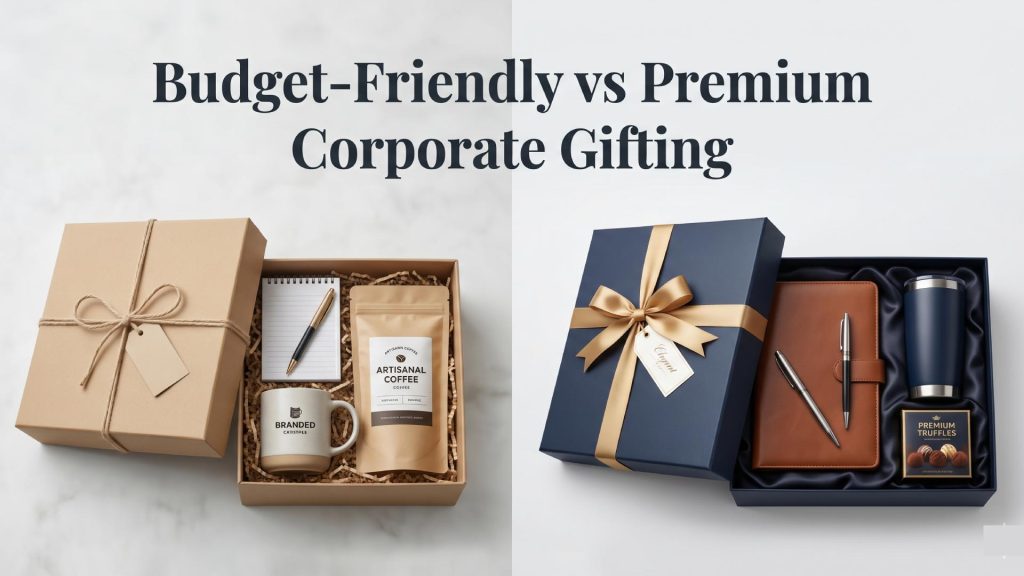
The Rs 14,000 Crore Question Every Indian Procurement Head Faces
You have a gifting brief sitting in your inbox. The occasion could be Diwali, an employee milestone, a client anniversary, or a product launch. Your HR team wants something memorable. Finance wants you to stay on budget. Leadership wants the brand to look premium. And you need to make a decision – fast. This is the exact dilemma that thousands of procurement managers, HR heads, and business owners across Bengaluru, Mumbai, Hyderabad, and Chennai face every gifting season. And the single most contested question in every boardroom conversation about corporate gifting is this: do we go budget-friendly or premium? The short answer is that there is no universally correct answer. The better answer – the one that actually helps you decide – depends on who you are gifting, why you are gifting, what outcome you expect, and what your brand identity says about the gesture. This guide cuts through the confusion. We break down both approaches with real Indian pricing benchmarks, recipient-segment recommendations, ROI considerations, and practical gifting scenarios so you can make the right call – every single time.Understanding the Two Approaches: What Do They Actually Mean in India?
Before comparing them, it is important to define what budget-friendly and premium corporate gifting actually means in the Indian market context – because these terms are relative and often misused.What Is Budget-Friendly Corporate Gifting?
In the Indian corporate gifting market, budget-friendly typically refers to gifts priced between Rs 150 and Rs 999 per unit. This tier is designed for:- Large employee bases (100+ recipients)
- Event and conference giveaways
- Promotional merchandise and brand activation
- New joiner welcome touches
- Pan-India bulk delivery requirements
What Is Premium Corporate Gifting?
Premium corporate gifting in India typically starts from Rs 1,500 per unit and can go up to Rs 25,000 or beyond for CXO and luxury tier gifting. This category is characterised by:- High-end brand associations (Apple, Sony, Parker, Sheaffer, Swiss Military, JBL)
- Curated hampers with multiple product combinations
- Bespoke packaging – magnetic boxes, ribbon wraps, foam inlays
- Personalisation at a deeper level – engraving, monogramming, custom-made items
- Targeted gifting for senior stakeholders, top clients, and leadership teams
Indian Pricing Tiers: A Practical Breakdown
Here is a structured view of the corporate gifting price bands most commonly used by Indian companies in 2025-2026: Tier 1 – Mass Budget (Rs 150 to Rs 499)- Ideal for: Large employee events, conference giveaways, brand activations, team day celebrations
- Popular products: Printed pens, tote bags, keychains, branded masks, seed paper notebooks, customised mugs
- Typical order size: 200 to 2,000 units
- Best use case: Diwali gifts for a 500-person team when the per-head budget is controlled
- Ideal for: General employee gifting, welcome kits for new joiners, festive gifting for mid-level teams
- Popular products: Steel bottles (Cello, Milton), printed T-shirts, desk organisers, small curated hampers
- Typical order size: 100 to 1,000 units
- Best use case: New joiner kits for an IT company onboarding 200 employees per quarter
- Ideal for: Client gifting, employee appreciation, long-service awards, manager-level recognition
- Popular products: Wildcraft backpacks, Borosil drinkware sets, curated Diwali hampers, branded travel kits, premium notebooks with pen sets
- Typical order size: 50 to 500 units
- Best use case: Client relationship gifts for a Bengaluru startup’s 100 key accounts
- Ideal for: Senior management gifting, key client retention, annual awards, brand ambassador gifts
- Popular products: American Tourister travel accessories, JBL speakers, Portronics tech accessories, luxury curated boxes, premium apparel bundles
- Typical order size: 25 to 200 units
- Best use case: Thanking the top 50 enterprise clients of a B2B software company
- Ideal for: CXO gifting, board-level relationships, strategic partners, high-value client onboarding
- Popular products: Apple AirPods, Sony headphones, Parker/Cross/Sheaffer pen collections, luxury hampers with artisan products, bespoke custom-made gifts
- Typical order size: 5 to 50 units
- Best use case: Gifting the leadership team of a newly signed enterprise client
Budget-Friendly vs Premium: The Head-to-Head Comparison
| Factor | Budget-Friendly (Rs 150 to Rs 999) | Premium (Rs 1,500 and above) |
| Recipient Volume | High (100 to 5,000+) | Low to medium (5 to 200) |
| Brand Impression | Good when well-branded | Strong and lasting |
| Personalisation | Logo branding, text | Engraving, monogramming, bespoke |
| Shelf Life | Short to medium | Long (often kept for years) |
| ROI Metric | Reach and brand visibility | Relationship depth and retention |
| Occasion Fit | Festive, events, onboarding | Milestones, client retention, leadership |
| Risk of Being Generic | Medium to high | Low when curated thoughtfully |
| Typical GST Impact | 12% to 18% | 18% to 28% on luxury items |
| Budget Planning | Rs 75,000 to Rs 5,00,000 for 500 people | Rs 1,50,000 to Rs 5,00,000 for 50 people |
When Budget-Friendly Corporate Gifting Is the Right Choice
There are very specific scenarios where choosing budget-friendly gifting is not just acceptable – it is the strategically smarter move.- Large-Scale Festive Campaigns Diwali, Holi, Christmas, and New Year gifting across a 500 to 2,000 person team demands volume and consistency. At this scale, a well-branded Rs 499 curated hamper – think a Milton steel bottle, a pack of artisanal cookies, and a branded greeting card – is more impactful than a generic Rs 1,500 gift that arrives in plain packaging.
- Employee Onboarding at Scale Startups and enterprises onboarding 50 to 300 new employees per quarter need practical, brand-aligned welcome kits that do not blow up the HR budget. A thoughtfully assembled New Joiner Kit at Rs 600 to Rs 900 per head – including a branded T-shirt, a notebook, a pen, and a mug – creates a genuinely warm first-day experience. It is useful. It is personal. And it scales.
- Conference and Event Giveaways When you are exhibiting at a B2B conference in Bengaluru or hosting a product launch in Hyderabad and need 500 branded giveaways, spending Rs 2,500 per unit is impractical. Budget-friendly Events and Conference Promotional Gifts – tote bags, printed notebooks, USB drives, or branded T-shirts – serve the dual purpose of brand promotion and attendee goodwill.
- Pan-India Distributed Teams For companies with employees spread across Tier 2 and Tier 3 cities, getting premium gifts delivered reliably and affordably is logistically complex. Budget-friendly gifts that are lightweight, low-risk, and pan-India deliverable are often the smarter operational choice.
When Premium Corporate Gifting Becomes Non-Negotiable
There are contexts where cutting corners on gifting budget directly damages your brand equity and relationship capital. Recognising these moments is just as important as controlling costs.- CXO and Leadership Gifting A Rs 350 branded diary sent to a Chief Executive of a Rs 500 crore client organisation says something – and it is not something positive. For Luxury and CXO Gifting, the gift must match the weight of the relationship. Apple AirPods, premium leather accessories, luxury hampers from curated artisan brands, or bespoke custom-made gifts in the Rs 5,000 to Rs 20,000 range communicate respect and seriousness. They also get remembered – and talked about.
- Strategic Client Retention and Milestone Recognition When a client renews a multi-year contract, refers your company to three other businesses, or crosses a significant transaction milestone with you – generic gifting is a missed opportunity. A premium, bespoke gift at this moment deepens the relationship. It converts a transactional gesture into a relational memory.
- Employee Long-Service and Performance Awards Recognising an employee completing five years or a team that delivered an exceptional quarter deserves more than a calendar or a pen. Mid-premium to premium gifts – a quality backpack from Wildcraft or American Tourister, a JBL speaker, or a personalised award trophy paired with a premium hamper – signal that the company genuinely values their contribution. This directly impacts retention in India’s highly competitive talent market.
- Sustainable and ESG-Aligned Gifting for Conscious Brands Indian companies with strong Environmental, Social and Governance commitments increasingly choose premium Sustainable and Eco-Friendly Gifting – bamboo products, recycled packaging, organic wellness hampers, and plantable stationery – that costs more per unit but aligns with brand values and CSR reporting objectives.
The Middle Path: The Tiered Gifting Strategy That Smart Indian Companies Use
The most sophisticated corporate gifting strategy is not a binary choice between budget and premium. It is a tiered approach that allocates the right spend to the right recipient segment. Here is a practical tiered gifting model used by many of Ridgegap’s clients in Bengaluru:- Tier A – All Employees (Rs 400 to Rs 800 per head) Every employee in the organisation receives a branded, festive-season gift. Consistent. Inclusive. A clear signal that the company sees and values everyone.
- Tier B – High Performers and Long-Tenure Employees (Rs 1,500 to Rs 3,000 per head) A step up – curated hampers, better quality products, personalised packaging – for employees who have gone above and beyond during the year.
- Tier C – Key Clients and Business Partners (Rs 2,500 to Rs 6,000 per head) A meaningful, high-quality, branded gift for the clients who matter most. Thoughtfully selected. Premium packaging. Often personalised with the recipient’s name.
- Tier D – CXO, Board-Level, and Strategic Partner Gifting (Rs 6,000 to Rs 20,000 per head) A fully bespoke, luxury-tier gift for the relationships that define your business. No compromises. Maximum personalisation.
The ROI Lens: Does Premium Gifting Actually Pay Off in India?
This is the question that finance teams ask – and it deserves a data-backed answer. Research from the Indian corporate gifting market shows that average per-employee gifting budgets have grown from Rs 2,500 to Rs 4,000 in recent years, reflecting a clear industry-wide recognition that better gifts produce better outcomes. Studies also indicate that companies with structured gifting programmes report measurably stronger employee engagement and client retention rates. For client gifting specifically, the ROI calculus is straightforward. If a Rs 5,000 premium gift helps retain a client worth Rs 20 lakh in annual business, the return on that spend is obvious. The question is never whether premium gifting is worth it – the question is whether the relationship is valuable enough to warrant it. For employee gifting, the ROI is expressed differently: in reduced attrition, improved morale, and stronger employer brand perception. In India’s competitive talent market – particularly in tech hubs like Bengaluru, Hyderabad, and Pune – being known as a company that treats employees well is a genuine recruitment advantage.Common Mistakes Indian Companies Make When Choosing Between Budget and Premium
Understanding where companies go wrong helps you avoid the same traps.- Sending the same gift to the CEO of a client company and to a mid-level employee in your own organisation – both tiers matter, but the same gift serves neither well
- Choosing premium packaging without a premium product inside – the unboxing experience can elevate a budget gift, but cannot substitute for product quality at the luxury tier
- Over-spending on one festive occasion and having no budget for milestone or recognition gifting throughout the year
- Ignoring GST implications – for gifts above Rs 5,000 per employee, the employer’s GST input credit may be restricted under Indian tax rules, which affects net cost calculation
- Selecting budget gifts for client gifting to reduce costs during a lean quarter – this is a false economy that damages relationship capital
- Not personalising budget gifts – a Rs 600 water bottle with an employee’s name on it costs only marginally more but has significantly greater impact than the same bottle with only a company logo
How to Choose the Right Corporate Gifting Partner in India
Whether you are opting for budget or premium gifting, the quality of your gifting partner determines your actual outcome. Here is what to look for:- A wide product range across all budget tiers – so you can build a tiered strategy with one trusted partner
- In-house customisation and branding capabilities – logo printing, laser engraving, screen printing, embroidery
- Low minimum order quantities – especially important for premium and CXO gifting where volumes are small
- Reliable pan-India delivery – with transparent tracking and lead time commitments
- Experience with both festive-season volume and bespoke one-off projects
- The ability to advise on product selection based on recipient profile and occasion – not just process orders
- In-House vs Outsourced Gifting: Corporate Guide 2026
- Swag Ideas for Employees: 50+ Corporate Gifts India
- Gift Basket Ideas on a Budget: 20+ Creative Hamper Ideas
- Personalization vs Standard Gifts: Corporate Guide India
Quick Reference: Budget vs Premium Corporate Gifting Decision Checklist
Use this checklist before you place your next order:- How many recipients are involved? Above 200 – lean budget. Below 50 – consider premium.
- What is the recipient’s seniority and relationship value to the business?
- What is the occasion – festive, milestone, appreciation, or strategic relationship?
- What outcome do you want – brand recall, relationship deepening, employee morale, client retention?
- Does your brand identity lean more aspirational or accessible? Your gift tier should reflect it.
- Have you factored in customisation, packaging, and delivery costs in your per-unit calculation?
- Have you consulted your CA or finance team on the GST and income tax implications of your gifting spend?
Resources
- Curated Gift Boxes – Ridgegap
- Luxury and CXO Gifting – Ridgegap
- New Joiner Kits – Ridgegap
- Swag Packs – Ridgegap
- Sustainable and Eco-Friendly Gifting – Ridgegap
- Events, Conference and Promotional Gifts – Ridgegap
- Special and Custom-Made Projects – Ridgegap
- Contact Ridgegap for a Free Gifting Consultation
Frequently Asked Questions
Q1. What is the average budget for corporate gifting per employee in India in 2026? The average per-employee corporate gifting budget in India has grown to approximately Rs 2,500 to Rs 4,000 for general festive gifting. For recognition and milestone gifting, companies typically allocate Rs 1,500 to Rs 5,000. For CXO and strategic client gifting, budgets range from Rs 5,000 to Rs 25,000 per recipient depending on relationship value. Q2. Is it possible to make budget-friendly corporate gifts look premium? Absolutely. The difference between a budget gift that looks cheap and one that looks thoughtful often comes down to three things: product selection, customisation, and packaging. A Rs 499 curated hamper in a branded kraft box with foam lining, a custom-printed ribbon, and a handwritten card can easily hold its own against a Rs 1,500 generic gift box. Work with an experienced gifting partner who understands how to maximise perceived value at every price point. Q3. What are the most popular budget-friendly corporate gifts in India under Rs 500? Some of the most popular choices under Rs 500 in India include branded steel bottles (Cello, Milton), custom-printed tote bags, seed paper notebooks, branded mugs, customised T-shirts, desk accessories like pen stands and organisers, and small curated snack hampers. These work particularly well for large-scale festive gifting and event giveaways. Q4. When should I choose premium corporate gifting over budget options? Choose premium gifting for CXO-level relationships, strategic client milestones, long-service employee recognition, high-value deal closures, and situations where the gift will be presented in a formal or high-visibility context. If the recipient’s professional stature and relationship value to your company is significant, a premium gift is always the right call. Q5. What are the best premium corporate gifts in India for clients between Rs 2,500 and Rs 5,000? In this range, excellent choices include branded laptop backpacks (Wildcraft, American Tourister), Borosil premium drinkware sets, Portronics or Ambrane tech accessories, curated gourmet hampers, premium stationery sets (Parker, Sheaffer), and custom-made branded merchandise. The key at this tier is combining practical utility with brand-forward presentation. Q6. Are there tax implications for corporate gifting in India? Yes. Under Indian income tax rules, gifts from employers to employees exceeding Rs 5,000 in a financial year are treated as a perquisite and are taxable in the hands of the employee. From a GST perspective, input tax credit on gifts is generally not available for businesses. It is advisable to consult your CA or tax advisor when planning large-scale corporate gifting programmes to structure them efficiently. Q7. What is the minimum order quantity for corporate gifting in Bangalore? This varies by vendor and product category. For budget and mid-premium gifting, most vendors in Bangalore – including Ridgegap – have minimum order quantities starting from 50 to 100 units. For luxury and CXO gifting or bespoke custom projects, minimum order quantities can be as low as 5 to 10 units. Contact Ridgegap directly for specific MOQ requirements based on your product and budget. Q8. How far in advance should I plan corporate gifting for Diwali or other festive occasions in India? For large-scale festive gifting (500+ units), plan at least 6 to 8 weeks in advance to allow time for product sourcing, branding, quality checks, and delivery coordination. For mid-scale orders (50 to 200 units), 3 to 4 weeks is typically sufficient. Premium and bespoke orders may require longer lead times depending on customisation complexity. Starting early also gives you better pricing and more product availability. Q9. Can I mix budget and premium gifts in the same gifting programme? Yes – and this is actually the recommended approach for most organisations. A tiered gifting strategy, where different recipient segments receive appropriately scaled gifts, is more thoughtful, more effective, and often more cost-efficient than a one-size-fits-all approach. Ridgegap regularly helps clients design and execute tiered gifting programmes across all budget levels simultaneously. Q10. How do I find the best corporate gifting company in Bangalore for both budget and premium needs? Look for a partner with demonstrated experience across price tiers, a wide in-house product and brand catalog, customisation capabilities, reliable delivery infrastructure, and a team that understands how to advise on gifting strategy – not just fulfill orders. Ridgegap has been Bangalore’s trusted corporate gifting partner for over a decade, serving companies from fast-growing startups to established enterprises like Google, Amazon, and Mercedes-Benz. Book a free consultation to discuss your next gifting programme.Corporate Gifts for Cultural Diversity: Indian Guide 2026
Why Corporate Gifts for Cultural Diversity Matter More Than Ever in India
India is not just one market. It is 29 states, 22 scheduled languages, 8 major religions, and hundreds of distinct cultural traditions – all working together inside the same office, on the same floor, in the same team. When Bengaluru alone hosts employees from Tamil Nadu, Bengal, Maharashtra, Rajasthan, Kerala, and Northeast India, plus international colleagues from the US, UK, and Southeast Asia, the need for culturally aware corporate gifting becomes impossible to ignore. The numbers confirm this shift. The Indian corporate gifting market reached approximately Rs 12,000 crores in 2022 and is projected to grow to Rs 18,000 crores by 2027. A major driver of that growth is the increasing demand for diversity-sensitive, culturally inclusive gifts that make every employee and client feel seen – not just the majority. And yet, this is exactly where most companies go wrong. They send the same box of sweets to everyone during Diwali, forgetting that some employees observe dietary restrictions, some are not Hindu, and some are celebrating an entirely different festival that week. One-size-fits-all gifting is not neutral – it is exclusionary. At Ridgegap, one of Bangalore’s most trusted corporate gifting solutions providers, we have spent over 10 years helping companies navigate this complexity at scale. This guide is built to help HR teams, procurement managers, and business owners choose corporate gifts that celebrate India’s beautiful diversity – not flatten it.Understanding India’s Cultural Calendar: The Starting Point for Inclusive Gifting
Before choosing a gift, you need to understand when to give it. India’s cultural calendar is dense, and the most inclusive gifting strategy is one that acknowledges multiple occasions – not just the dominant ones. Here is a quick-reference map of major cultural occasions across communities:- Diwali (Hindu, Jain, Sikh) – October/November. The single largest corporate gifting season in India, accounting for 40–45% of annual gifting spend.
- Eid-ul-Fitr & Eid-ul-Adha (Muslim) – Dates vary each year per the lunar calendar.
- Christmas & New Year (Christian, secular corporate culture) – December 25 and January 1.
- Pongal / Sankranti / Lohri / Bihu (Regional harvest festivals) – January. Hugely significant in South India, Punjab, and Northeast states.
- Holi (Hindu, North India, Maharashtra) – March.
- Onam (Kerala) – August/September. A major gifting occasion in South Indian corporate circles.
- Durga Puja / Navratri (Bengal, Gujarat, Maharashtra) – September/October.
- Guru Nanak Jayanti (Sikh) – November.
- Ugadi / Vishu / Gudi Padwa (Kannada, Malayalam, Marathi New Year) – March/April.
- Ambedkar Jayanti / Constitution Day – Increasingly observed in corporate DEI calendars.
- International Women’s Day – March 8. Cross-cultural occasion for employee recognition.
8 Categories of Corporate Gifts That Work Across Cultures in India
The safest and most appreciated culturally inclusive gifts tend to be functional, premium, non-food, or food-with-clarity. Here is a category-by-category breakdown with Indian pricing to help you budget accurately.1. Branded Drinkware and Thermos Sets
A high-quality insulated bottle or stainless-steel tumbler respects every dietary preference – there is no food allergen risk, no religious restriction, and no lifestyle conflict. It is useful in every state, every season, and every community.- Popular choices: Milton thermos, Borosil glass bottle, branded copper bottle sets, personalised sipper with name engraving
- Indian pricing: Rs 350 – Rs 1,800 per unit (depending on brand and customisation)
- Best occasions: Pongal, Eid, New Year, Onam, Women’s Day, onboarding kits
2. Handcrafted and Artisan Gifts – Celebrating India’s Regional Craft Heritage
This is where culturally diverse gifting becomes genuinely exciting. India’s craft traditions – from Channapatna wooden toys in Karnataka to Madhubani art in Bihar, Dhokra metalwork in Chhattisgarh, Pashmina shawls from Kashmir, and Warli painting from Maharashtra – offer a world-class gifting palette that most companies underuse. Gifting a piece of regional craft does three things at once: it celebrates Indian cultural heritage, supports artisans, and creates a gift the recipient is proud to display.- Popular choices: Hand-painted ceramic mugs (Jaipur blue pottery), bamboo desk accessories (Northeast India), wooden desk organiser (Channapatna), Kalamkari tote bags (Andhra Pradesh)
- Indian pricing: Rs 400 – Rs 3,500 per unit
- Best occasions: Independence Day, Republic Day, regional festivals, client appreciation gifts, CXO gifting
3. Eco-Friendly and Sustainable Gifting Kits
Sustainability is a shared value that transcends cultural and religious boundaries. A well-curated eco-friendly gift kit – plantable seed paper notebook, bamboo pen set, jute tote bag, or organic cotton T-shirt – resonates with millennials and Gen Z employees across all communities. This category has been growing at approximately 9.5% CAGR in India, driven by companies aligning their gifting programs with ESG commitments and green goals.- Indian pricing: Rs 500 – Rs 2,500 per kit
- Best occasions: Earth Day, World Environment Day, Independence Day (local craft emphasis), Onam (harvest/nature theme), new joiner welcome kits
4. Premium Office and Desk Accessories
A leather-look planner, engraved pen set, desk organiser, or laptop stand is culturally neutral, professionally meaningful, and highly practical. These gifts signal quality and respect without any cultural misstep risk.- Popular choices: Premium diary with gold embossing, branded pen sets (Parker, Cello), desk calendar, card holder with logo engraving
- Indian pricing: Rs 300 – Rs 2,000 per piece
- Best occasions: New Year, work anniversaries, promotions, conference giveaways
5. Tech Accessories and Gadgets
Nothing ages cultural relevance faster than gifting last-decade technology, but a well-chosen tech accessory in 2026 is almost universally appreciated. Wireless earbuds, smart charging hubs, portable power banks, and branded laptop bags bridge every generational and cultural divide.- Popular choices: Branded power bank, Bluetooth speaker, USB hub, wireless mouse, custom laptop bag
- Indian pricing: Rs 700 – Rs 5,000 per unit (mid-tier), Rs 5,000 – Rs 20,000 (premium tier)
- Best occasions: New joiner kits, milestone recognitions, leadership gifts
6. Non-Religious, Multi-Community Festival Hampers
Festival hampers are the most popular category in Indian corporate gifting – but they need careful curation for diverse teams. The key rules for culturally inclusive hampers are:- Avoid alcohol – not universally appropriate across Muslim, Hindu, Sikh, and Jain communities
- Label dietary information clearly – vegetarian, vegan, gluten-free, nut-free variants
- Avoid beef or pork products – never appropriate in an Indian corporate setting
- Prefer dry goods, nuts, and gourmet items – longer shelf life and fewer restrictions
- Add a non-food anchor product – a branded mug, candle, or desk accessory that every recipient keeps
- Indian pricing: Rs 800 – Rs 5,000 per hamper
- Best occasions: Diwali, Eid, Christmas, Pongal, Onam, New Year
7. Custom Branded Apparel (Thoughtfully Designed)
Customised T-shirts and branded apparel are enormously popular in Indian corporates – but cultural diversity means paying attention to sizing, modesty preferences, and design sensibility. Offering both T-shirt and full-sleeve options, and including women-specific cuts, is a small change that makes a big difference in how inclusive the gift feels.- Indian pricing: Rs 350 – Rs 1,200 per piece
- Best occasions: Team outings, onboarding kits, company anniversaries, swag packs
8. Wellness and Self-Care Kits
Post-pandemic, wellness gifting has become one of the fastest-growing categories in Indian corporate gifting. A curated wellness kit – aromatherapy candle, eye mask, herbal tea sampler, stress-relief ball, or a premium journal – communicates genuine care for the recipient’s wellbeing, regardless of their cultural background.- Indian pricing: Rs 600 – Rs 3,000 per kit
- Best occasions: Employee appreciation week, Women’s Day, mental health awareness month, work-from-home teams
A Quick Gift Selection Framework for HR and Procurement Teams
Choosing the right gift for a culturally diverse workforce does not need to be complicated. Use this decision framework before finalising your order:Step 1 – Know your audience
What is the cultural composition of the team or client list? Are you gifting a pan-India workforce or a specific city/region-based team?Step 2 – Check the occasion
Is this tied to a specific festival? If yes, is the festival observed by the majority of recipients, or are you inadvertently excluding a significant segment?Step 3 – Apply the food test
If the gift includes food, confirm that it is vegetarian (at minimum), clearly labelled for allergens, and free of any ingredient that may conflict with religious practices.Step 4 – Consider the price bracket
Indian corporate gifting budgets typically fall into three bands:- Economy tier: Rs 300 – Rs 800 per recipient (bulk promotional gifting, large team events)
- Mid-range tier: Rs 800 – Rs 2,500 per recipient (standard employee or client gifting)
- Premium and CXO tier: Rs 2,500 – Rs 15,000+ per recipient (leadership gifts, key client appreciation, luxury hampers)
Step 5 – Personalise where possible
Adding a name, a short personal note, or regional language greeting (Shubh Deepawali, Eid Mubarak, Happy Onam) on packaging goes a long way in making a gift feel intentional rather than transactional.What Not to Gift in a Culturally Diverse Indian Workplace
Equally important is knowing what to avoid. Here are the most common gifting missteps in multicultural Indian corporate settings:- Alcohol or wine hampers – off-limits for a large portion of any Indian workforce
- Leather products (wallets, belts, bags) without checking preferences – sensitive for Hindu recipients who revere the cow
- Religious symbols or deity figurines – never assume someone’s religious affiliations or preferences
- Pork or beef-based food products – universally inappropriate in an Indian corporate context
- Gifting only during one festival while ignoring others – sends an unintentional message about whose culture matters
- Generic, mass-produced items with poor quality – worse than no gift at all; it signals low regard for the recipient
Why South India – and Bangalore in Particular – Leads in Inclusive Corporate Gifting
It is no coincidence that South India is identified as the largest regional market for corporate gifting within India. Cities like Bengaluru, Hyderabad, Chennai, and Kochi host some of the most culturally diverse workforces in the country – global tech MNCs, Indian startups with pan-India hiring, and international clients – all demanding higher standards of cultural sensitivity in business practices. Bangalore in particular sits at the intersection of Kannadiga heritage, South Indian tradition, and cosmopolitan multinational corporate culture. A gifting partner based in and deeply familiar with this ecosystem is not just a logistical convenience – it is a strategic asset. Ridgegap, headquartered in Kumar Park West, Bengaluru, has built its entire service model around this reality. With over 10 years of experience, 300+ corporate clients, and 20,000+ packages delivered pan India, the team understands what works for a 50-person startup in Koramangala, a 5,000-person MNC in Whitefield, and a regional sales team spread across Tier-2 cities.The Ridgegap Advantage for Culturally Inclusive Corporate Gifting
Here is what sets a specialist apart from a generic gifting vendor when it comes to diversity-conscious gifting:- Curated catalog of 5,000+ products across 20+ categories – enabling tailored selection for any cultural occasion
- In-house customisation team for branding, engraving, packaging design, and regional language personalisation
- New joiner kits that welcome employees from day one, regardless of their background
- Luxury and CXO gifting for senior stakeholders who expect premium quality
- Swag packs for team events, offsites, and diversity-and-inclusion initiatives
- Special and custom-made projects for companies wanting something truly unique and regionally crafted
- Pan-India delivery – door delivered to employees across Bengaluru, Mumbai, Delhi, Hyderabad, Chennai, Pune, Kolkata, and Tier-2 cities
- Bulk order pricing – competitive Indian pricing with transparent quotes and no hidden charges
Resources and Further Reading
- Ridgegap Blog – Corporate Gifting Insights
- Personalization vs Standard Gifts: Corporate Guide India
- Swag Ideas for Employees: 50+ Corporate Gifts India
- Door Gift Ideas for Corporate Events in India
- In-House vs Outsourced Gifting: Corporate Guide 2026
- Ridgegap Contact & Free Quote